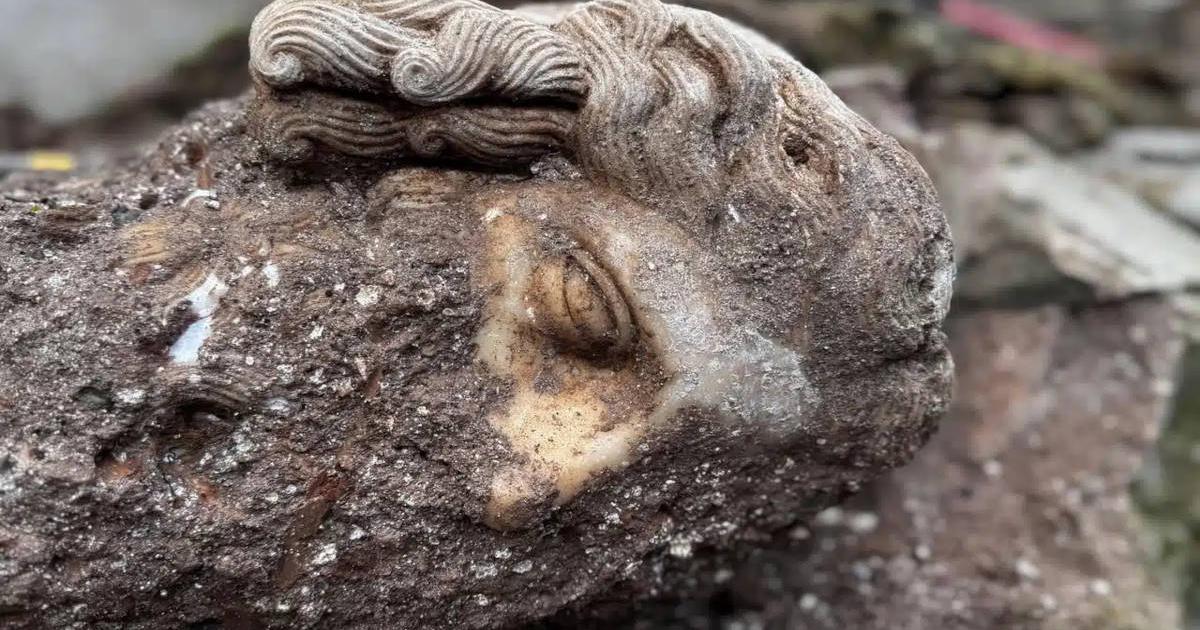

A marble head, believed to depict a bearded male deity well-known in the ancient Roman world, has been uncovered in the archaeological zone of the Tombe di Via Latina in Rome, inside the Archaeological Park of the Appian Way. This striking sculpture, dating to around the second century, was found during excavations at the early Christian basilica of Santo Stefano, a church built in the fifth century. Remarkably, the curious artifact had remained hidden for beneath the structure’s underground layers, embedded within the foundation of what is known as the Paleochristian Basilica.
The first glimpse of the discovery came as long, flowing locks of hair made from carved stone became increasingly visible through compacted earth and rubble. As the excavation progressed the full shape of a large sculpted head became apparent.
“The whiteness of those artfully arranged hairs was still tangible, despite the crusted deposits from millennia of burial,” the discoverers said, in an interview published in Il Messaggero. The head was larger than life-sized, making it clear that the original statue had been constructed to impressive dimensions.
Following its discovery, the marble head was transported to Matera, where it is now undergoing meticulous analysis and restoration under the guidance of the Istituto Centrale per il Restauro (ICR). Experts from the ICR, along with students from the Scuola di Alta Formazione per il Restauro, are documenting the piece in detail and conducting technical studies to determine more about its origin and purpose.
- Incredible Ancient Statue of Hercules Pulled from Rome Sewer
- Gallo-Roman Worship Complex Dedicated to Jupiter and Mars Discovered
An Ancient Roman God Hidden in the Basement
Early assessments suggest that the sculpture may represent a Roman god, and some of the possible candidates include Jupiter, Apollo (originally a Greek god), and Serapis (who had Egyptian roots). Its also possible that the statue depicted a revered philosopher, although its large size suggests that a deity was the more likely figure being honored.
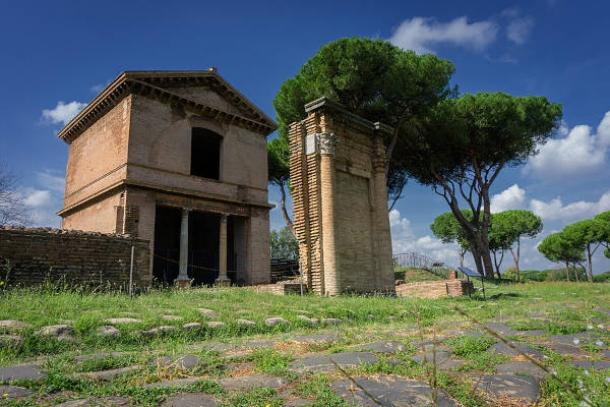
The Tombe di Via Latina in Rome, near where the statue head was unearthed. (Sara Fioravanti/CC BY-SA 4.0).
The beard and composed expression speak to a figure of great authority or wisdom. However, the presence of several layers of mortar still clinging to the head is making definitive identification difficult. Conservators hope that as these layers are carefully removed, they might uncover inscriptions or symbols that will help reveal the subject’s true identity. It’s also possible that once the marble has been fully cleaned and restored, its resemblance to other known statues will clarify the mystery.
One of the more intriguing aspects of the find is the location in which the head was discovered. It was built directly into the foundations of the Christian basilica, leading archaeologists to believe it may have been reused during the building’s construction, a not-uncommon practice in Late Antiquity, when high-quality stone was considered precious.
But this is only one possibility, and not all researchers agree on why the head ended up there. Some theorize that its inclusion was deliberate and may have been done as a sign of respect, indicating that early Christian builders were not entirely divorced from the cultural or spiritual legacy of earlier Roman religious practice. Others suggest a more personal motive: that someone may have hidden the statue part intentionally, perhaps out of a desire to preserve a fragment of Rome’s earlier identity in a rapidly changing world. Or simply because they thought it would bring good luck.
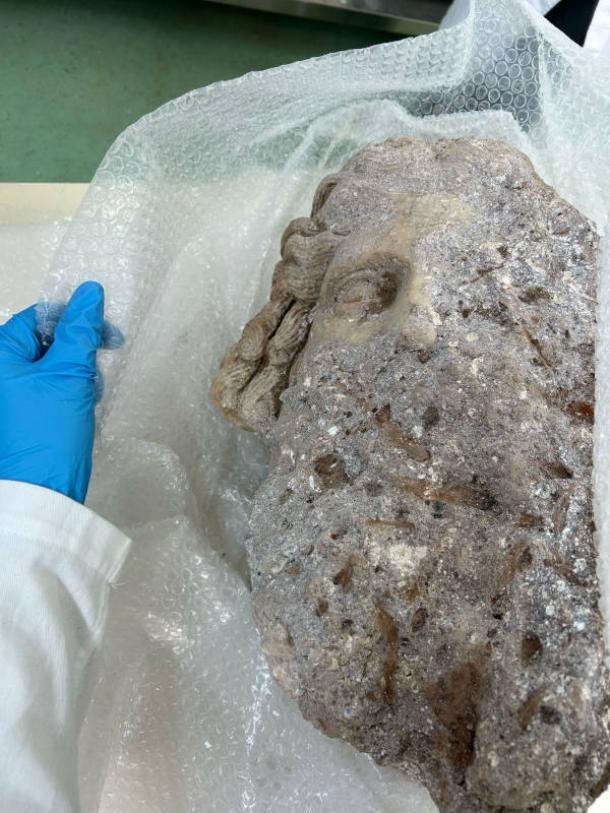
The statue head after being moved to the laboratory for cleaning, maintenance and further study. (Parco Archeologico dell’ Appia Antica).
Whatever the motivation, the statue offers a rare and tangible link to the past. Its discovery offers clues about how Romans during the fourth to sixth centuries navigated the shift from a predominantly pagan society to one increasingly dominated by Christianity. This transitional period, often referred to as Late Antiquity, was characterized by both cultural conflict and synthesis, and the basilica of Santo Stefano was constructed while this change was still very much ongoing.
- ‘Astounding’ Roman Statues Found Under Medieval Church in Britain
- The World’s Greatest Equestrian Statues: Artistic Masterpieces and Propaganda of Empires
The question remains whether the head once belonged to a grand statue that was on display and worshipped, or whether it had already been discarded or devalued before being placed in the foundation. Researchers aim not only to restore the sculpture's physical appearance but also to contextualize its role in history, which will require extensive study. Each reused artifact from this period offers unique insights into how people reinterpreted or reappropriated objects from previous eras.
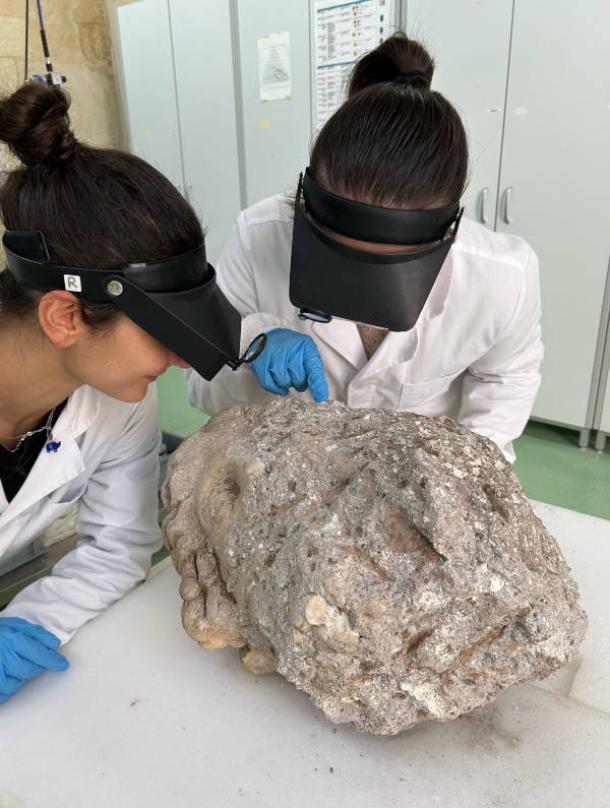
Technicians examining the stone statue head in the laboratory. (Parco Archeologico dell’ Appia Antica).
The Via Latina: A Corridor Through Time
This intriguing find also underscores the archaeological richness of the Via Latina, one of Rome’s ancient thoroughfares that runs nearly parallel to the more famous Appian Way. Lined with tombs dating back to the second century, this road was once a key corridor for Rome’s elite, their elaborate funerary monuments reflecting both their wealth and religious beliefs.
The tombs lining the Via Latina are distributed along a short stretch of the Roman road, and represent a veritable gold mine for archaeologists seeking to learn more about ancient Roman mortuary practices and spiritual inclination. This area was literally a crossroads for the evolution of religious practices in ancient times, and as such it continues to produce notable and revealing finds.
Top image: The large, detached statue head, at the site where it was originally excavated in the Archaeological Park of the Appian Way.
Source: Parco Archeologico dell’ Appia Antica.
By Nathan Falde