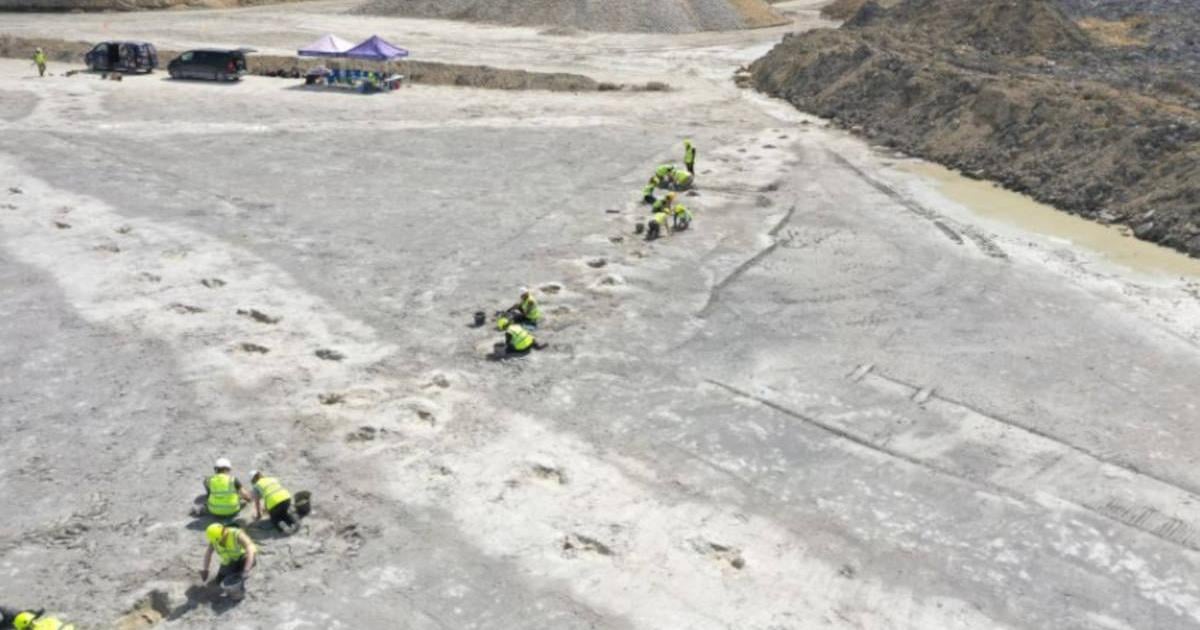

In one of the most stunning developments in the history of paleontology in the British Isles, researchers from the Universities of Oxford and Birmingham have discovered a massive collection of dinosaur footprints tracking across the floor of a quarry in Oxfordshire. More than 200 footprints have been uncovered in total, making this easily the largest dinosaur track site ever found in the United Kingdom.
Incredibly, these prints were not just scattered here and there. They were found in five long linear trackways, revealing the movements of five dinosaurs as they walked through a muddy lagoon leaving behind their imprint for posterity.
The tracks have been dated to the Middle Jurassic Period, which means they are around 166 million years old. This was during a time when dinosaurs truly ruled the earth, as they would for the next 100 million years.
Walking With the Dinosaurs in 166 Million BC
Based on their analysis of the shapes and sizes of the footprints, the paleontologists supervising the digs at the Dewars Farm Quarry believe they were made by two Jurassic Period species: the meat-eating predator Megalosaurus, which could grow up to 30 feet (nine meters) in length, and the humongous 60-foot- or 18-meter-long herbivore Cetiosaurus, which was the cousin of the well-known species Diplodocus. The trackways they created varied in length, with the longest measuring an astonishing 490 feet (150 meters) from end to end.
- Dinosaur Footprints of Unimaginable Age Found Romping Along England’s Coastline
- New Duckbill Dinosaur Evidence Shows That Dinosaurs Crossed Oceans
Four of the trackways were made by the long-necked, lumbering herbivores, while the intimidating predator that hunted them laid down the other, its distinctive three-toed clawed feet making its footprints easy to identify. At one point the path of the Megalosaurus actually crosses the path of one of the Cetiosauri, although this couldn’t have happened in real-time since the Cetiosauri would have been stopped in its tracks (because it would have been eaten).
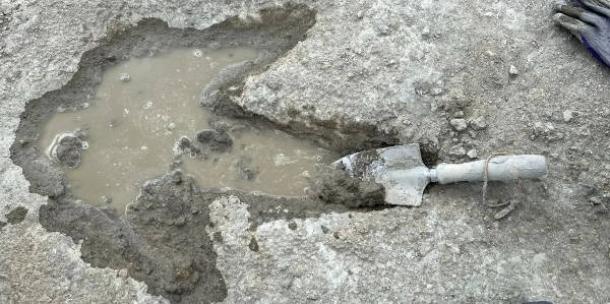
Close-up of one of the more than 200 dinosaur footprints (belonging to a Megalosaurus) found in the Dewar Farms Quarry in Oxfordshire. (Oxford University Museum of Natural History).
The Megalosaurus holds the distinction of being the first dinosaur species to be described and given a scientific name, in 1824.
“Scientists have known about and been studying Megalosaurus for longer than any other dinosaur on Earth, and yet these recent discoveries prove there is still new evidence of these animals out there, waiting to be found,” said Dr. Emma Nicholls, a Vertebrate Paleontologist from the Oxford University Museum of Natural History, in an Oxford press release.
Naturally, this astonishing collection of dinosaur tracks was not sitting exposed in the Dewar Farms Quarry just waiting to be noticed. They were buried in mud near the surface of the quarry floor, and were only found after quarry worker Gary Johnson felt some ‘unusual bumps’ as he was stripping the clay back to harvest the underlying limestone in June of 2024. Eventually someone realized the bumps might be the outline of fossils, and after word was passed to authorities an initial examination revealed the presence of multiple dinosaur footprints just beneath the quarry surface.
Once excavations began, more and more tracks were recovered, and ultimately a team of more than 100 quarry workers and researchers from the Universities of Oxford and Birmingham cooperated in digging out all the prints that could be found. The experts were delighted when they realized how long the various trackways were, and they arranged to have the site extensively photographed using aerial drones in order to create a 3D model that revealed every detail of this amazing discovery.
- Dinosaur Tracks in Brazil Found to Have Petroglyph ‘Companions’
- Footprints on the Wall: Were Dinosaurs Actually Climbing the Cliffs in Bolivia?
“These footprints offer an extraordinary window into the lives of dinosaurs, revealing details about their movements, interactions, and the tropical environment they inhabited,” said Professor Kirsty Edgar, a paleontologist and excavation team member from the University of Birmingham.
A Dinosaurs’ Playground in the United Kingdom
While the newly discovered tracks represents the most extensive collection ever found in the UK, they are not the first dinosaur footprints to be unearthed in this general area of Oxfordshire.
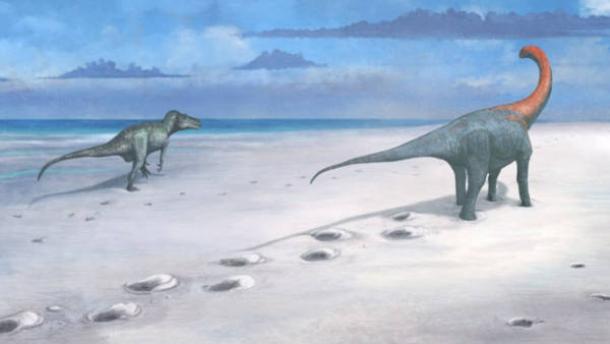
Illustration of the two species of dinosaur responsible for leaving the tracks in the quarry, Cetiosaurus and Megalosaurus. (Mark Witton/Oxford University Museum of Natural History).
In 1997 about 40 sets of footprints that were also arranged in tracks were found in another limestone quarry nearby. Now that even more footprints have been found, it is clear that this part of England (which still would have been a part of the larger Eurasian continent during the dinosaur age) was rather heavily occupied by gigantic reptiles during the Middle Jurassic Period.
The new trackways add to the significance of the area, and even though the discoveries are separated by just 30 years, modern technology allows the prints at the Dewar Quarry to be recorded and analyzed much more comprehensively than their predecessors.
“The preservation is so detailed that we can see how the mud was deformed as the dinosaur’s feet squelched in and out,” marveled Dr. Duncan Murdock, an Earth Scientist with the Oxford University Museum of Natural History who participated in the excavations. “Along with other fossils like burrows, shells and plants, we can bring to life the muddy lagoon environment the dinosaurs walked through.”
More than 20,000 high-resolution photographs have been taken of the newly discovered footprints, from the ground and from the air. This will give scientists years’ worth of images to examine, in their quest to reconstruct the lives of the massive and long-extinct creatures that traversed the lands of the modern United Kingdom in the impossibly distant past.
Top image: Pair of dinosaur trackways crossing over each other on the floor of Dewars Farm Quarry in Oxfordshire.
Source: University of Birmingham.
By Nathan Falde