For the first time ever, a team of researchers has found chemical evidence that wine was actually drunk in Troy, verifying a conjecture of Heinrich Schliemann, who discovered the legendary fortress city in the 19th century. In addition, the researchers from the Universities of Tübingen, Bonn and Jena found that both members of the Trojan elite and the common people also drank wine, which is contrary to the pattern of exclusively elite consumption found elsewhere in the ancient world.
These findings are now being published in the April edition of the American Journal of Archaeology, adding a new layer of fascinating detail to the story of the legendary ancient city of Troy – and verifying the accuracy of history’s most famous poet, in one of his two most famous works.
"Hephaestus spoke, then stood up, passed a double goblet across to his dear mother," says the first book of Homer’s Iliad, recounting how the god of fire, metalworking and volcanoes encourages his mother. "As he spoke, the white-armed goddess Hera smiled. She reached for her son's goblet. He poured the drink, going from right to left, for all the other gods, drawing off sweet nectar from the mixing bowl."
This drinking vessel, a depas goblet (depas amphikypellon), is well-known to archaeologists: It is a 12- to 40-centimeter-tall, slender, clay drinking vessel with two handles, narrowing to a pointed base. More than 100 such goblets have been found to date in Troy alone, covering the period of 2500 to 2000 BCE. They are also scattered across the Aegean to Asia Minor and Mesopotamia, and can hold 0.25 to 1 liter.
"Heinrich Schliemann already conjectured that the depas goblet was passed around at celebrations—just as described in the Iliad," said Dr. Stephan Blum, a co-author of the study from the Institute of Prehistory, Early History and Medieval Archaeology at the University of Tübingen, in a press release from that institution.
The classical archaeology collection of the University of Tübingen holds a depas goblet and two fragments from Schliemann's trove. Maxime Rageot from the University of Bonn milled a 2-gram sample from the two fragments. Then he heated the samples to 380°C and studied the resulting mixture using gas chromatography (GC) and mass spectrometry (GC-MS).
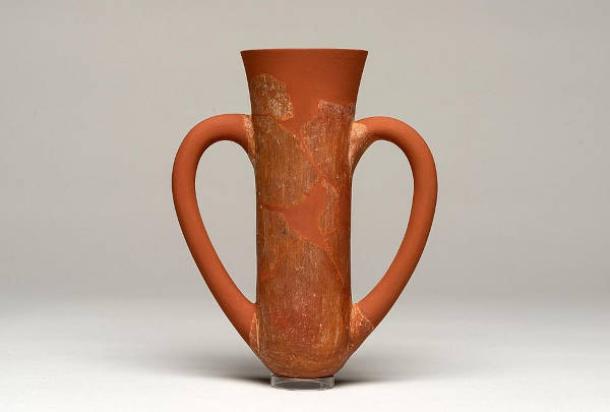
Depas cup, excavated by Heinrich Schliemann, 15 cm high. (University of Tübingen).
"The evidence of succinic and pyruvic acids was conclusive: They only occur when grape juice ferments. So now we can state with confidence that wine was actually drunk from the depas goblets and not just grape juice," explained Rageot.
Troy’s Egalitarian Wine Drinking Culture
Wine was the most expensive drink in the Bronze Age and a depas goblet was the most precious vessel. Depas goblets have been found in temple and palace complexes. So, scientists had deduced that wine drinking took place on special occasions in elite circles. But it seems that the city of Troy, remarkable in so many ways, was an exception to the rule.
"We've also chemically studied ordinary cups that were found in the outer settlement of Troy and therefore outside the citadel. These vessels also contained wine," Blum stated. "So it is clear that wine was an everyday drink for the common people too."
This is surprising and unexpected revelation, at a site that has produced many of them over the past three centuries of excavations.
- Troy in Turkey or Troy in Britain? False Leads vs Hard Evidence
- Hector of Troy: The Battle for Peace and the Wrath of Achilles
"Research into Troy has a long tradition at the University of Tübingen, and I am delighted that we have been able to add another piece to the puzzle revealing the picture of Troy," added Professor Dr. Dr. h.c. (Dōshisha) Karla Pollmann, President of the University of Tübingen.
Excavations at Troy (Turkish: Hisarlık) were carried out by the University of Tübingen from 1987 to 2012. Currently, the excavation results are being evaluated and further analyses carried out on the material findings.
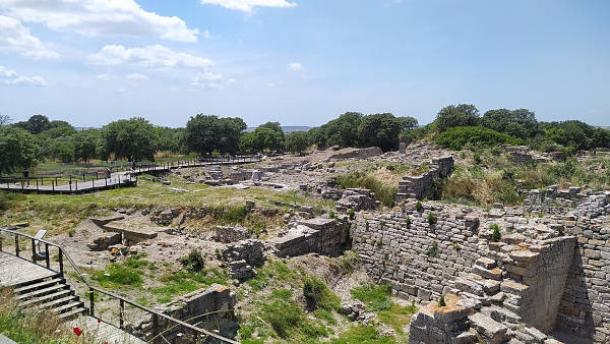
Ruins of the ancient city of Troy. (Kizildeniz/CC BY-SA 4.0).
Troy: The Legendary City That Actually Existed
The existence of the legendary city of Troy is now accepted fact. But it wasn’t always that way.
Entering the latter half of the 19th century, the historical consensus around Troy - the mythic, legendary location from Homer’s notable work, the Iliad - was thought to be just that - a legend. However, due to the work of Heinrich Schliemann, a famous German businessman and amateur archaeologist, we now know that Troy was a real place and that the millennia old Illiad had some historical truth to it.
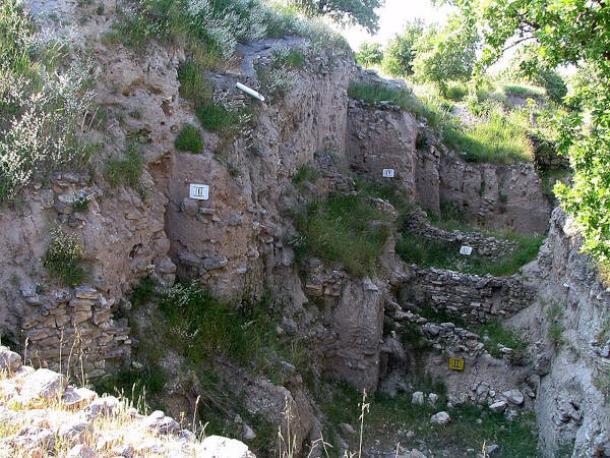
Excavation layers of Heinrich Schliemann at Troy, marked with Roman numerals. (Winstonza/CC BY-SA 3.0).
Schliemann was interested in the city of Troy from his boyhood, when he would read the Iliad and dream of himself in the situations and the vast lands Homer described. This, in turn, led him to a life of the pursuit of his childhood dream, Troy, which, of course, came to fruition.
During his controversial excavation, taking place in 1870 in modern-day Turkey, Schliemann notably destroyed the top layers of the city - ironically, the very thing he was looking for. Though he is considered to be the founder of modern archaeology, Schliemann’s practices during his excavations are now a textbook example of how not to conduct an archaeological study.
Yet despite the damage what he unearthed was still a veritable gold mine from the perspective of archaeology. At the discovered site lay gold masks, various weapons, cutlery, cups, and treasure; most notably Priam’s Treasure, a collection of gold and valuable artifacts. Unbelievably, Schliemann actually encouraged his wife Sophia to put some of the jewelry on and pose with it for what has become a rather infamous photograph. The artifacts later gave Schliemann legal trouble due to him smuggling them out of Turkey.
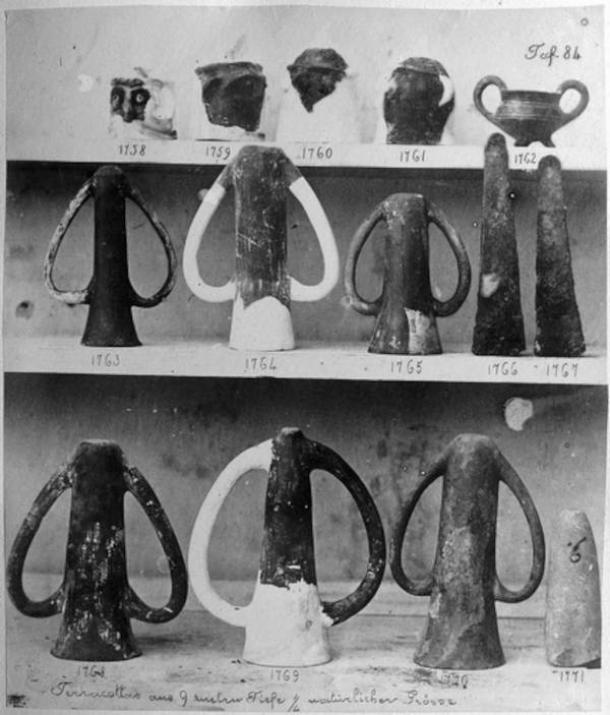
Grouping of depas-style vessels collected by Heinrich Schliemann during his excavations at Troy in the 19th century. (Blum, et.al/American Journal of Archaeology).
We should note that this discovery is one of the most consequential in archaeological history, and lends credence to the ideas that the most legendary civilizations and societies did, in fact, once exist. The once-popular notion that stories about such places were likely myths has been replaced with the more nuanced idea that myths and legends usually contain grains (sometimes large grains) of truth.
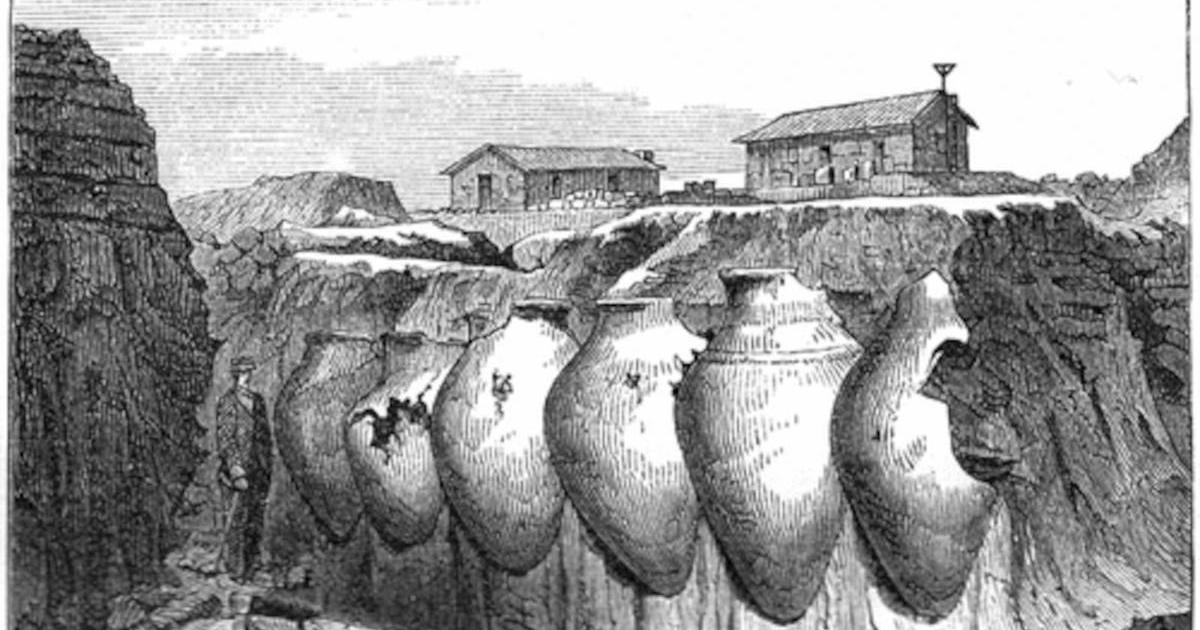
Top image: Drawing of several large vessels discovered during excavations in Troy by Heinrich Schliemann in 1880, which he deduced would have been used to hold wine.
Source: Blum, et.al/American Journal of Archaeology.
This is an edited version of a press release from the University of Tübingen, entitled ‘In Troy, Ordinary People Also Drank Wine.’