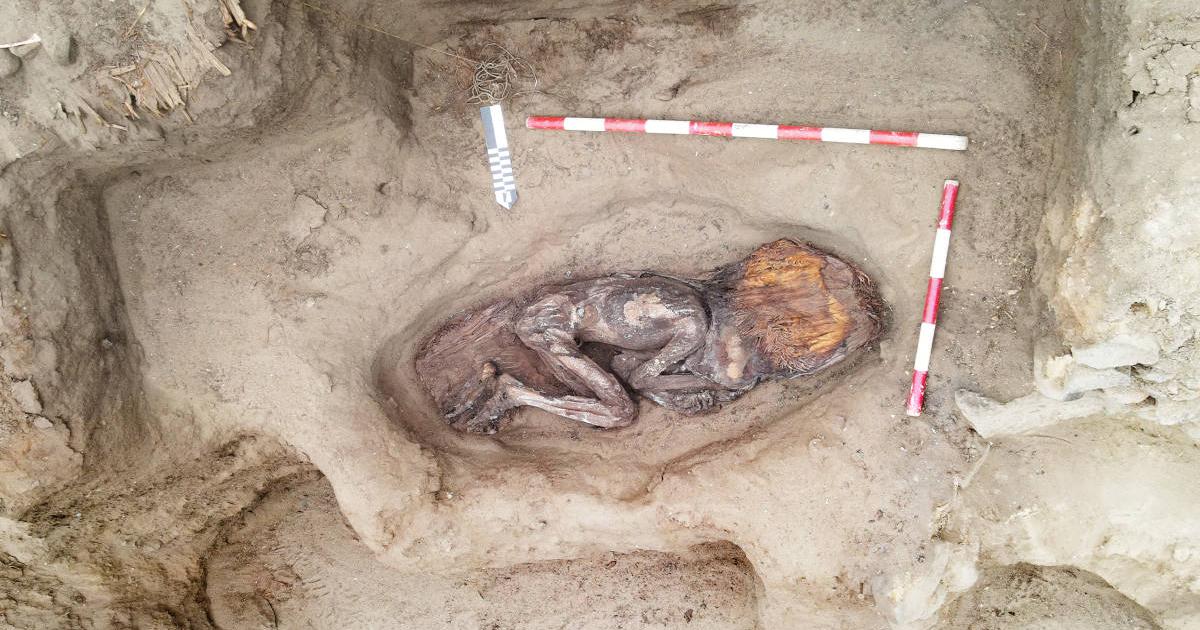

Archaeologists at the Áspero archaeological site in western Peru in the Lima region have unearth a unique burial of an elite woman from the ancient Caral civilization, the oldest-known culture in the Americas (3,500 BC to 1,800 BC).. This remarkable discovery highlights the sophistication of this ancient society and also reveals the prominent roles women held within it.
The woman's body, dating from between 3000 and 1800 B.C., was found at the Huaca de los Ídolos public building within Áspero, an ancient fishing town situated about 0.4 miles (0.7 kilometers) from the Pacific Ocean. Excavated by a team led by Dr. Ruth Shady Solís of the Caral Archaeological Zone, sponsored by Peru’s Ministry of Culture, the burial stands out for its exceptional state of preservation. This is rare in the coastal desert environment, where typically only scattered skeletal remains survive. Astonishingly, her skin, hair, and nails were all intact.
Wrapped in layers of cotton fabrics, reed mats, netting, and bundles of plant fibers, the woman's remains were accompanied by an array of grave goods. Among them were a panel intricately embroidered with macaw feathers, a toucan's beak adorned with green and brown beads, an Amazonian snail shell, sweet potatoes, a fishing net, weaving tools, and several reed baskets. Her head was decorated with a fiber headdress made from carefully wound threads. These artifacts were arranged with great care, suggesting complex funeral rituals and a deep symbolic meaning.
- The 5,000-year-old Pyramid City of Caral
- 4,500-Year-Old Burial Suggests Norte Chico People of Peru Practiced Gender Equality
Evidence of Early Andean Artistic and Technological Sophistication
The feathered panel found in the burial is one of the oldest known examples of feather art in the Andes, revealing the high degree of craftsmanship achieved by the Caral civilization. It seems the Caral developed some highly refined techniques for producing such items, and their work suggests advanced artistic abilities were likely common among these industrious and creative Andean people.
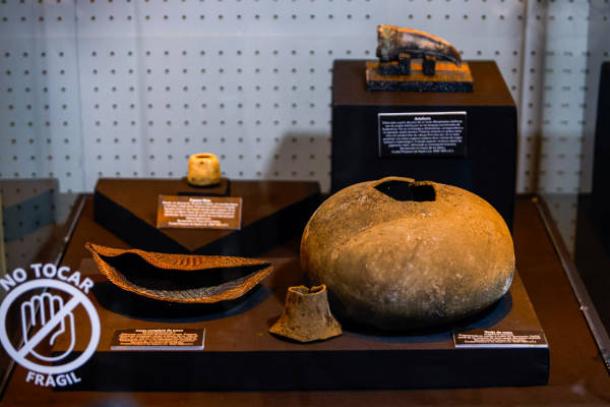
Display featuring some of the artifacts excavated from the elite Caral woman’s burial. (Peruvian Ministry of Culture).
The presence of exotic items, such as Amazonian shells and tropical bird parts, also suggests that Áspero’s residents engaged in trade with their neighbors, and also with peoples living farther away who were connected to the same trade networks. Objects from both the jungle and highlands have been found at the site, revealing a peaceful and beneficial exchange system with distant regions. These trade relationships provided access to valuable goods and helped reinforce and support the Caral’s interest in constructing a complex and organized society.
The artifacts included in the woman’s burial were especially notable, as they show clearly she was someone who enjoyed a high social standing. Items like the finely crafted feather work, beaded toucan beak, weaving tools, and an embroidered wool textile indicate that she likely played a significant role in her community’s social or religious life. Although the Caral civilization had no known writing system, grave goods like these allow archaeologists to infer societal structures and determine the status of individuals within those structures.
Women’s Leadership in the Caral Civilization
The burial goods found with this woman add to the growing body of evidence that women held positions of power and influence within the Caral society. Previous discoveries at Áspero, such as the "Lady of the Four Tupus" found in 2016, and the "Elite Male" burial uncovered in 2019, suggest that social leadership roles may have been accessible to both genders in the Peruvian Andes 4,000 to 5,000 years ago.
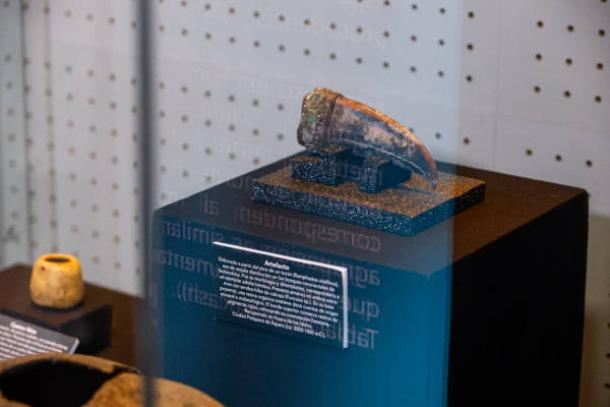
Adorned toucan’s beak recovered from among the grave goods buried with the elite Caral woman. (Peruvian Ministry of Culture).
The Lady of the Four Tupus was buried with four brooches shaped like birds and monkeys, prestigious items that further demonstrate the association between symbolic objects and elite status. Both her burial and the newly discovered woman's grave were located close to each other, implying they belonged to a select group of influential individuals. Scholars note similarities between this clustering of elite burials and later patterns observed at other ancient Andean sites, like La Galgada in Ancash (a department in western Peru).
- 3,800-Year-Old Statues from Advanced Caral Civilization found in Peru
- New Archaeological Findings Reaffirm the Important Role of Women 4,000 Years Ago in Peru
Although the exact titles or names of these individuals remain unknown due to the absence of a written language, the archaeological evidence points to a society where leadership and prestige were not restricted to men. This challenges long-held assumptions about gender roles in early civilizations and opens new lines of inquiry into the social dynamics of Caral society.
Áspero: From Trash Dump to Treasured Archaeological Destination
Áspero played a vital role in the ascendency of the Caral civilization. Covering 46 acres (18.8 hectares), the site includes 22 identified architectural complexes that testify to its importance as a center for marine production, trade, and social organization. Living in a community that was situated strategically near the Pacific Ocean, Áspero’s inhabitants relied heavily on fishing and seemingly maintained strong trade ties with inland and jungle communities, as evidenced by the diverse origins of goods found during excavations at the site.
Before systematic archaeological work began in 2005, Áspero suffered decades of neglect and even served as a municipal dump. Thanks to the efforts of the Caral Archaeological Zone team, the site has been reclaimed and has now been repurposed as an important cultural heritage center. Excavations over the last 20 years have turned Áspero into a source of regional pride and have also brought in increasing numbers of tourists, contributing to the area's economic and social revitalization.
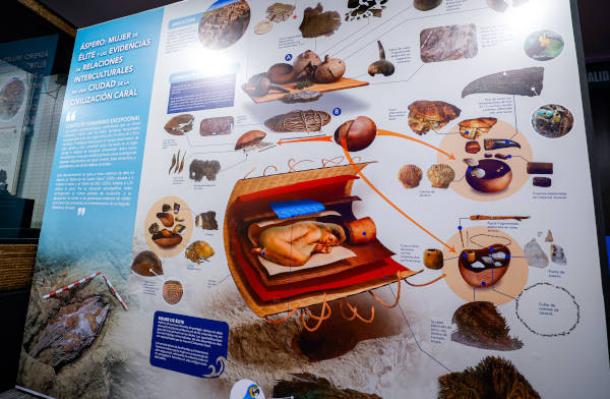
Museum display of the elite woman’s burial and artifacts. (Peruvian Ministry of Culture)
The experts from the Caral Archaeological Zone project will continue to study the elite woman's remains and her funerary offerings, aiming to uncover details about her health, diet, and cause of death, and also more information about the broader cultural practices of her society. As research progresses, this discovery promises to provide even deeper insights into one of the earliest advanced societies in the Americas, and into the vital roles women played in its development and the maintenance of its prosperity.
Top image: The well-preserved body of the elite Caral woman, including her headdress.
Source: Peruvian Ministry of Culture.
By Nathan Falde