
Deep within South Africa's Wonderwerk Cave, a team of researchers has uncovered compelling evidence that early hominins, likely Homo erectus, were using fire as far back as 1.79 million years ago. This groundbreaking discovery pushes the timeline for controlled fire use back by hundreds of thousands of years, offering profound new insights into human evolution. The findings, published in the journal PLOS One, rely on an innovative combination of techniques to detect ancient burning on fossilized bones.
The ability to control fire was a monumental leap for early humans. It provided warmth during cold nights, protection from predators, and extended the hours of daylight. Eventually, it led to cooking, which unlocked more nutrients from food and fueled the evolutionary expansion of the human brain. Wonderwerk Cave has long been recognized as a critical site for studying early fire use, with previous research identifying traces of burning dating to around one million years ago. Now, by examining deeper, older deposits, scientists have extended that record significantly.
- Breakthrough Research Reveals Wonderwerk Cave Is the World's Oldest Home
- First Human Fire Starter Was 1.6 Million Years Ago, Scientist Says
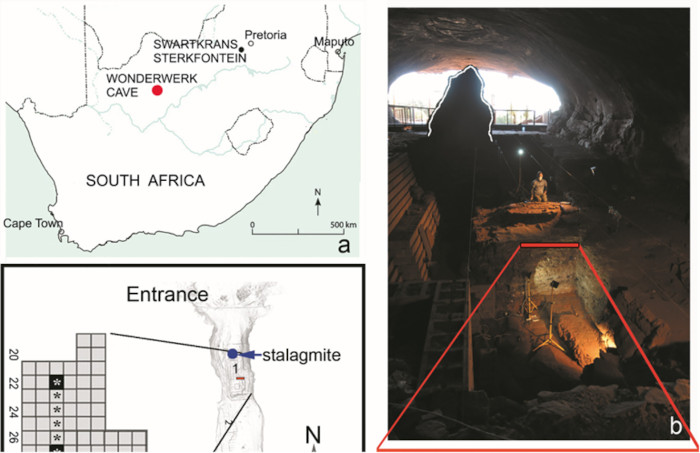
a) Location of Wonderwerk Cave (red dot) in South Africa. (b) Excavation 1 area showing the stalagmite landmark (outlined in white). (PLOS One/CC BY 4.0)
Unearthing the Evidence
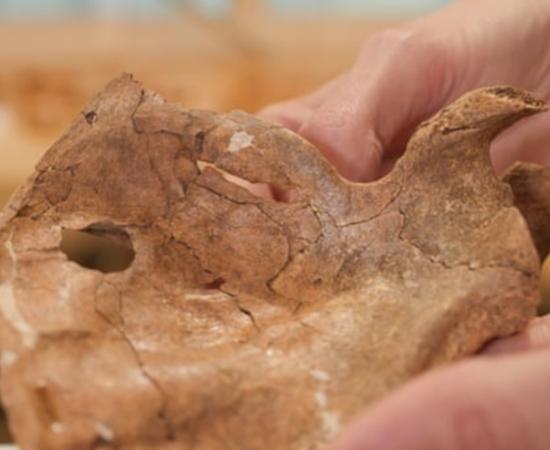
The new study focused on 161 tiny fossilized bones from small mammals, recovered from two Early Pleistocene layers in the cave known as Stratum 10 and Stratum 11. Many of these bones were originally brought into the cave by barn owls, whose pellets accumulated on the cave floor over millennia. Some of these remains subsequently came into contact with fire. To determine if the bones had been heated, the researchers employed a novel, non-destructive method called bone luminescence, alongside the more established Fourier Transform Infrared Spectroscopy (FTIR).
Under a microscope, using high-energy blue light and specific filters, the scientists observed that bones exposed to high temperatures emitted a distinct reddish glow. Unheated bones, however, remained dark. This luminescence technique proved highly effective, and its results were corroborated by the FTIR analysis, which detects structural changes in bone mineral caused by heat. In the older Stratum 11, which dates between 1.07 and 1.79 million years ago, every white and gray fossil bone tested showed clear evidence of burning.
- Homo Erectus Mastered Oldowan and Acheulean Tools 2 Million Years Ago
- How Taming Fire Changed Everything for Early Humans
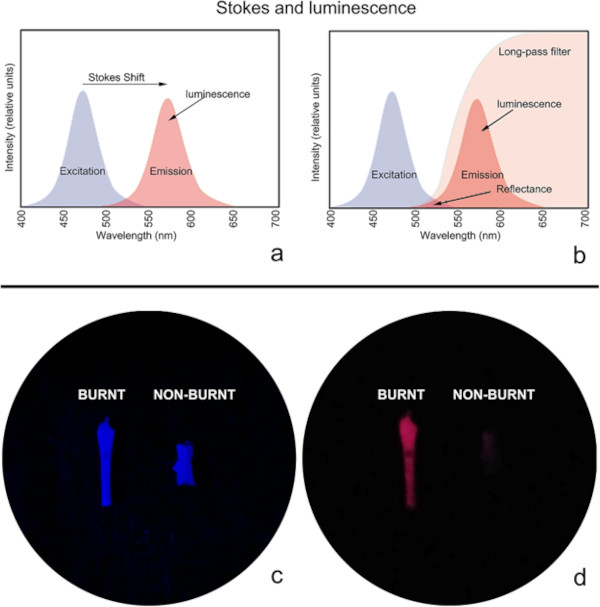
Stokes shift and luminescence principles used to detect burning. (PLOS One/ CC BY 4.0)
A Safe Haven from Wildfires
One of the most persuasive aspects of the Wonderwerk Cave discovery is the location of the burnt remains. The fossils were found at least 30 meters (nearly 100 feet) inside the cave entrance. At this depth, it is highly improbable that natural wildfires could have swept in and caused the burning. Instead, the evidence strongly suggests that early hominins deliberately carried fire into the cave. Furthermore, the burnt bones were found in distinct clusters, indicating repeated, intentional burning events in specific areas over long periods, rather than random, isolated incidents.
These findings are associated with Acheulean stone tools, further linking the fires to hominin activity. While the study does not prove that these early humans possessed the technology to spark fires from scratch, it does imply a sophisticated level of interaction with fire. They likely collected embers from natural wildfires and transported them into the cave, maintaining the flames for extended periods. This level of planning and management is a hallmark of the cognitive advancements seen in Homo erectus.
Rewriting Human History
The implications of this research are vast. By pushing the timeline of fire use back to 1.79 million years ago, the Wonderwerk Cave findings challenge existing narratives about when our ancestors first harnessed this powerful tool. The introduction of the rapid, non-destructive bone luminescence technique also provides archaeologists with a valuable new tool for identifying ancient burning at other sites worldwide, potentially leading to even more discoveries.
As researchers continue to analyze the wealth of artifacts and fossils from Wonderwerk Cave, our understanding of early human behavior and the pivotal role of fire in our evolution continues to grow. This ancient South African site remains a crucial window into the deep past, revealing the ingenuity and adaptability of the early hominins who once called it home.
Top image: Human ancestors working with fire in a cave. Source: AI Generated
By Gary Manners
References
Arnold, P. 2026. Wonderwerk Cave bones reveal possible fire use by human ancestors 1.79 million years ago. Phys.org. Available at: https://phys.org/news/2026-06-wonderwerk-cave-bones-reveal-human.html
Heritage Daily. 2026. Ancient humans used fire nearly 1.8 million years ago, cave evidence suggests. Heritage Daily. Available at: https://www.heritagedaily.com/2026/06/ancient-humans-used-fire-nearly-1-8-million-years-ago-cave-evidence-suggests/158261
Marin-Monfort, M.D. 2026. New evidence for Early Pleistocene use of fire at Wonderwerk Cave (South Africa ). PLOS One. Available at: https://journals.plos.org/plosone/article?id=10.1371/journal.pone.0347480
Pringle, H. 2026. Early humans used fire in Wonderwerk Cave up to 1.8 million years ago. Archaeology Magazine. Available at: https://archaeologymag.com/2026/06/early-humans-used-fire-in-wonderwerk-cave/