
Verdict:
Established: The Nazlet Khater 2 skeleton was excavated in 1980 near Sohag, Upper Egypt, and dates to the Upper Paleolithic, about 33,000 years ago.
Established: A facial approximation by Moraes and Santos was published in 2023 with a documented method. Whether it shows what he actually looked like is not established. The authors call the color version partly speculative.
Unverified: The viral image as a scientific facial reconstruction of Nazlet Khater 2. No method, data or author has been published.
A smiling Stone Age face posted on X on October 19, 2026, and captioned as a 37,000-year-old man from North Africa had drawn about 2.6 million views by October 21, by the post's count. Yet it carries a commercial reconstruction service's branding rather than coming from the published study of the skeleton it names. The post matters because many readers took it as the real face of Nazlet Khater 2, an Upper Paleolithic burial from Egypt's Nile Valley. No method, measurements or named scientist come with the picture, however, so for now it cannot be checked, which is a different thing from showing it to be wrong.
The skeleton was described in a study published in the Journal of Human Evolution in March 1984 by Pierre Vermeersch, G. Gijselings and E. Paulissen, while the face most people had seen before that post was the 2023 approximation by Cicero Moraes and Moacir Elias Santos, published with its full method. So how well does the viral version hold up?
A Face Without a Method
The X account @WithoutHistory posted the image on October 19, 2026, with the caption "Facial reconstruction of a 37,000 yo man from ancient North Africa." It is a four-panel collage of a smiling man with long locs threaded with orange beads, a necklace of teeth or claws and a leather hide wrap.
The corner watermark reads "Nazlet Khater 2", followed by two web addresses that show whose branding the picture carries. Ancestralwhispers.org is a commercial service that sells cranial reconstructions and DNA reports, and its site says it is "now partnered with Kvali", while Kvali.app is a consumer app that turns a 23andMe, MyHeritage, Ancestry or FamilyTreeDNA file into a guided ancestry story, at $29.95 per kit.
However, the pages that could be opened on both sites show no Nazlet Khater 2 project page. Nor was there any method, measurement, tissue-depth data or named scientist for this image, and no paper or data set travels with the post.
The Skeleton Found at Nazlet Khater in 1980
The bones behind the name, by contrast, are real and well documented. The Belgian Middle Egypt Prehistoric Project of the Catholic University of Leuven, begun by Vermeersch in 1976, excavated two skeletons at Nazlet Khater 2, also called Boulder Hill, near Sohag in 1980, and the individual known as Nazlet Khater 2 is the young male.
The 1984 abstract wastes few words on the find. "A grave on the boulder hill at Nazlet Khater, Upper Egypt, yielded a skeleton of modern man with archaic features," it reads. The authors added that a bifacial axe in the grave suggests it is contemporaneous with a nearby chert mining site, which they dated "between 35,000 and 30,000 years ago."
A companion paper in Nature that May called that mine, Nazlet Khater 4, a site "with a complex extraction strategy, going back 33,000 yr." It described the man as buried in the extended position, with an anatomically modern skull that kept archaic traits such as a very heavy lower jaw.
The date is indirect: according to the 2023 paper, an attempt to date the bones themselves failed because they were too fragmented, so the age came from nine radiocarbon samples at the mine. A later electron spin resonance estimate on tooth fragments, cited in the same paper from studies by Isabelle Crevecoeur and colleagues, gives about 38,000 years, plus or minus 6,000.
Age at death has been put at 17 to 20, or 20 to 29 in other readings, with a height of 161 to 165 cm. The ribs, hands, feet and parts of both shins are missing, though Santos told Live Science that "the skull, was well preserved." Leuven held the skeleton until Belgium returned it to Egypt in 2015, and it is now on display at the National Museum of Egyptian Civilization in Cairo.
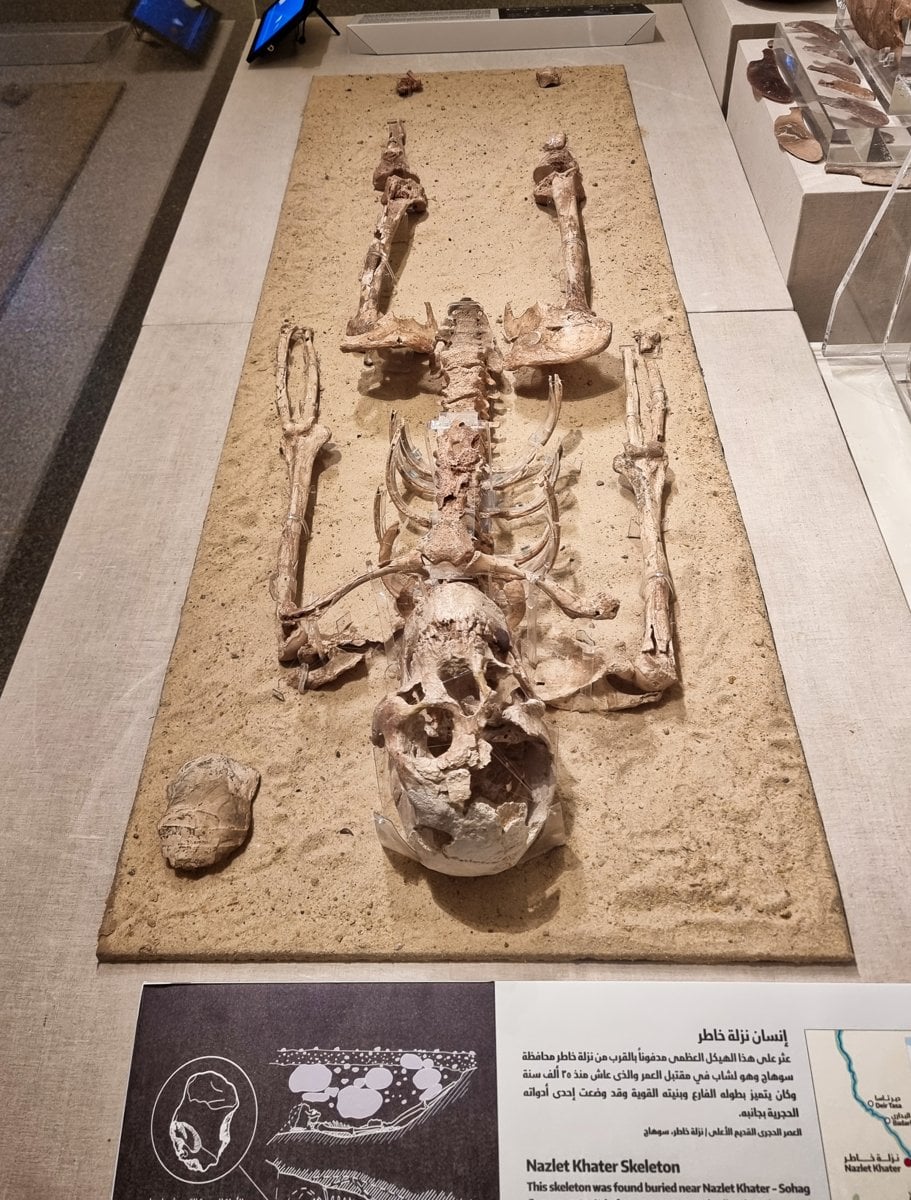
The Nazlet Khater skeleton on display at the National Museum of Egyptian Civilization in Cairo, photographed in May 2022. Photo: Richard Mortel, via Wikimedia Commons, CC BY 2.0.
Later studies stress just how unusual the skull is. Linda Bouchneb of the University of Bordeaux and Crevecoeur called it "the only complete modern human skeleton from the earliest Late Stone Age in Africa." In 2009 Crevecoeur, then of the Royal Belgian Institute of Natural Sciences, and colleagues found "elevated levels of variation" among skulls of this age. That suggests the skull does not map neatly onto any living population, so every bit of modern styling placed on it is a choice.
How the Published 2023 Face Was Built
Moraes, a 3D designer with Arc-Team Brazil, and Santos, an archaeologist at the Ciro Flamarion Cardoso Archaeology Museum in Ponta Grossa, published their approximation in the online journal OrtogOnLineMag on March 22, 2023, under a CC BY 4.0 license. The difference from the viral image starts right there, because their method is written down for anyone to follow.
Santos filmed two video sequences of the more complete side of the skull at the Cairo museum, and 72 frames went into a 3D photogrammetry model, with the missing right side mirrored from the left. The model was then scaled with measurements published by A. Thoma in 1984 and checked against a CT-based profile of the skull published in 2002.
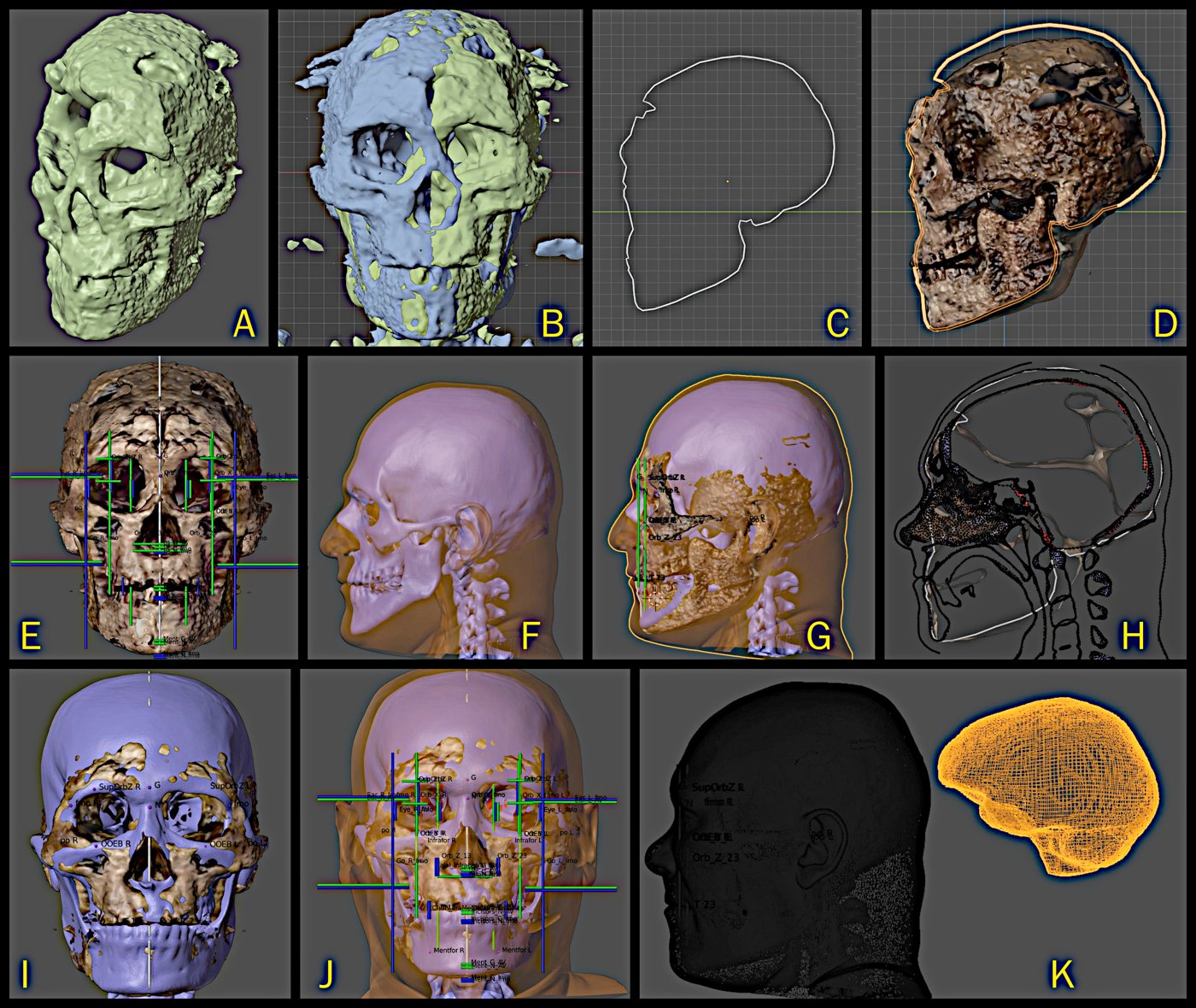
Stages of the 2023 work, from the photogrammetry model of the skull to the warped donor scan and the reconstructed profile (Fig. 9 of the paper). Image: Cicero Moraes and Moacir Elias Santos, OrtogOnLineMag 6 (2023), CC BY 4.0.
Gaps were filled by warping the CT scan of a living donor to fit the fossil, a technique the authors call anatomical deformation. Soft-tissue depths came from a published study of present-day Egyptians, and the nose was projected from another CT-based study, before the team produced two different versions of the face.
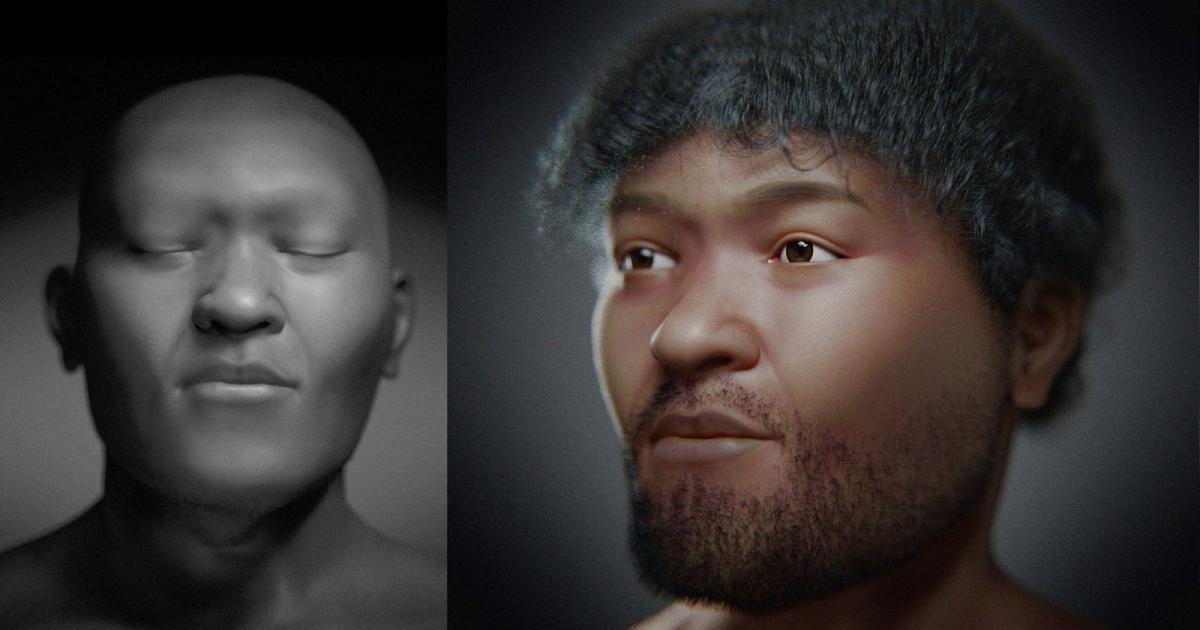
The first is a grayscale bust with the eyes closed and no hair, which the authors chose because the bones give no information about hair or skin tone. The second is a color version with open eyes, short dark hair and a trimmed beard, which they say contains speculative elements and was made for the public.
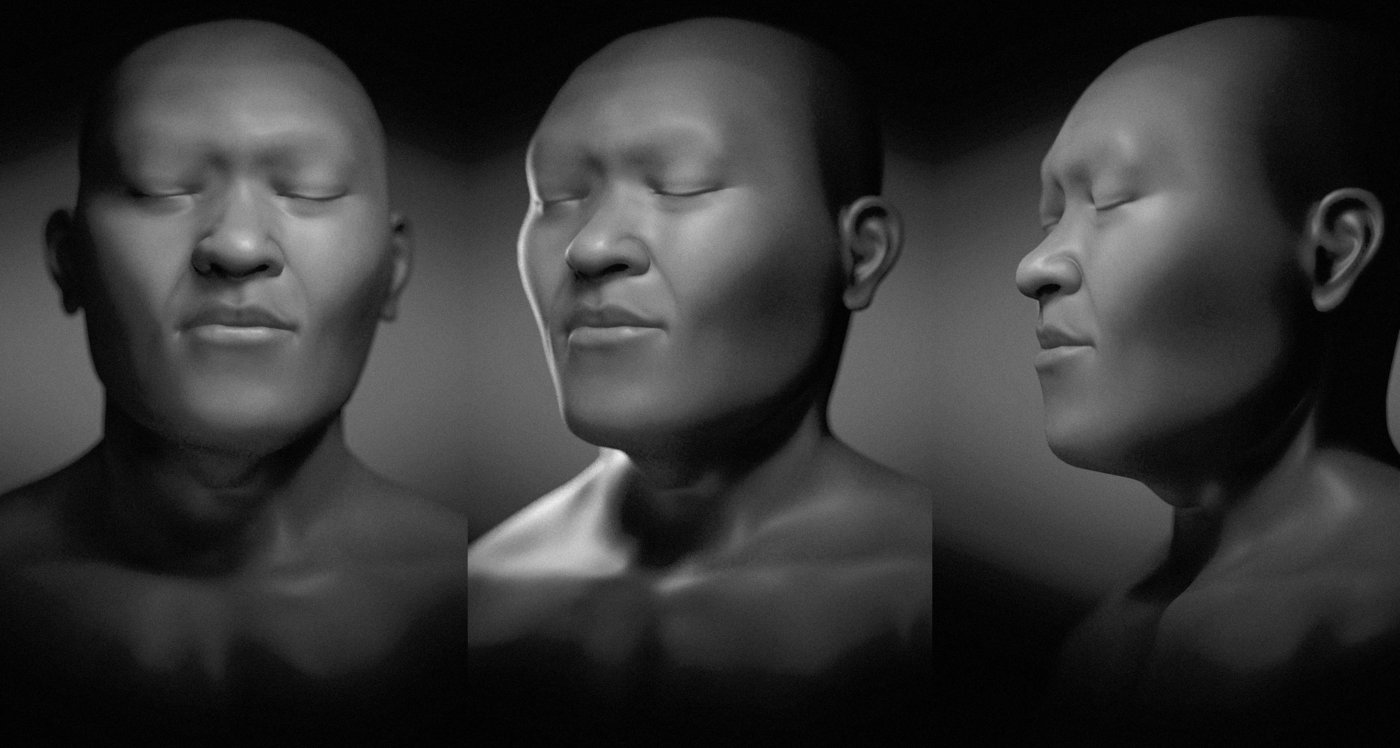
The grayscale bust of the 2023 approximation, shown with closed eyes and no hair because the bones give no information about either (Fig. 11 of the paper). Image: Cicero Moraes and Moacir Elias Santos, OrtogOnLineMag 6 (2023), CC BY 4.0.
Moraes has been frank about the limits of the craft. "In general, people think that facial approximation works like in Hollywood movies, where the end result is 100% compatible with the person in life," he told Live Science. "What we do is approximate what could be the face, with available statistical data and the resulting work is a very simple structure."
Even the published face has not escaped criticism. In April 2023, as reported by Arab News, Egypt's Ministry of Tourism and Antiquities disputed the work's credibility, saying, "The two researchers did not submit any request to the museum authority to photograph the skeleton of Nazlat Khater to study its anatomical measurements." It said the result rested on "graphic programs and not on the anatomical measurements of the skeleton."
Could This Be the Face of Nazlet Khater 2?
The caption's figure of 37,000 years sits inside the spin resonance range and is a little older than the radiocarbon dates for the mine, so it is broadly consistent, though it is not a published date for the skeleton. The phrase "ancient North Africa" is accurate too, since Nazlet Khater lies in Upper Egypt.
The words "facial reconstruction" are where the post runs short of support, because no method, data or author has been published for this image and nothing in it can be measured against the skull. Set side by side with the 2023 work, the differences are plain to see, as the viral man has long beaded locs and a broad smile, while the published versions show short hair or none, and no smile.
What did the grave actually hold? The 1984 abstracts mention one object, the bifacial axe, and say nothing of a necklace or clothing, while the 2023 paper treats hair and skin as things the bones cannot reveal. On the published record, nothing supports the jewelry, the hide or the locs.
How the viral image was made is unknown, and it could be an artist's own approximation built on real measurements that simply have not been shared. However, a missing method only means the claim cannot yet be tested, and on its own it says nothing about whether the image was invented.
With these factors taken into account, the skeleton, its 1980 excavation and its Upper Paleolithic age are Established, with the mine dated to 35,000 to 30,000 years ago and the teeth to about 38,000. The viral image as a scientific reconstruction of Nazlet Khater 2 is Unverified. The next step lies with its makers. If they publish their landmarks, tissue-depth sources and workflow, the picture could be tested against the skull like any other.
Related on Ancient Origins
- Digital Scientists Resurrect A 30,000-Year-Old Egyptian Man
- How Reliable are Computer Reconstructions of Ancient Faces?
- Cícero Moraes: Insights into the Fascinating World of Forensic Facial Reconstruction
- Photos: Scientists Have Reconstructed the Face of a 75,000-Year-Old Neanderthal Woman
The 2023 facial approximation of Nazlet Khater 2 by Cicero Moraes and Moacir Elias Santos: the grayscale bust (left) and the artistic color version (right). Image: Cicero Moraes and Moacir Elias Santos, OrtogOnLineMag 6 (2023), CC BY 4.0.
By Aris Manus
Sources
- Vermeersch, P.M., Gijselings, G. and Paulissen, E. 1984. "Discovery of the Nazlet Khater man, Upper Egypt." Journal of Human Evolution 13(3): 281 to 286. https://doi.org/10.1016/s0047-2484(84)80013-5
- Vermeersch, P.M., Paulissen, E., Gijselings, G., Otte, M., Thoma, A., van Peer, P. and Lauwers, R. 1984. "33,000-yr old chert mining site and related Homo in the Egyptian Nile Valley." Nature 309: 342 to 344. https://doi.org/10.1038/309342a0
- Moraes, C. and Santos, M.E. 2023. "A Aproximação Facial do Crânio de Nazlet Khater 2." OrtogOnLineMag 6. CC BY 4.0. https://ortogonline.com/doc/pt_br/OrtogOnLineMag/6/NazletKhater2.html
- Bouchneb, L. and Crevecoeur, I. 2009. "The inner ear of Nazlet Khater 2 (Upper Paleolithic, Egypt)." Journal of Human Evolution 56(3): 257 to 262. https://doi.org/10.1016/j.jhevol.2008.12.003
- Crevecoeur, I., Rougier, H., Grine, F. and Froment, A. 2009. "Modern human cranial diversity in the Late Pleistocene of Africa and Eurasia." American Journal of Physical Anthropology 140(2): 347 to 358. https://doi.org/10.1002/ajpa.21080
- Nalewicki, J. 2023. Report on the Nazlet Khater 2 facial approximation, with interviews with Moraes and Santos. Live Science, 3 April 2023. https://www.livescience.com/see-the-oldest-human-ever-found-in-egypt-in-stunning-new-facial-approximation
- BBC News Brasil. 2023. "A impressionante reconstrução facial de egípcio que viveu há 35 mil anos feita por brasileiros." 19 April 2023. https://www.bbc.com/portuguese/articles/cz5pryp8km5o
- Mohamed, G. 2023. "'Real face' of ancient Egyptian man: Ministry comments on latest research." Arab News, 14 April 2023. https://www.arabnews.com/node/2286736/middle-east
- Museum of Looted Antiquities. "Nazlet Khater Man." https://mola.omeka.net/items/show/2048
- @WithoutHistory. 2026. Post of 19 October 2026 on X. https://x.com/WithoutHistory/status/2111972953743306846