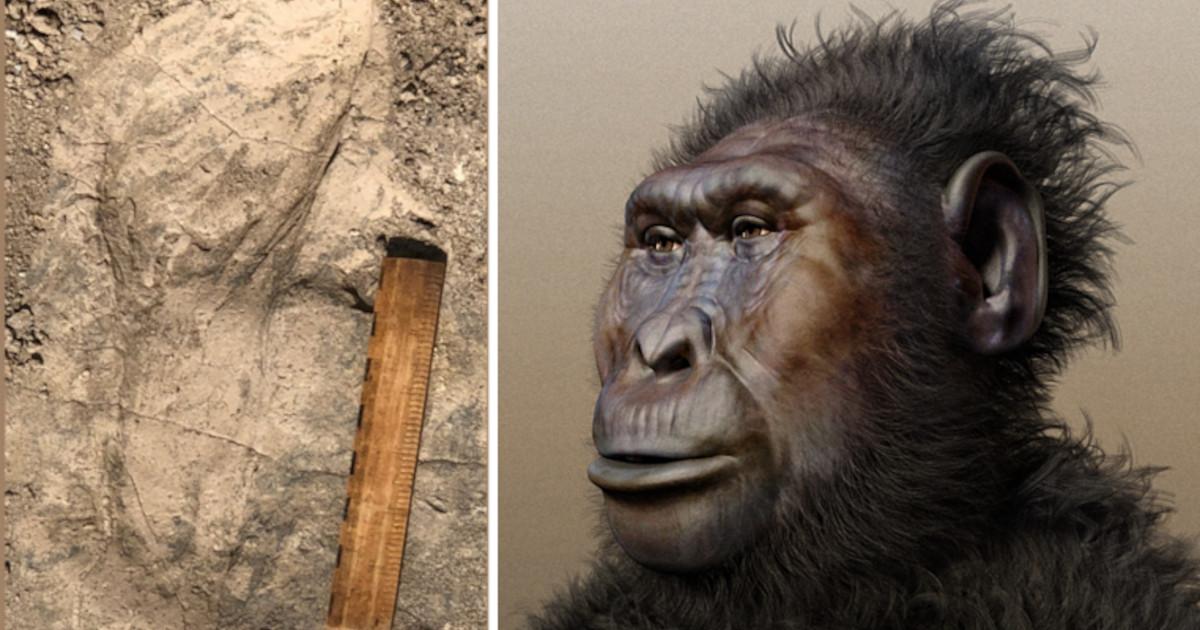

The recent findings conflict with previous views regarding the size and society of Paranthropus boisei. Most fossils associated with this species have been skulls, therefore very little of their body structure has been identified. The new footprint analysis done on fossils first identified by Smithsonian geologist Kay Behrensmeyer in 1978, with further work conducted in 2016 and 2023, provides a new window into our understanding of the stature and locomotion of Paranthropus boisei.
As Behrensmeyer observed:
"The special thing about footprints scientifically is that they preserve an instant in time. They also allow people to relate to these fossils much more easily than an isolated piece of bone or jaw."

Overview of the excavated GaJi10 track surface at Lake Turkana, showing hominin and hippopotamus footprints preserved in ancient sediment (Kay Behrensmeyer / Smithsonian)
In the past, scientists did not have enough data to construct a picture of this species' place within the prehistoric hominin society. The majority of fossils discovered were skulls; very few skeletons existed that showed how this species moved or interacted socially. By conducting a detailed analysis of the feet of Paranthropus boisei through these new footprint findings, researchers can now better approximate what this species would have looked like as an adult and how it moved within its environment.
Unexpectedly Large Bodies
The research team, led by Kevin Hatala of Chatham University and the Max Planck Institute for Evolutionary Anthropology, used advanced 2D and 3D imaging to analyze the footprints at the site known as GaJi10. By comparing the tracks with those of modern humans and other early hominins, they determined the makers were Paranthropus boisei, identified by their distinctive foot anatomy and movement patterns. The most striking revelation, however, was their physical size.
- Footprints Reveal Two Extinct Hominin Species Living Side By Side
- The Faces of Ancient Hominids Brought to Life in Remarkable Detail
"The sizes of the footprints indicate human-like body sizes — up to 6 feet tall and around 165 pounds," Hatala stated in a Smithsonian press release. This directly contradicts earlier studies suggesting that Paranthropus boisei was considerably smaller than its contemporary, Homo erectus — a species considered a potential direct ancestor of modern humans. The evidence now suggests that two distinct, similarly sized hominin species shared the same environment during the Early Pleistocene, a finding that fundamentally reshapes our understanding of the period.
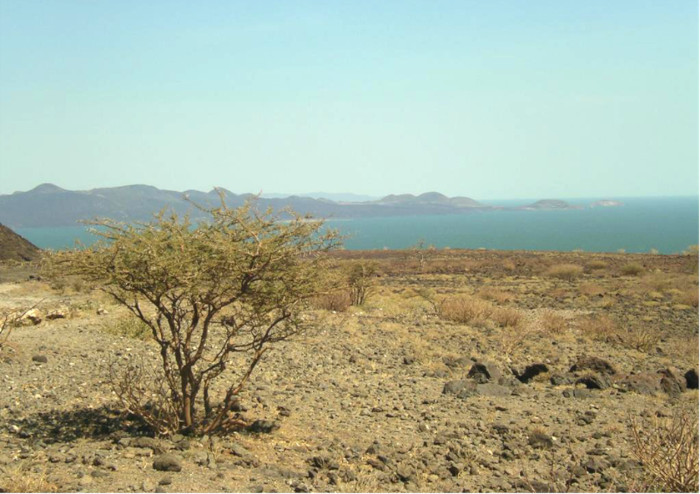
The arid landscape around Lake Turkana, Kenya, where the GaJi10 footprint site is located (AdamPG / CC BY-SA 3.0)
A Prehistoric All-Male 'Gang'
Beyond body size, the footprints offer a fascinating snapshot of ancient social behavior. The analysis of the footprints of eight individual hominins indicates that most, if not all members are adult male, with females and children conspicuously absent. This unusual configuration hints at a level of social complexity previously unseen in the fossil record of this species, and one that draws intriguing parallels with the social structures observed in some modern primates.
Co-author Neil Roach of Harvard University noted that the grouping "hints at a complex social structure in this species." He suggested that Paranthropus boisei may have lived in large groups where males competed for mates, but also tolerated one another at times for mutual protection in a dangerous environment — one shared with crocodiles, elephants, and other large predators. This all-male traveling party offers a rare window into the group dynamics of our extinct cousins, and adds an important behavioral dimension to the fossil record of Paranthropus.
- Paranthropus "Nutcracker" Teeth Theory Debunked in New Study
- New Paranthropus Jaw Finds a Home Farther North Than Expected
Life on the Lakeshore
The Koobi Fora Formation on the eastern side of Lake Turkana is regarded as one of the most significant paleoanthropological site globally as it has thick sedimentary layers that preserve some of the key fossils of human evolutionary history over the last two million years. The footprints found on the GaJi10 site were fossilized in rapidly consolidated mud, indicating it was captured at one moment in time. The research group utilized volcanic ash found in the rocks surrounding the prints to ascertain that the footprints were made approximately 1.43 million years ago.
According to researchers, it is thought that Paranthropus boisei would have been attracted to the edge of the lake due to the availability of plentiful plant life such as papyrus as well as food items such as shellfish and molluscs. The presence of both Paranthropus and Homo erectus footprints in the same geological layers across multiple sites, spanning more than 100,000 years, indicates that these two distinct branches of the human family tree shared this landscape for an enormous stretch of time.
Co-author Kay Behrensmeyer of the Smithsonian Institution reflected:
"I never dreamed when we found these in 1978 that it would develop into such a large assemblage and provide such widespread insights into the ecology of these hominins."
The research team plans to return to Kenya to continue their excavations, hoping to uncover more snapshots of our prehistoric past. As Hatala put it:
"Each site represents a snapshot of our past, and we are quickly building a photo album with several different windows to hominin anatomy, locomotion, behavior, and environments during the Early Pleistocene."
The muddy shores of ancient lakes continue to yield surprising revelations about the intricate and often unexpected lives of our distant relatives.
Top image: Left; One of the large, 1.43-million-year-old footprints excavated at the GaJi10 site, with a 6-inch ruler for scale. Right; Forensic reconstruction of Paranthropus boisei. Source: Left; Kay Behrensmeyer / Smithsonian, Right; Cicero Morae/CC BY-SA 4.0
By Gary Manners
References
Behrensmeyer, K. 2026. Fossil footprints reveal body size and group dynamics of 1.4-million-year-old human relative. Smithsonian Institution. Available at: https://www.si.edu/newsdesk/releases/fossil-footprints-reveal-ancient-human-relative-was-larger-previously-thought-and
Daily Mail. 2026. The prehistoric 'mafia': 1.4 million-year-old footprints reveal our ancient relatives may have travelled in all-male gangs. Available at: https://www.dailymail.co.uk/sciencetech/article-16008373/prehistoric-mafia-old-footprints-ancient-gangs.html
Hatala, K.G. et al. 2026. Insights into hominin body size, locomotion, and behavior from Early Pleistocene trackways in northern Kenya. Proceedings of the National Academy of Sciences. Available at: https://www.pnas.org/doi/10.1073/pnas.2530996123
Max Planck Society. 2026. Fossil footprints reveal body size and group dynamics of 1.4-million-year-old human relative. Available at: https://www.mpg.de/26870451/fossil-footprints-show-large-body-size-and-group-dynamics-in-1-4-million-year-old-human-relatives