
Throughout history, the structure of the human pelvis has been explained by scientists as the outcome of evolution between two different demands, namely moving on two legs and giving birth to large-brained babies. However, new research conducted on two well-preserved Neanderthal skeletons proves that this view may not be entirely correct as childbirth and pelvic floor stability may have been more important for evolution than walking.
The scientists conducted the research which was later published in the Proceedings of the National Academy of Sciences. The researchers studied a 1.5-year-old Neanderthal child from Dederiyeh Cave in Syria and a young adult female from Sima de las Palomas del Cabezo Gordo in Spain. The scientists worked with the aid of CT and 3D-reconstruction methods and they compared the two fossils with other Neanderthal pelvic bones and bones of modern people. The research showed that although the anatomy of modern humans and Neanderthals is very similar when it comes to childbirth, the differences in locomotion-related anatomy are significant, reported Archaeology Magazine.
- The Evolution of Human Birth: An Incredible Story a Million Years in the Making
- Birthing Trauma Comes from Two Million Years of Walking Upright
Two Rare Fossils Offer New Insights
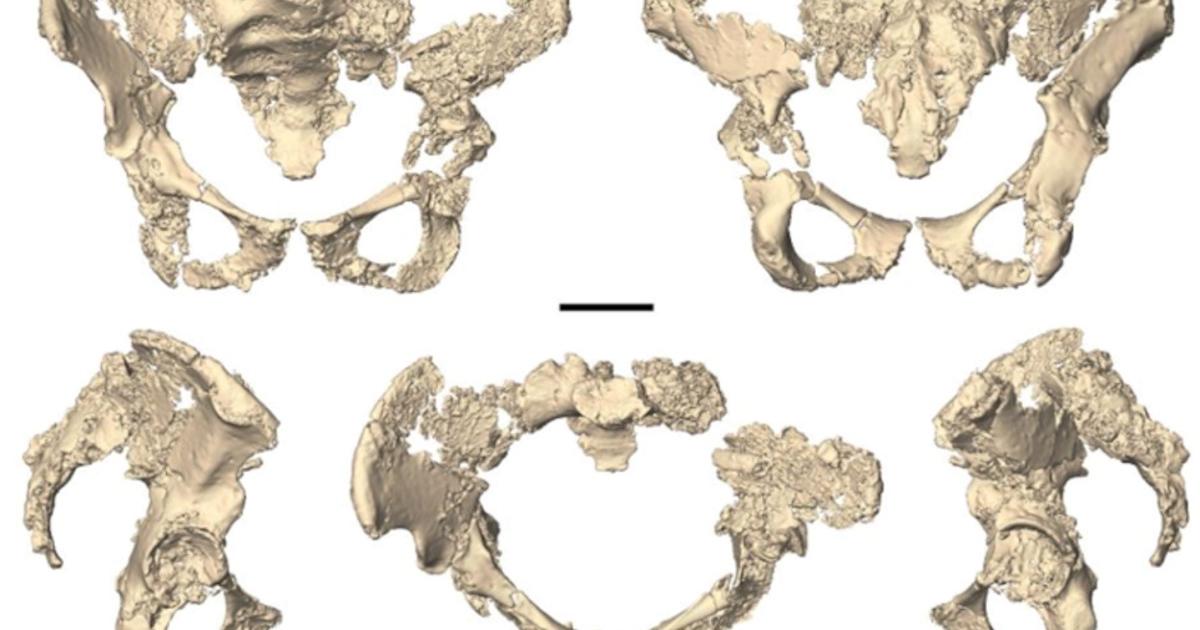
The study focused on two unusually complete Neanderthal pelvises. The Dederiyeh infant, though only a toddler, already displayed characteristic adult Neanderthal traits, including flaring hip blades and a pelvis that was short from front to back relative to its width. This suggests the basic Neanderthal pelvic shape developed early in life.
The adult female from Sima de las Palomas, excavated from breccia deposits in 2006-2007, underwent extensive digital processing to get rid of the sediment matrix and fix taphonomic distortion. Researchers compared these new models with the pelvises of the Tabun female and the Kebara male Neanderthals, as well as with the modern humans scans.
The Sima de las Palomas site in Murcia, Spain, has previously yielded important Neanderthal remains and may represent one of the first known Neanderthal burial grounds in Mediterranean Europe.
Childbirth Anatomy Remained Similar
One of the notable discoveries is the similarity between the pelvis of Neanderthal women and that of modern human women regarding the areas linked to childbirth. It has been found that Neanderthal women have a wider pelvic canal than the men do, similar to modern human women. This means that Neanderthal women and modern human women might have used similar birthing mechanisms, as both had to manage delivering babies with relatively large brains.
The similarities continued to exist despite the two groups taking separate evolutionary paths in other aspects of pelvic anatomy. The results support the view that Neanderthals and modern humans had a variety of biological and behavioral characteristics in common, including the capacity to interbreed successfully.
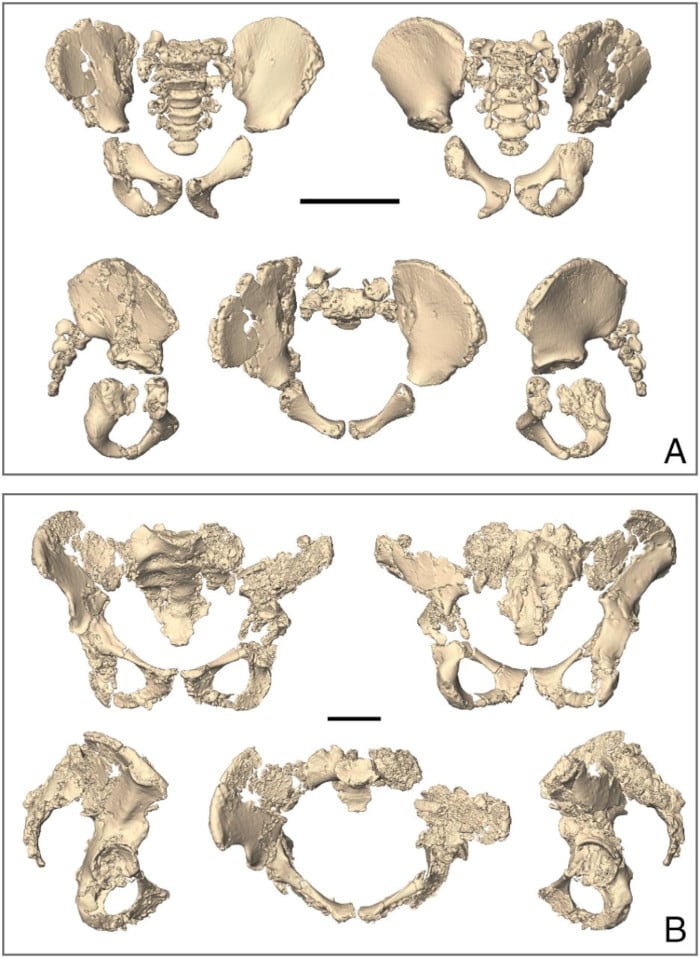
Virtual reconstruction of Neanderthal pelves. (A) Infant from Dederiyeh Cave ("Dederiyeh 1"). (B) Young adult female from Sima de las Palomas del Cabezo Gordo ("Paloma"). (Scale bar, 5 cm.) (Zollikofer et al., PNAS (2026))
Locomotion Followed a Different Path
The differences between the two groups arose from their distinction in posture and gait characteristics. Neanderthals had hip joints and muscle attachments designed to enable them to stand and walk differently than modern humans, with less tilt of the pelvis and curvature of the lower back. Those differences imply that Neanderthals had distinct locomotor adaptations and did not merely sacrifice a wide birth canal for efficient walking.
This discovery is valuable because the so-called Obstetrical Dilemma Hypothesis has influenced our understanding of the human pelvis for many years. The hypothesis assumes that evolution had to reconcile the benefits of having wide hips for giving birth with the need for the pelvis to be adapted for being bipedal. There are researchers who have challenged this theory, arguing that wider hips would not have impaired movement in humans that much. The new Neanderthal evidence suggests a different version of events: the wide birth canal may have demanded more from the pelvic floor that makes it possible for our body to keep the organs in place.
- All About Neanderthals – The Surprising Facts
- World's Oldest Human-Neanderthal Hybrid Child Discovered
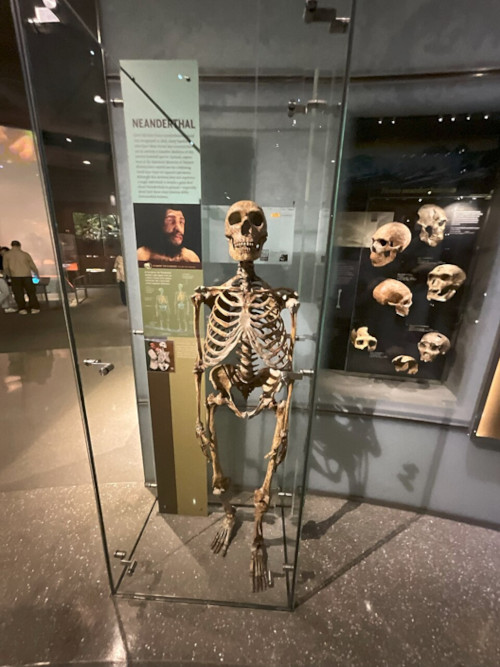
Neanderthal skeleton cast on display at the Neanderthal Museum. (Vicpeters/CC BY 4.0)
A Revised View of Human Evolution
The fossil record provides further information concerning how these shapes altered in the course of time. The old fossil remains of australopithecines and the early Homo had broad pelvises with a wide lateral form similar to that of Neanderthals. Meanwhile, the narrower front-to-back form of modern humans appears to be a later evolutionary change. This implies that childbirth and pelvic floor stability have been a more important evolutionary conflict than childbirth versus locomotion.
The study therefore shifts attention from walking alone to the wider demands placed on the pelvis. As bipedalism evolved and brain size increased, the pelvis had to accommodate multiple pressures. The Neanderthal evidence suggests that maintaining pelvic floor stability while delivering large-brained infants was a central challenge, one that both Neanderthals and modern humans solved in remarkably similar ways despite their different locomotor adaptations.
Top image: Virtual reconstruction of Neanderthal pelvis of the young adult female from Sima de las Palomas del Cabezo Gordo. Source: Zollikofer et al., PNAS (2026
By Gary Manners
References
Radley, D. 2026. Neanderthal pelvises challenge a long-held idea about childbirth and walking. Available at: https://archaeologymag.com/2026/08/neanderthal-pelvises-challenge-idea-about-childbirth/
Zollikofer, C. P. E., Ponce de León, M. S., Uriarte, M. H., López, M. V., Ortega, J., Kondo, O., Akazawa, T., & Walker, M. J. 2026. Insights into Neanderthal development, childbirth, and locomotion from the Palomas and Dederiyeh pelves. Proceedings of the National Academy of Sciences, 123(35 ), e2535303123. Available at: https://www.pnas.org/doi/10.1073/pnas.2535303123