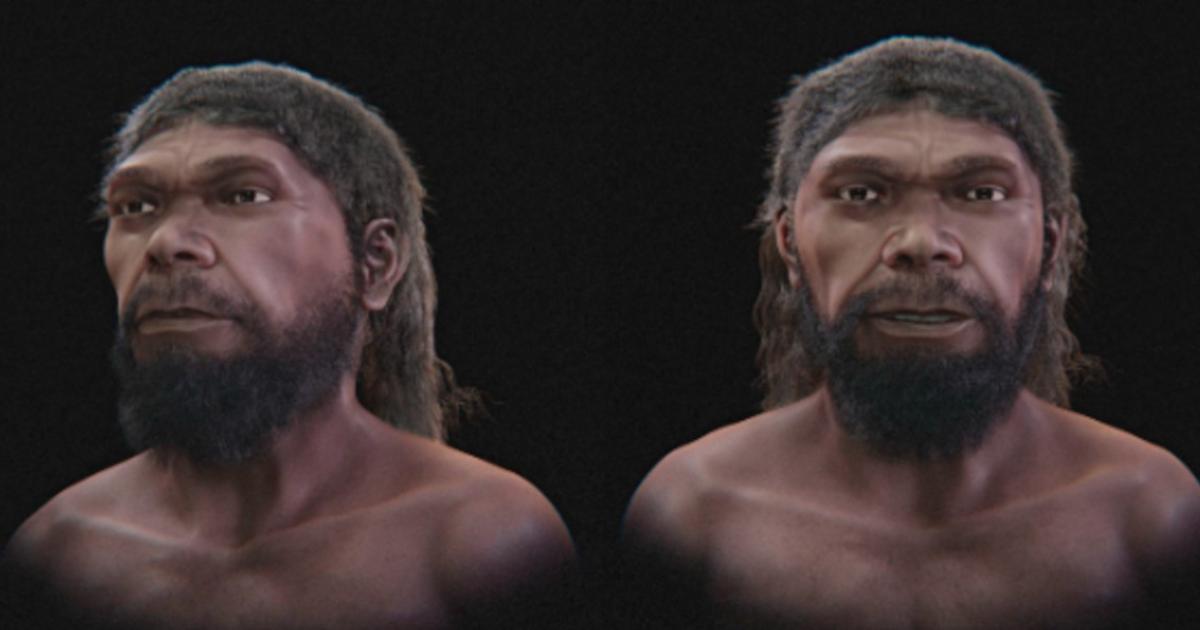

A striking new depiction envisions an ancient Homo sapiens featuring a heavy brow, dark hair, and a beard, but it is not a picture of a single prehistoric human. In a new Heritage study, researchers have created the simulated Jebel Irhoud face from the digitally reconstructed Moroccan skull, believed to be around 315,000 years old. The Daily Mail report focused on the photo-realistic impression, while scientists published a plain black-and-white version to indicate skeletal structure. Between the two lies a useful lesson about how we picture our earliest relatives.
One Skull, Several People
The starting point of the reconstruction goes back to Irhoud 1, which was extracted from a mine in the early 1960s. The braincase and upper facial bones made up the main components of the model. Then remains Irhoud 11 provided the jawbone, and other fossil fragments were used to fill in the teeth and the upper jawbone. While these finds belonged to the same occupation layer, they were not parts of a single individual. As AO’s history of forensic facial reconstruction shows, filling gaps in a skull has always required informed choices.
- 300,000-Year-Old Remains Place Oldest Homo Sapiens in Morocco
- Omo Kibish Homo Sapiens Just Got Older!
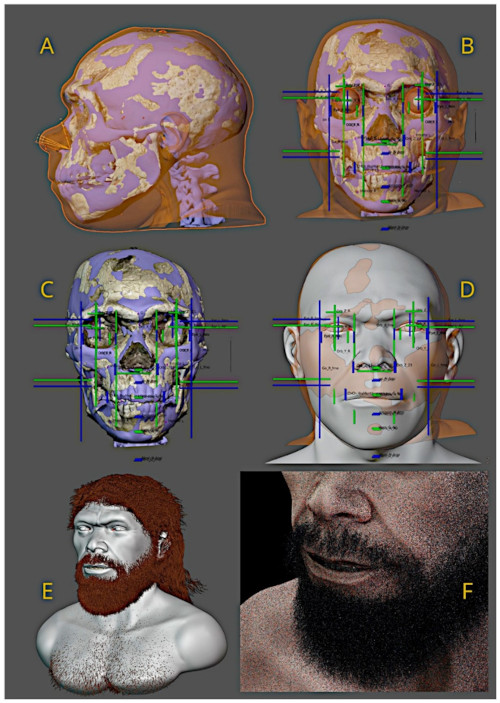
The modelling process, from the fossil skull to soft tissue and hair. (Moraes et al., Heritage / CC BY 4.0; underlying skull imagery: Philipp Gunz/MPI-EVA / CC BY-SA 2.0)
The date of these fossilized human bones is key, as they are some of the oldest Homo sapiens remains available. In 2017, Daniel Richter and colleagues dated associated fire-heated flint tools to 315,000 years ago, plus or minus 34,000. Max Planck’s account describes stone tools and animal remains found alongside the fossils. A separate analysis led by Jean-Jacques Hublin identified a modern-looking face and teeth paired with a longer, more archaic braincase.
- World’s Earliest Known Woman ‘Zlatý Kůň’ Has Her Face Reconstructed!
- Facing the Facts: Just How Accurate Are Facial Reconstructions?
Building a Face from a Fossil
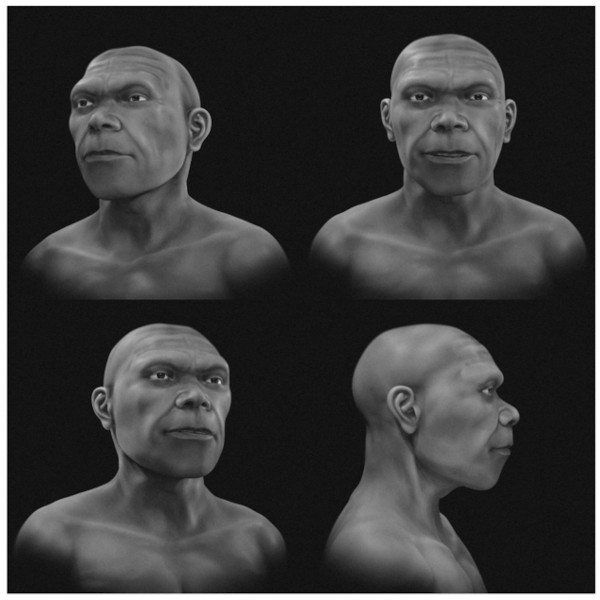
The grayscale version omits speculative hair and skin color. (Moraes et al., Heritage / CC BY 4.0)
In order to fabricate a face for Jebel Irhoud, Cicero Moraes and his colleagues used images from a digital reproduction of a skull created in 2017 that is available on the Internet. They combined the data from their skull model with the data obtained from a modern person who underwent a CT scan of the head and utilized programming tools, such as Blender, to alter the model so that it fits the skull of the fossil. In turn, they used reference measurements from modern people in order to create projections of soft tissues and nose, with the help of data collected from the bone they managed to define the final shape. It is worth noting that although modern techniques have transformed possibilities in facial reconstruction, when dealing with such old findings, much is still left to artistic interpretation.
The team created two models: a grayscale, hairless bust used for analyzing anatomy, and an illustrated version aimed at a general audience. Their version boasts an estimated braincase volume of 1,364 milliliters, which is comparable to an earlier estimate made using fossil scans. Hence, the agreement confirms the size of the digital skull rather than the skin color and hair. Other reconstructions of ancient hominin faces show the appeal of seeing faces emerge from the past, even if they are an approximation.
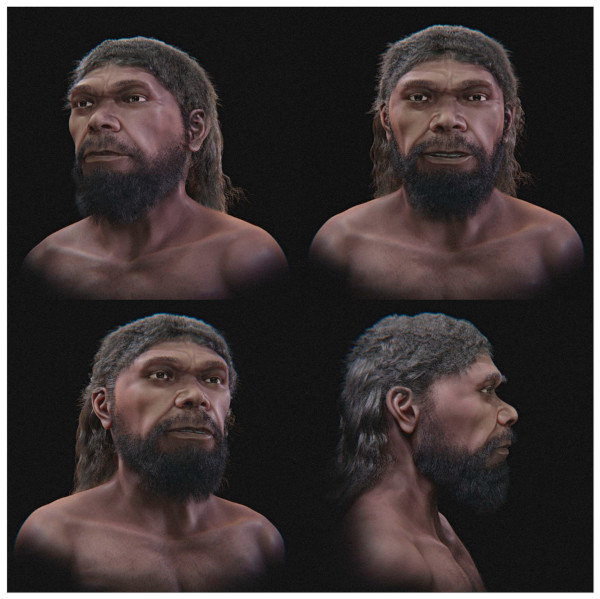
Four views of the proposed Jebel Irhoud face; whose hair, facial hair and pigmentation are artistic choices. (Moraes et al., Heritage / CC BY 4.0)
A Glimpse, Not a Portrait
While the image displays a rich palette of colors, the fossils offer no clues as to the person’s hairstyle, facial hair, or skin tone. Moreover, the flesh is studied by comparing the ancient humans to their living relatives since no soft tissue has survived. Likewise, the composite skull provides no unique detail about the anatomy of an individual inhabitant of Jebel Irhoud. Instead, according to its authors, it only serves as an approximation, as discussed in AO’s article on precision in reconstruction.
That uncertainty does not diminish the fossils. They remain a crucial marker in the African story of Homo sapiens, while other Moroccan finds show how much of the region’s ancient record is still emerging. Digital techniques are surely bringing us closer to the real look of ancient people.
Top image: Two views of the proposed Jebel Irhoud face; whose hair, facial hair and pigmentation are artistic choices. Source: Moraes et al., Heritage / CC BY 4.0.
By Gary Manners
References
Hublin, J.-J. et al. 2017. New fossils from Jebel Irhoud, Morocco and the pan-African origin of Homo sapiens. Nature 546, 289–292. Available at: https://www.nature.com/articles/nature22336
Leatham, X. 2026. The first face of mankind? Ancient human who lived 315,000 years ago is brought back to life in stunning digital reconstruction. Available at: https://www.dailymail.com/sciencetech/article-16168675/first-face-mankind-Ancient-human-reconstruction.html
Max Planck Society. 2017. The first of our kind. Available at: https://www.mpg.de/11322481/oldest-homo-sapiens-fossils-at-jebel-irhoud-morocco
Moraes, C. et al. 2026. Digital Facial Approximation of Jebel Irhoud Composite Skull (~315,000 BP ). Heritage 9(9), 369. Available at: https://www.mdpi.com/2571-9408/9/9/369
Richter, D. et al. 2017. The age of the hominin fossils from Jebel Irhoud, Morocco, and the origins of the Middle Stone Age. Nature 546, 293–296. Available at: https://www.nature.com/articles/nature22335