
A new study has called into question a long-held assumption in anthropology: that human ancestors gradually increased in size over millions of years, and in a linear manner. Researchers from the University of Reading and the University of Oxford discovered that the largest and most rapid increase in body size occurred about 2 - 2.5 million years ago with the emergence of two species, Homo erectus and Homo ergaster. This change occurred at the same time as the emergence of many significant behavioral and ecological changes, prompting a complete reevaluation of our understanding of the human family tree, as well as our perceptions of the evolution of hominins and humans as much more complex than previously understood.
For many decades, paleoanthropologists believed that hominins (the evolutionary lineages leading to modern humans) consistently grew in height and weight over evolutionary time; in other words, that there was a general evolutionary trend toward increasingly larger hominin body sizes. However, the new study by the University of Reading and the University of Oxford paints a different picture, showing that early hominin relatives, such as Australopithecus, were actually about 40 kg (88 lbs) in weight, and had heights similar to modern children. This was done by using estimates of body mass from 386 fossil specimens from across 21 different species of hominins.
"The human story is not simply one of constant growth, but also of a major change that happened later, within our own genus," explained Dr. Jacob Gardner, lead author at the University of Reading. "While other branches of the family, including some surprisingly small relatives, went their own way entirely."
A Dramatic Leap in the Genus Homo
The clearest signal in the fossil data points to a marked size increase specifically in later members of the genus Homo. Species such as Homo ergaster and Homo erectus were among the first of our relatives to regularly weigh around 60 kilograms (132 pounds) or more, achieving weights similar to many modern humans. This dramatic leap in body size around 2 million years ago aligns with other significant evolutionary shifts.
These ancestors were walking upright more efficiently, adapting to bipedalism to cover much larger distances in search of food. They were also expanding their range across different landscapes and incorporating more meat into their diets. A bigger body likely supported this more demanding lifestyle, making long-distance travel easier and facilitating a varied diet that included meat eating.
"This change coincided with broader developments in how our ancestors moved across landscapes and exploited their environments, pointing to a close relationship between body size and major ecological and behavioral transitions," noted Dr. Thomas Puschel, co-author from the University of Oxford.
- Bigger Brains Led to Bigger Bodies in Our Ancestors
- A Snapshot of Our Mysterious Ancestor Homo erectus
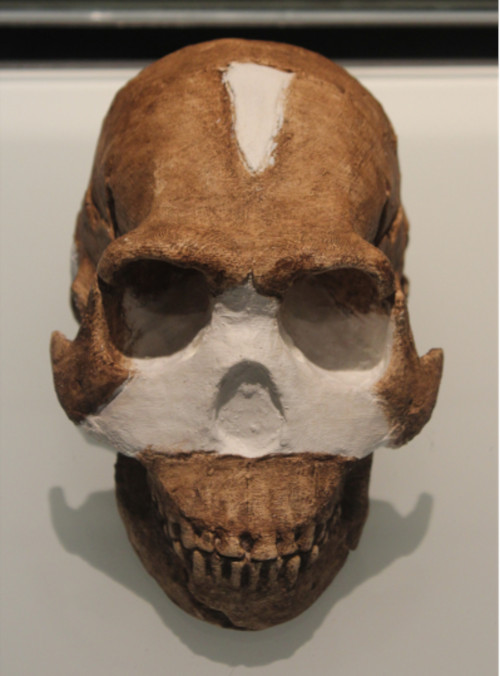
Skull of Homo naledi, one of the hominin species that remained small. (Martinvl / CC BY-SA 4.0)
The Small-Bodied Exceptions
While some branches of the human family were experiencing this growth spurt, others were following entirely different evolutionary paths. The study highlighted species that bucked the trend completely. For instance, Homo floresiensis, the famous "Hobbit" from the Indonesian island of Flores, and Homo naledi from South Africa both remained significantly smaller than the general Homo trend throughout their existence.
Even Homo habilis, one of the earliest members of our own genus, did not fit the pattern of increased body size. These exceptions demonstrate that the human family tree did not move in a single direction. The reasons why these specific species diverged from the broader trend and maintained smaller statures remain a fascinating area of ongoing research in paleoanthropology.
- Scientists Discover New Human Ancestor Species in Ethiopia
- The Feet and Hands of Homo Naledi were Similar to those of Modern Humans
Piecing Together the Fossil Puzzle
Working out how much an ancient hominin weighed from fossilized bones is a complex task. Previous studies often reached conflicting conclusions because they focused on different parts of the fossil record, such as early relatives like Australopithecus or later members of Homo. They also used various methods to estimate body mass from different skeletal elements.
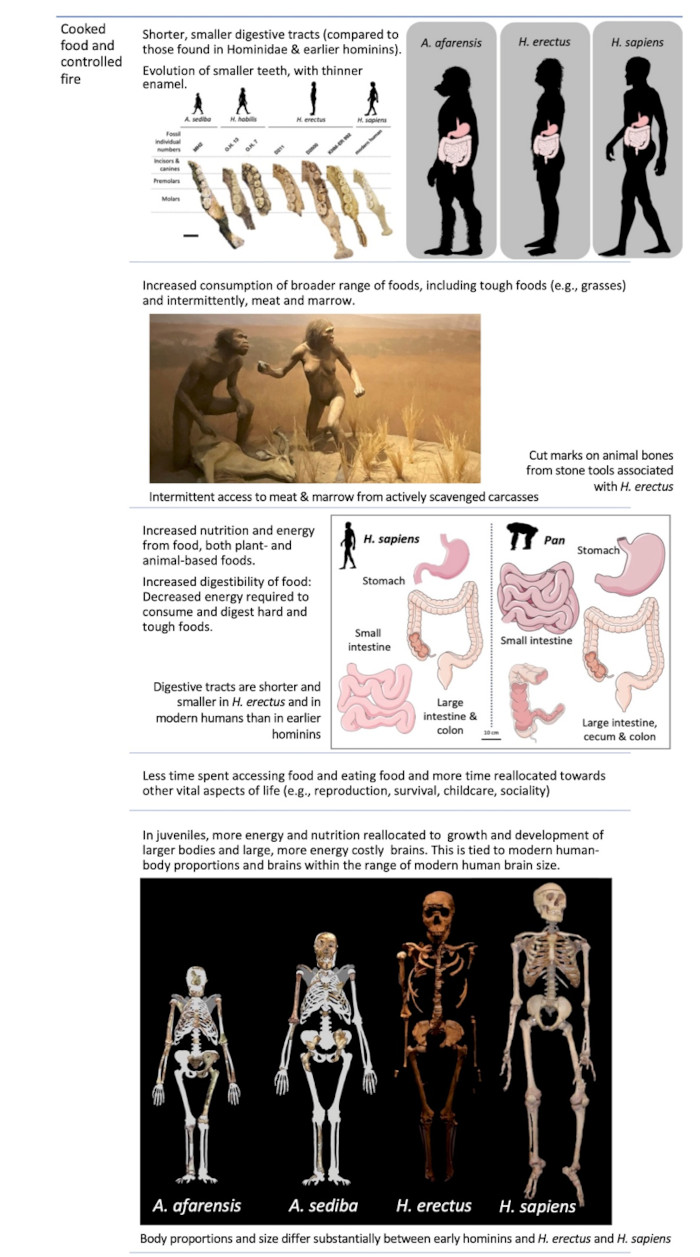
Comparison of hominin diets, brains, and bodies showing evolutionary changes. (Bioanthropologist1 / CC BY-SA 4.0)
By utilizing sophisticated statistical models that account for evolutionary relationships between species and running these models across 1,000 different evolutionary family trees, the new research was able to synthesize these disparate pieces of information. The result is a clearer, more comprehensive picture showing that earlier studies weren't necessarily disagreeing, but rather looking at different parts of a much bigger, more complicated puzzle.
The findings confirm that while there was a steady, gradual increase in body weight over time in earlier hominin relatives, the defining moment in human body size evolution was the sudden, significant leap within the genus Homo. This crucial development helped pave the way for the human migration out of Africa and the eventual global spread of our ancestors.
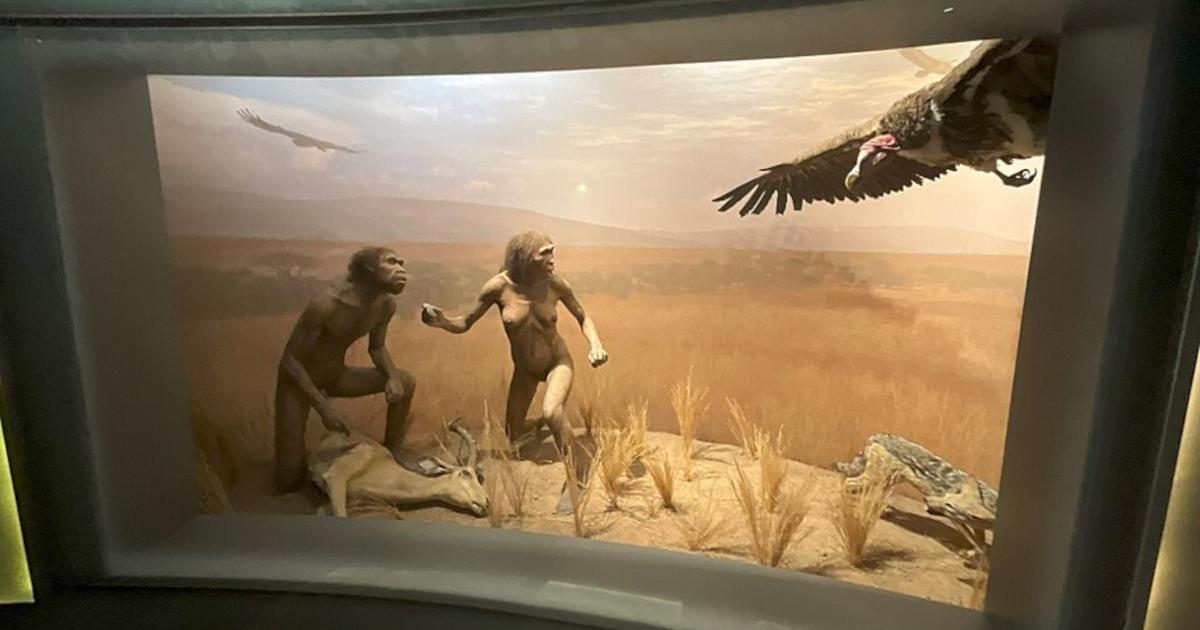
Top image: Homo ergaster Diorama at American Museum of Natural History. Source: Vicpeters / CC BY 4.0
By Gary Manners
References
Discover Magazine. 2026. Human Ancestors Suddenly Got Bigger Around 2 Million Years Ago — With Average Body Size Jumping From 88 to 132 Pounds. Available at: https://www.discovermagazine.com/human-ancestors-suddenly-got-bigger-around-2-million-years-ago-with-average-body-size-jumping-from-88-to-132-pounds-49275
Gardner, J. D. et al. 2026. Competing models of hominin body size evolution. Proceedings of the National Academy of Sciences. Available at: https://www.pnas.org/doi/10.1073/pnas.2521732123
Phys.org. 2026. New findings challenge idea that human bodies simply got bigger and bigger over time in a steady line. Available at: https://phys.org/news/2026-06-idea-human-bodies-simply-bigger.html
Sci.News. 2026. New Study Challenges Long-Held Idea that Our Ancestors Simply Grew Bigger Over Time. Available at: https://www.sci.news/othersciences/anthropology/hominin-body-size-evolution-14864.html
University of Reading. 2026. Bigger bodies were a late addition for humans. Available at: https://www.reading.ac.uk/news/2026/Research-News/Bigger-bodies-were-a-late-addition-for-humans