
One unique characteristic of human beings may have played a role in our ancestors’ ability to traverse greater distances: putting the heel down first. Researchers from Penn State University show that walking with a heel-strike allows individuals to expel less energy while moving, but generates much more severe shocks throughout the leg. This dual effect may have affected the anatomy, ecology, and evolution of early hominins.
An efficient step with a hidden price
An experiment was conducted to compare three chimpanzees to 12 healthy humans as with the results just published in the Proceedings of the National Academy of Sciences. The experiment used high-speed cameras and force plates to capture how the feet met the ground. In addition, people in the study were monitored to measure the energy expenditure during normal heel-first walking and various midfoot walking. The results showed that walking using the midfoot consumed 26.1 to 40.8 percent more energy than traditional heel-strike walking.
- The Maasai Legend Behind Ancient Hominin Footprints in Tanzania
- Ancient 'Bear' Footprints in Laetoli Tanzania Belonged to Human Ancestors
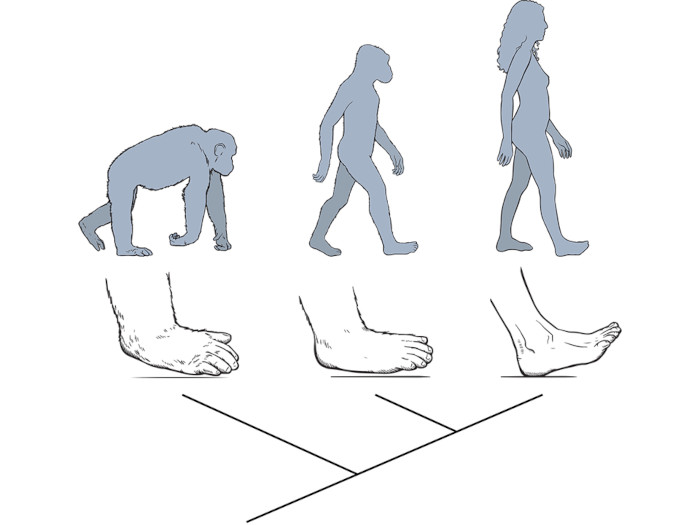
A diagram showing the foot-strike posture of a chimpanzee on all fours, an early human ancestor and a modern human. The modern human consistently lands heel-to-toe, while the chimpanzee and early human are shown landing on the side or ball of the foot. (Credit: Provided by Nicholas Holowka. All Rights Reserved. Penn State University)
Humans and chimpanzees do not land alike
The comparison challenges the assumption that the human foot landing style is just a carbon copy of that of other great apes. All measured human steps began at the heel, within a narrow range of foot angles, whereas the chimpanzees shifted between heel and midfoot contacts and varied much more from stride to stride. This variability is reminiscent of the mosaic anatomy that fossils such as the Dikika child suggest, with the latter showing how features that facilitate walking can coexist with adaptations for climbing.
Efficiency came with a jolt. In the modern-human trial, heel strikes generated impact peaks 168 to 206 percent higher and maximum loading rates 121 to 162 percent higher than midfoot strikes, even though maximum vertical force was almost unchanged. Study author Nicholas Holowka said heel landing is “a unique aspect of human walking that’s maybe been underappreciated,” adding a new detail to the long story of bipedal locomotion.
- Little Foot's Skeleton Adds To Human Evolution Story
- Scientists Study 3.5-Million-Year-Old Origins of Unique Human Spring
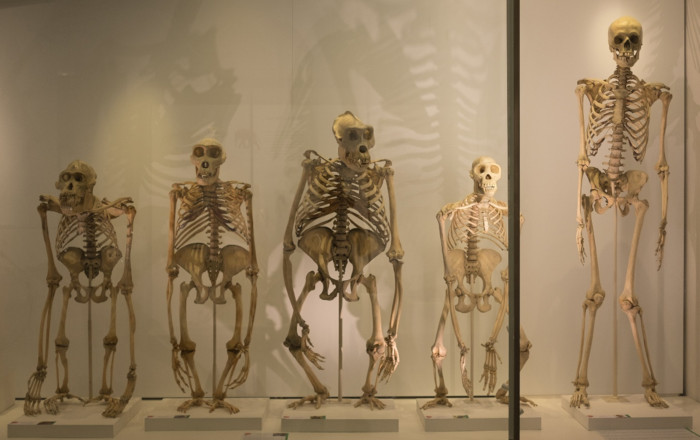
Great ape skeletons and a human skeleton at the University Museum of Zoology, Cambridge, showing striking differences in posture and proportion. (Image Source/CC BY-SA 4.0)
Why the heel changed the walking equation
A 2016 Journal of Experimental Biology study helps explain the saving. Initiating the walking motion from the heel causes the center of pressure to press even forward below the foot, thus extending the effective leg length as the body moves forward onto the toes. During experiments on 14 subjects, the researchers have related the increased effective leg length to faster and more economical walking as well, although directly measuring the energy costs of the process could not be accomplished, and so were based on estimates.
Nevertheless, it is likely that early hominins had to deal with the mechanical disadvantages of heel-strike walking. The authors of the study presented in PNAS suggest that an evolution of larger heels and stronger joints in the lower limbs occurred to withstand impacts, which eventually made heel-toe walking possible. Such an evolution might have already been observed in such species as Homo erectus, while earlier species like Australopithecus afarensis probably exhibited a transitional type of heel-toe walking.
Fossil footprints leave part of the story open
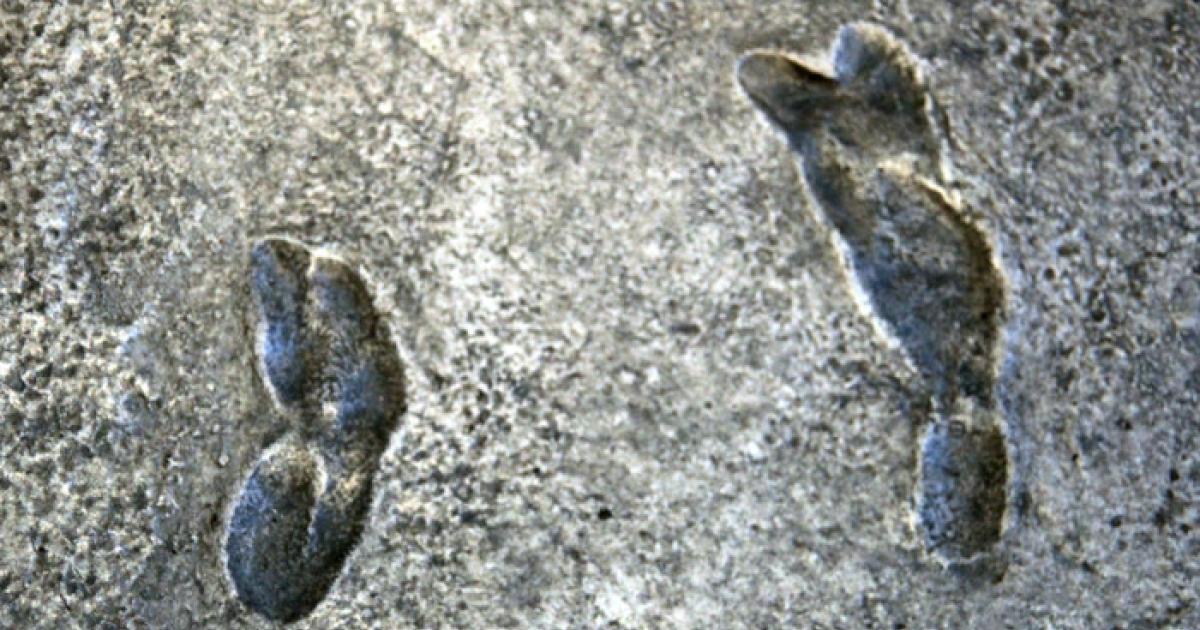
Ancient footprints show evidence that our ancestors were walking on two legs. The Laetoli footprints dating back to 3.6 million years ago show a human-like way of walking on volcanic ash, while fossils of Danuvius indicate that two-legged walking has arisen through a complicated mixture of traits. However, researchers from PNAS argue that one footprint isn’t enough to explain the precise mechanics of foot strike without more experimental validation.
Other limitations must be noted regarding the findings of the study. The main dataset has been collected from only three trained captive male chimpanzees. Furthermore, the volunteers from today had to imitate an unfamiliar biomechanical process which is different from the locomotion of an extinct animal. Even so, the study replaces a simple story of upright posture with a sharper evolutionary bargain: heel-strike walking made every kilometer cheaper, but only bodies capable of absorbing the blow could fully exploit it.
Top image: Cast of the 3.6-million-year-old Laetoli footprint trail at the Smithsonian National Museum of Natural History. The trackway is associated with Australopithecus afarensis. Source/CC BY-SA 2.0
By Gary Manners
References
Holowka, N. B., O’Neill, M. C., Bhandal, V., Lam, O., Apolito, Z. M., Massimi, C. A., Palmisano, K. G., Worthington, S., Demes, B. and Thompson, N. E. 2026. Heel-strike mechanics reveal evolutionary trade-offs in hominin bipedalism. Proceedings of the National Academy of Sciences, 123(37), e2533918123. Available at: https://doi.org/10.1073/pnas.2533918123
Penn State. 2026. ‘Heel-strike’ allowed early humans to walk farther at cost of high impact forces. Available at: https://www.psu.edu/news/research/story/heel-strike-allowed-early-humans-walk-farther-cost-high-impact-forces
Webber, J. T. and Raichlen, D. A. 2016. The role of plantigrady and heel-strike in the mechanics and energetics of human walking with implications for the evolution of the human foot. Journal of Experimental Biology, 219(23 ), 3729–3737. Available at: https://doi.org/10.1242/jeb.145359