A fossil that had long been housed in the British Museum collections has been recognized as that of the world's largest true scorpion. The fossilized remains belong to a creature called Praearcturus gigas, defined as a creature that could reach a length of about a meter (3.3 feet) with pincers measuring more than 16 centimeters (6.3 inches). It lived about 415 million years ago, i.e. at a time when complex, multicellular life forms were only starting to evolve in land environments. The finding adds a formidable new predator to the story of scorpions among the first animals to venture onto land.
A Museum Puzzle Finally Solved
The open-access Palaeontology paper reassesses fragmentary specimens from the St Maughan's Formation in England and Wales by integrating fossils from many collections and studying them using detailed photography, drawings and CT imaging. Praearcturus, previously described as a giant isopod, was revised as it was compared to various other arthropod groups, and its identity remained disputed even after a scorpion interpretation was proposed in the 1980s. The current study combines fossils originally considered to come from three separate organisms and reveals additional characteristics associated with scorpions, including how its claw fingers are arranged and how long and grooved its sternum region is. This type of reinterpretation has changed how researchers view many other exceptionally preserved ancient arthropods.
- The Cosmic Scorpion Evident in Ancient Cultures
- ‘Scorpion King’s Domain’: The Oldest Place Name Sign in the World
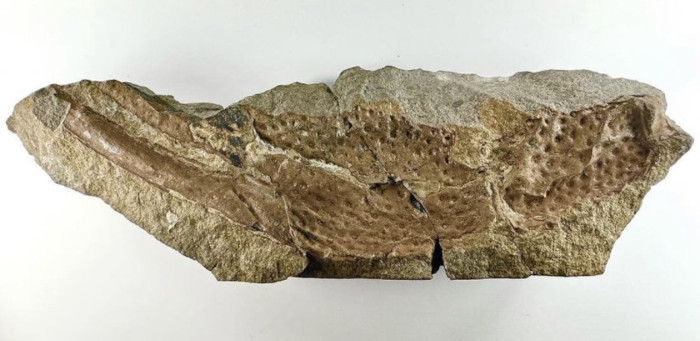
A fossil pincer assigned to Praearcturus gigas, with a claw comparable in size to an entire large living scorpion. (The Trustees of the Natural History Museum / University of Manchester)
A clear comparative example is Eramoscorpius brucensis, which is a Silurian scorpion from Canada that was described in 2015. Both species exhibit long triangular sternums with a middle groove and the fossil claws of Praearcturus also show the same claw configuration as present in modern scorpions.
Lead author of the study, Dr. Richard J. Howard, said that being able to confirm this species “fundamentally changes our understanding of how and when these creatures evolved to such extraordinary sizes,” recorded a University of Manchester announcement,
However, because no complete specimens exist, the length of the animal being reconstructed to a length of approximately one meter is still only an informed estimate, based upon the dimensions of other fossilized parts compared to current-day species of scorpions that are more familiar and well studied.
- Joggins Fossil Cliffs: Uniquely Preserved Fossils and Primeval Forest
- Ancient Origins: Reptiles Appeared 40 Million Years Earlier, Show Australian Fossils
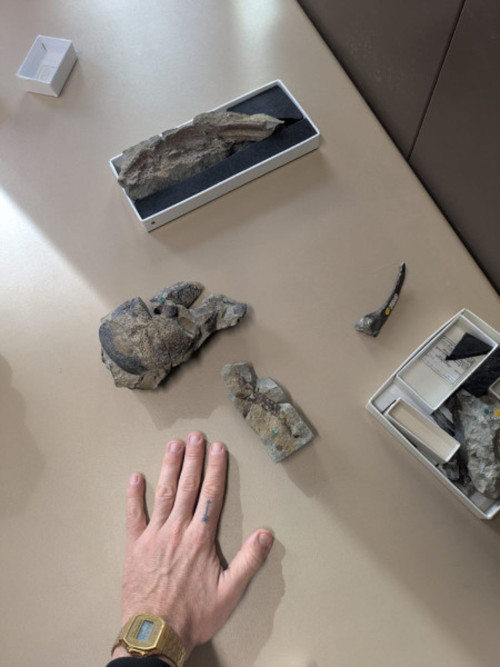
Fragmentary fossil remains helped researchers reconstruct the giant Devonian scorpion. (The Trustees of the Natural History Museum / University of Manchester)
A Giant Before the Forests
In the Early Devonian, nearly 50 million years earlier than the enormous Carboniferous arthropods, scorpions lived in the rivers and floodplains. The Devonian period had very few large plants or animals. The first forest fossils date back millions of years after the Devonian, so it is impossible to explain the enormous size of giant fossil scorpions by comparing the Devonian coal swamps to more recent coal swamps like that of the Joggins Fossil Cliffs.
The researchers theorize that the early scorpion lineage had little competition for food and was able to dominate an open niche in the environment, while an amphibious way of life allowed it to eat aquatic prey and stay physically supported by the water around it.
Between River and Land
Praearcturus may not have been an organism that only lived on land. The fossils were located in river deposits, and they feature wing-like abnormalities along the belly similar to those found in some aquatic arthropods. Water could have helped this heavy body and provided large food sources like fish or other available prey. So the authors propose that this animal was an amphibious or aquatic predator and possibly indicates a connection to scorpions that returned to water after their ancestors progressed to life on land.
The Natural History Museum’s account notes that additional fossils will be needed to clarify how the animal lived and when it disappeared. A Smithsonian report also advises caution because the known specimens remain incomplete.
Even so, the giant scorpion fossil shows how forgotten museum drawers can still overturn long-standing ideas about ancient life, especially when new imaging methods are applied to specimens collected before modern palaeontology existed. It also reveals that enormous predators were testing the boundary between water and land long before the rise of forests, reptiles and the complex terrestrial food webs that followed.
Top image: Life reconstruction of Praearcturus gigas, the largest known true scorpion. Source: Franz Anthony / University of Manchester
By Gary Manners
References
Ashworth, J. 3 June 2026. World’s largest scorpion revealed by 415-million-year-old fossils. Available at: https://www.nhm.ac.uk/discover/news/2026/june/worlds-largest-scorpion-revealed-415-million-year-old-fossils.html
Howard, R. J., Garwood, R. J., Edgecombe, G. D. and Legg, D. A. 2 June 2026. A revision of Praearcturus gigas: a giant scorpion from the Lower Devonian (Lochkovian ) of Britain. Palaeontology. John Wiley & Sons Ltd. Available at: https://doi.org/10.1111/pala.70064
Stark-Elster, E. 1 July 2026. After Decades of Debate, Scientists Say These Fossils Belong to the Largest Known Scorpion, Which Lived 415 Million Years Ago. Available at: https://www.smithsonianmag.com/smart-news/after-decades-of-debate-scientists-say-these-fossils-belong-to-the-largest-known-scorpion-which-lived-415-million-years-ago-180989022/
University of Manchester. 3 June 2026. World’s largest scorpion revealed from 415-million-year-old fossils. Available at: https://www.manchester.ac.uk/about/news/worlds-largest-scorpion-revealed-from-415-million-year-old-fossils/