Two long-forgotten relatives of humans are still present in our genes, revealing a much richer evolutionary history than previously known. The discovery strengthens the idea that human evolution is a long process of mating and interacting with other hominins that are close to humans.
Scientists have previously found signs that Homo sapiens mated not only with Neanderthals and Denisovans, but also with other early humans. Now researchers from the University of California Berkeley have found the particular genes of mysterious ancestors in human DNA and the time when the mating occurred. The team made the discovery using a new method that examines hundreds of present-day human genomes and reconstructs ancient genealogical connections among their DNA sequences.
A Ghost Ancestor Shared by All Humans
One of the unknown groups, described by the researchers as a ghost ancestor, interbred with modern humans in Africa more than 50,000 years ago. This mating occurred before the last migration of Homo sapiens from Africa to Europe and Asia. DNA inherited from the 'ghost' comprise about 1% of modern humans' genes, the same share of genes as Homo sapiens share with Neanderthals.
The ghost lineage separated from the ancestors of modern humans around 800,000 years ago, close to the time when Neanderthals and Denisovans also split from one another. However, the ghost population exchanged genes with modern humans at an earlier point than the Neanderthal and Denisovan encounters outside Africa.
- Neanderthal Desire For Homo Sapiens Revealed in DNA
- Super Archaic Humans Mixed with Unknown 'Ghost' Species
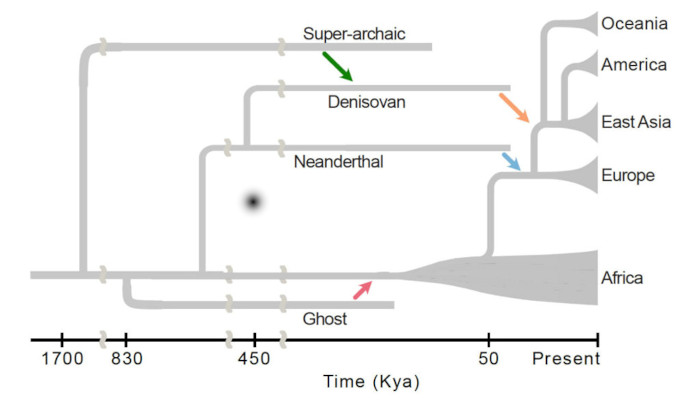
A timeline showing four separate instances (colored arrows) of archaic hominins interbreeding with early Homo sapiens. The dates were inferred from a genealogical analysis of present-day human genomes using TRACE, a technique developed at UC Berkeley. (Yulin Zhang and Priya Moorjani/UC Berkeley)
"Previous publications suggested that there might be ghost ancestry - ancestry from unknown archaic lineages in modern humans - but they hadn't concluded whether this unknown ancestry is present only in Africans or not, and when this introgression event happened," said Berkeley graduate student Yulin Zhang, one of two first authors of the study published in Science.
"We were actually able to find and map genomic locations in modern humans that are from this ghost lineage and show that this ghost ancestry is in all modern humans, not only in Africans."
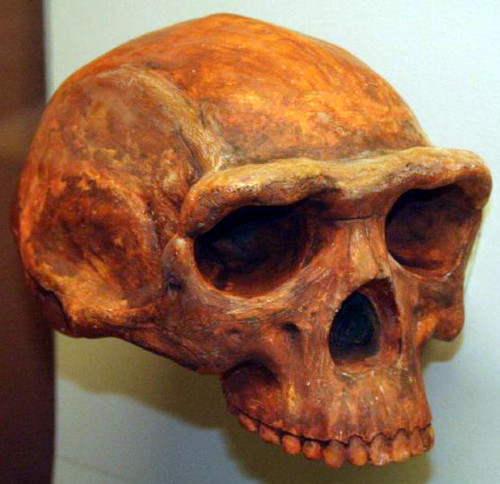
Homo erectus skull on display at the Natural History Museum in London. (Emőke Dénes / CC BY-SA 4.0)
DNA From a Million-Year-Old Lineage
The researchers also detected genetic material from an even more ancient population, which they call a super-archaic ancestor. This hominin descended from a lineage dating back about 1.8 million years and appears to have interbred with Denisovans in Eurasia, probably more than 200,000 years ago.
Denisovans later mixed with Homo sapiens, allowing a small portion of that super-archaic DNA to enter the genomes of modern humans.
"The super-archaic finding is particularly exciting because it reveals genetic contributions from a human lineage that lived over a million years ago, despite the absence of any sequenced DNA from that population," said Arjun Biddanda, a postdoctoral researcher at Johns Hopkins University and a co-first author of the study.
Together, the findings suggest that early Homo sapiens lived alongside numerous related human groups in Africa and Eurasia during the past million years. These populations were genetically similar enough to have children together, leaving behind lasting biological traces.
- Study Shows Mysterious Denisovans Interbred with Modern Humans
- First Ice Age May Have Led to Epic Hominin Migration
"With ancient DNA from Neanderthals and Denisovans and with these new genealogical methods, we are learning that mixture among human populations has been very pervasive across time, and that this is also likely to be true at ancient time scales," said Priya Moorjani, a Berkeley associate professor of molecular and cell biology.
"We often think of human evolution as a branching tree, but new genomic data and analytical methods reveal a much more interconnected history - more like a complex web of populations connected by repeated episodes of migration and mixing."
Scientists still do not know the identities of the ghost and super-archaic populations. However, the estimated dates when they separated from other human lineages overlap with Middle Pleistocene Homo groups living in Africa around 800,000 years ago and Homo erectus populations living in Eurasia around 1.8 million years ago, respectively.
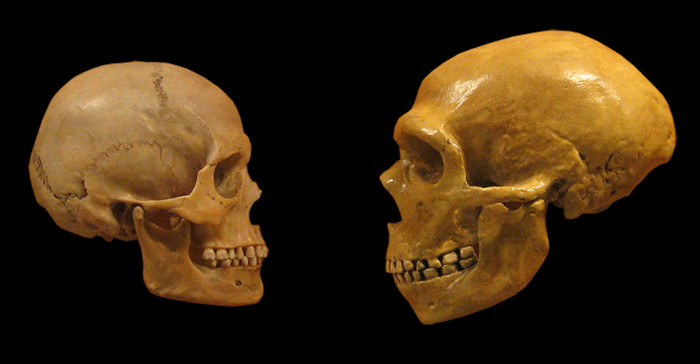
Comparison of Modern Human and Neanderthal skulls. (hairymuseummatt, DrMikeBaxter / CC BY-SA 2.0)
Tracing Archaic DNA Without Fossils
Around 50,000 years ago, early modern humans migrated from Africa and in the process encountered Denisovans and Neanderthals, leading to the interbreeding of these groups. Although the Denisovans and Neanderthals went extinct later on, they left some of the traces of their DNA in the genomes of modern humans.
Researchers uncovered that by collecting and sequencing the residue-preserved DNA of Neanderthals and Denisovans that has been preserved in fossils of these groups. However, modern human genomes also reflect interbreeding episodes that went way back.
Those signals were difficult to investigate because scientists do not have sequenced DNA from most other extinct hominins. To overcome that, Moorjani and the team have developed a technique TRACE – TRacking Archaic Contributions via ARG Estimation. The technique looks for archaic sequences from the genomes of modern humans, not ancient remains.
The researchers examined genomes from individuals around the world and reconstructed the relationships among DNA segments over many generations. This reconstruction, known as an ancestral recombination graph (ARG), produces a detailed picture of how different parts of the genome are connected through shared ancestry.
"Genealogies preserve a record of our evolutionary past," said Moorjani. "TRACE reconstructs those histories across the genome. By identifying regions whose ancestry extends unusually far back in time, we can uncover genetic contributions from extinct human populations, even in the absence of ancient DNA."
Ancient Signals Hidden in Modern Genomes
Some of the oldest genetic regions identified by TRACE matched DNA from a sequenced Neanderthal genome. Neanderthal ancestry accounts for about 1% of the human genome.
The method also successfully identified known Denisovan DNA when the team focused on genomes from Asia and Oceania, where some populations carry substantial Denisovan ancestry.
Many other ancient regions, however, matched neither Neanderthals nor Denisovans. The researchers concluded that these sections came from two separate archaic lineages that interbred with other groups at different times.
The ghost ancestry appeared in both African and non-African populations. That widespread distribution indicates that the interbreeding happened before Homo sapiens made their final major migration out of Africa and expanded around the planet.
"We discovered that about 2% of the modern human genome is from archaic hominins," Zhang said. "In the case of the ghost lineage, modern-day Africans and non-African populations both inherited similar amounts of ghost ancestry. Each individual has about 0.5 to 1% of their genome inherited from this ghost lineage."
Top image: Two mysterious human relatives left their genetic footprints in the modern human genome alongside the DNA of Neanderthals and Denisovans. Source: Yulin Zhang and Priya Moorjani/UC Berkeley
By Gary Manners
References
Sanders, R. 2026. New technique pinpoints human DNA inherited from ‘ghost’ ancestors. Berkeley News. Available at: https://news.berkeley.edu/2026/07/30/new-technique-pinpoints-human-dna-inherited-from-ghost-ancestors/
Zhang, Y., et al. 2026. Recovering signatures of archaic hominin introgression using ancestral recombination graphs. Science. Available at: https://www.science.org/doi/10.1126/science.aef8874