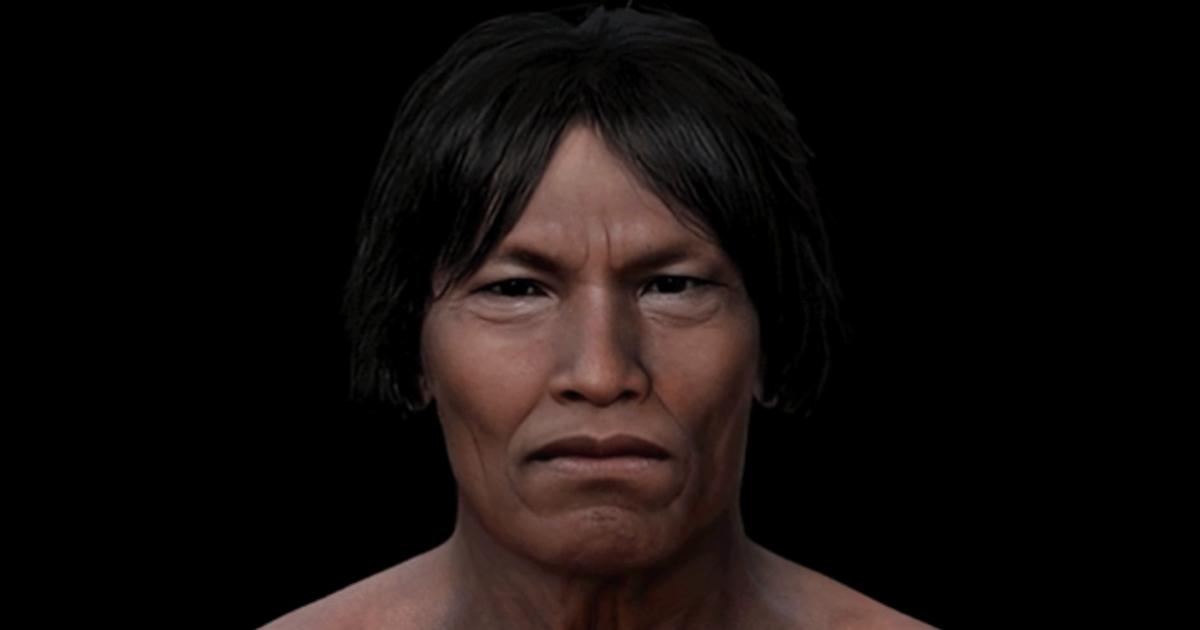

A man who died in the Ecuadorian Andes more than 3,000 years ago has a face again. An international team has completed a digital facial reconstruction of the Punín-2 skull, a hunter-gatherer from what is now Ecuador's Chimborazo region, and the portrait has been shown to the people most likely to be his descendants. The work closes a century-old argument about a skull that some scientists once thought came from another continent — and his living relatives approved.

Laguna de Colta in Chimborazo province, close to the parish of Punín where the Punín-1 and Punín-2 skulls were recovered (David Ceballos/CC BY-SA 2.0)
A Skull at the Heart of a Century-Old Argument
The Punín-2 skull was recovered in 1974 from a ravine near Punín, a rural parish in Chimborazo province, according to the Universidad Nacional de Chimborazo. It was not the first find there. In 1923 an expedition from the American Museum of Natural History in New York recovered a similar skull, Punín-1, from the same ravine, as Live Science reports.
Some researchers of that era judged the first skull's heavy brow archaic, and in 1925 the anatomists Louis Sullivan and Milo Hellman published their study of the Punín calvarium. The suggestion that followed was that the skull indicated Oceanic ancestry, hinting at ancient contact with people from Australia or the Pacific islands. Because the sediment holding it appeared to predate modern humans, others wondered whether the bones belonged to an extinct relative such as Homo erectus or the Neanderthals. Later geological studies dismantled that reading, and the new facial reconstruction confirms a modern human of purely Native American ancestry, descended from North Siberians and East Asians who reached the continent during the last ice age.
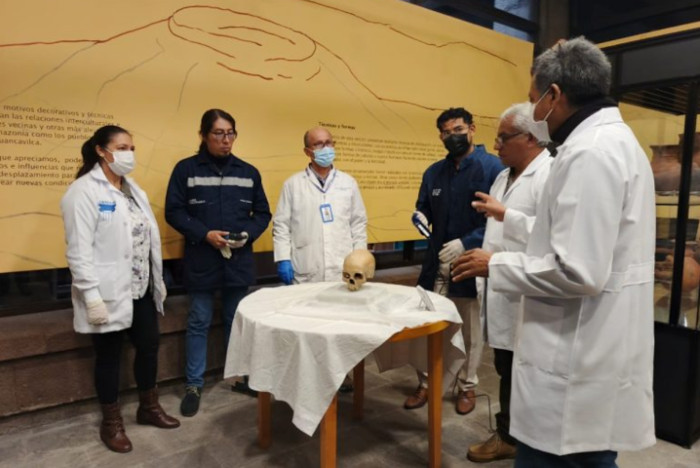
Launch of the project investigating Punin 2 at Universidad Nacional de Chimborazo (UNACH) (Cultural Heritage Ecuador)
Building a Face from Bone Alone
Christopher Rynn, an independent forensic craniofacial anthropologist in the United Kingdom, deliberately learned as little as possible about the skull's origins so the face would be shaped by bone rather than expectation. He worked with Héctor Flores-Franco of the Universidad Nacional de Chimborazo, using the Manchester Method — techniques developed at the University of Manchester in the 1970s that combine digital modelling with partial wax reconstruction and data on soft-tissue thickness. It is the same approach behind many remarkable reconstructions of ancient hominids.
The man was about 50 when he died, with an elongated cranium and an estimated brain capacity of roughly 1,455 cubic centimeters. A bone fragment found with the skull gave a radiocarbon date of about 3,190 years before the present, though the university cautions that the test was not run directly on the skull. Rynn told Live Science that the skull's mixed signals are what make it interesting.
"Punín-2 resembles an East Asian skull from the front, but not at all from the side," he said — a reminder of how variable skull shape can be between populations.
- Reconstructing Ancient Faces: Art Meets Science
- Forensic Facial Reconstruction: The Journey to Connect with our Ancestors
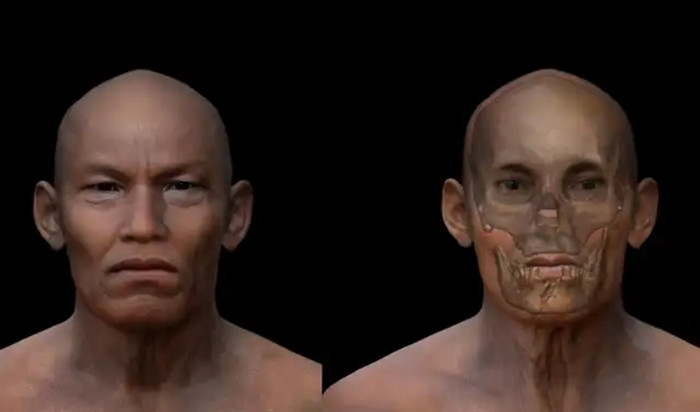
The digital facial reconstruction of the Punín-2 skull shows an Indigenous American man of about 50 who died more than 3,000 years ago (Dr Chris Rynn).
The Hairstyle Was Chosen by His Descendants
Bone cannot reveal skin color, hair color or how a man wore his hair, so the team turned to local evidence. The hairstyle and hair color used in the reconstruction were modelled on ceramics from the Regional Development period of the Chimborazo area, the university says. Rynn also asked people living in the region today — likely descendants of the man himself — for guidance, and their advice changed the face. "The hairstyle is very specific," he said. "If it's wrong, it looks like a different tribe."
Early versions gave the man slightly protruding eyes, more typical of East Asian skulls, and local input led Rynn to set them deeper, producing a face that reads as distinctly Indigenous American. "It's a portrait of their actual ancestor," he said of sharing the result. "They seem to like it!" A physical bust, finished with real hair, is due to be completed at the university in early 2027.
- Earliest Modern Human Face Reconstruction from 315,000-Year-Old Fossils
- Reconstruction Reveals True Face of 9,000-Year-Old Jericho Skull
What Ancient DNA Could Reveal Next
The digital face is only a beginning. Rynn and his colleagues are raising funds to reconstruct the Punín-1 skull, held at the American Museum of Natural History in New York, and to attempt ancient DNA analysis of both individuals. "DNA will tell us the true genetic lineage," Rynn said. The ravine has a complicated history of its own: it also produced Pleistocene fossils of mastodons, ancient horses and giant ground sloths, and erosion seems to have mixed those far older bones with much younger human remains.
For Ecuador, the project is as much about the present as the past. The country's National Institute of Cultural Heritage, which gave technical support for 3D scanning of the skull, describes the work as a way of strengthening cultural identity — an aim that echoes how communities elsewhere in the Andes have long cared for and claimed their ancient dead. Ecuador's archaeology keeps producing surprises of its own, from lost pre-Hispanic landscapes hidden beneath jungle canopy to the country's first recorded rock paintings. A man known for half a century only as a difficult skull is now being reintroduced to his descendants as an ancestor.
Top image: The face of a man who lived 5,000 years ago in Chimborazo region, Ecuador. Source: UNACH
By Gary Manners
References
Archaeology Magazine. 2026. Face of Ancient Andean Man Reconstructed. Available at: https://archaeology.org/news/2026/10/05/face-of-ancient-andean-man-reconstructed/
El Telégrafo. 2026. UNACH reconstruye el rostro de Punín 2, un hombre que vivió hace 3.000 años en Ecuador. Available at: https://www.eltelegrafo.com.ec/noticias/nacionales/210/unach-reconstruye-rostro-punin-2-hombre-vivio-hace-3000-anos-ecuador
Instituto Nacional de Patrimonio Cultural. 2025. Inició la reconstrucción facial del cráneo de Punín 2. Available at: https://www.patrimoniocultural.gob.ec/inicio-la-reconstruccion-facial-del-craneo-de-punin-2/
Metcalfe, T. 2026. 'It's a portrait of their actual ancestor': Facial reconstruction of Indigenous man who lived in Ecuador 3,000 years ago shared with his descendants. Live Science. Available at: https://www.livescience.com/archaeology/americas/its-a-portrait-of-their-actual-ancestor-facial-reconstruction-of-indigenous-man-who-lived-in-ecuador-3-000-years-ago-shared-with-his-descendants
Sullivan, L. R. and Hellman, M. 1925. The Punin Calvarium. Anthropological Papers of the American Museum of Natural History, Vol. 23, Pt. 7. American Museum of Natural History. Available at: https://digitallibrary.amnh.org/items/9bd81b8e-b0e5-4562-aa6c-0f325d2aa34f