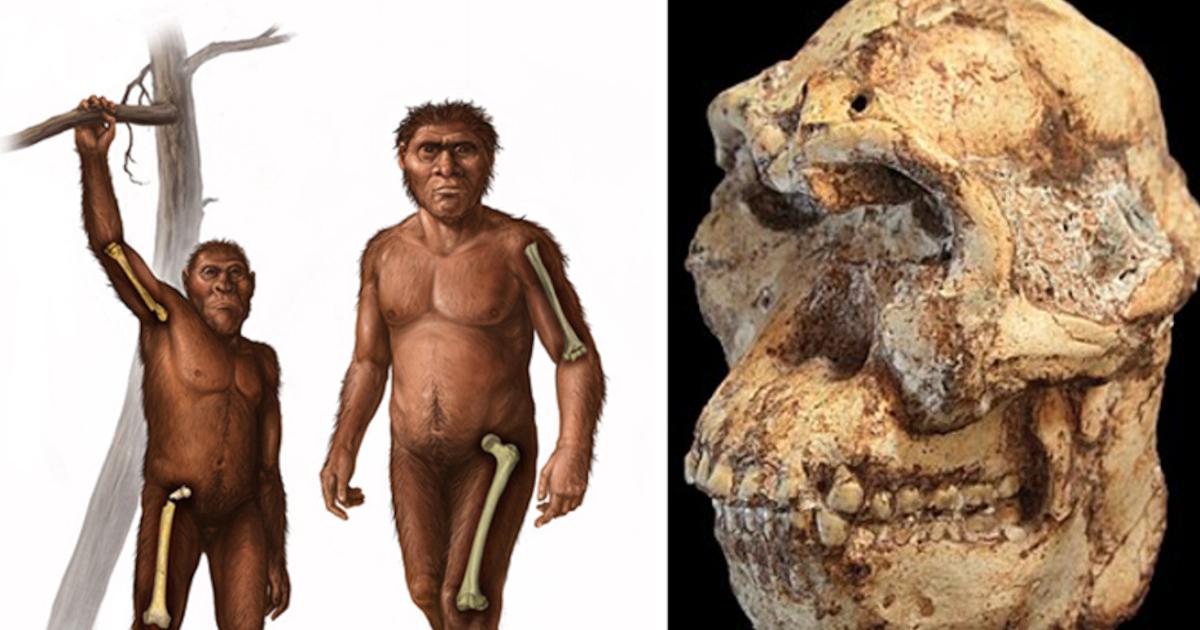

The result adds a new line of evidence to a long-running question in human evolution: not simply when our ancestors first walked on two legs, but when climbing stopped being a central part of their everyday lives. It also places a major change in locomotion close to the period when body size, brain size and ranging behavior were all expanding.
The finding adds a new line of evidence regarding one of the long-lasting human evolution questions concerning not only the appearance of bipedalism but also a more comprehensive understanding of the absence of climbing in everyday life of our human ancestors.
Bone strength preserves a record of movement
According to the study published in Science Advances, the researchers used computed tomography scans and also cross-sectional measurements of fossil limb bones in their research. Bones remodel their shafts in response to forces acting on them during their lifetime. Thus, their strength can offer insights into the habitual loads during their lifetime that cannot always be deduced from just their shape. In living apes, stronger forelimbs are correlated with more frequent climbing, while in humans, higher mechanical loads are exerted on the lower limbs as a result of upright bipedalism.
The research team utilized previously discovered fossil remains belonging to seven different hominin species, which included the famous Little Foot – the 3.67 million old skeleton discovered at Sterkfontein Cave in South Africa, and a rather large specimen of early Homo from Dmanisi in the Republic of Georgia which is believed to be at least 1.8 million years old. They also included fossils attributed to Australopithecus afarensis, Homo habilis or a closely related australopith, and Homo erectus, testing a pattern across several individuals rather than relying on one skeleton.
- “Downclimbing” is the Overlooked Key to Human Evolution, Says Study
- Human Ancestors Were Already Bipeds 7-Million Years Ago
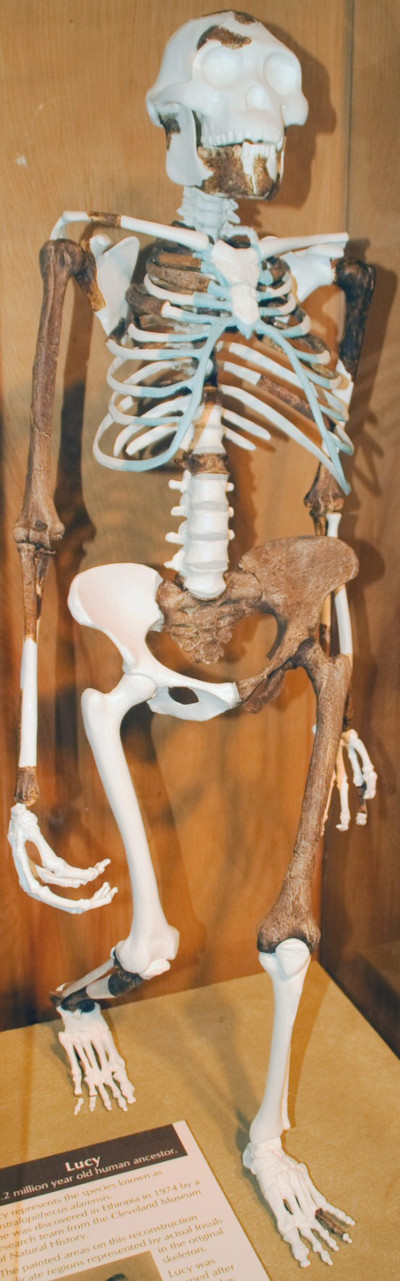
Lucy’s skeleton with long arms and short legs shows why early human locomotion is often described as a mosaic of walking and climbing. (Chiswick Chap / CC BY-SA 3.0)
Little Foot points to a mixed lifestyle
The results obtained from the study of Little Foot were astonishing. The relationship between arm strength and thigh strength in Little Foot was found to be similar to that of African apes, which indicates that climbing activities were still practiced by Little Foot although lower-limb proportions were more human-like. In other words, Australopithecus appears to have walked upright on the ground while retaining a powerful arboreal component (a combination also discussed in Evidence Suggests Human Ancestor Walked Upright In Trees).
Lead author Kristian Carlson described the finding in a summary from the Keck School of Medicine of USC:
“Australopithecus combined an ape-like upper limb strength with a human-like pattern in the legs, suggesting they had a unique movement strategy that has no modern comparison.”
This is significant because it invalidates a simplified scenario whereby the act of walking replaced climbing in a straightforward way. Early hominids were trying both options concurrently.
- A Snapshot of Our Mysterious Ancestor Homo erectus
- Earliest Homo Looked Nothing Like A Human, Skeleton Suggests
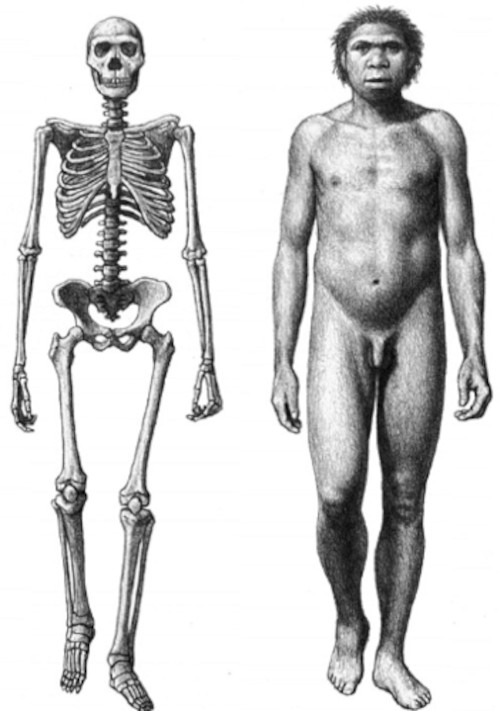
Turkana boy, example of a Homo erectus skeleton, a later example of the more ground-adapted human body plan. (Mauricio Antón, published with Alan Turner/CC BY 4.0)
Early Homo shows a threshold change
The early Homo sample found in Dmanisi presented different evidence. Its limb-strength proportions were within the range observed in modern humans in both the arm-versus-thigh comparison and the thigh-versus-shin comparison, indicating the dominance of lower limbs as a mechanical system. The writers explain that the same human type of phenomenon is also true from later Homo erectus fossils obtained from Africa.
The conclusion is not that every early Homo individual could not climb a tree. Rather, climbing had ceased to be a regular, evolutionarily important part of the genus’s locomotor repertoire by approximately 1.8 million years ago. The time frame is consistent with the modern body plan described by the Smithsonian Human Origins Program, particularly in the context of long legs and short arms adapted to living on land.
Walking farther, changing more
What caused the change is still unknown. The researchers postulate that increased scouting range, new foraging demands and more open habitats could have allowed for a development of stronger hind limbs and the capacity for more effective uptake in land locomotion. The change correlates with a general growth trend for the size of the brain, although timing alone does not imply that one development caused the other.
The new research adds to the discussion rather than putting it to bed. According to Smithsonian’s Walking Upright overview, archaic man walked in a way that combines human and ape-like features for millions of years, while the fossil record shows that as early as 1.8 million years ago, early Homo crossed a line in their behavioral evolution in which the ground was no longer just one of the available options but became the focus of their daily routine.
Top image: Left; Depiction of an early Homo (right) characterized by relatively greater bone strength of the femur in the thigh compared to the humerus in the arm, and a depiction of an older human ancestor, Australopithecus (left), characterized by more equivalent strength in the bones of the arm and thigh. Image credit: Cullen Townsend/WITS). Right; Littlefoot skull fossil. (Wits University/CC BY 4.0)
By Gary Manners
References
Abrams, Z. 2026. Study of bone strength reveals new clues about human evolution. Keck School of Medicine of USC. Available at:https://keck.usc.edu/news/study-of-bone-strength-reveals-new-clues-about-human-evolution/
Carlson, K. J. et al. 2026. Proportional limb strengths signal an adaptive shift in arboreality in early human evolution. Science Advances. Available at: https://www.science.org/doi/10.1126/sciadv.aeh1752
Clark, G. and Egan, R. 2026. Bone strength study reveals new clues about human evolution. Available at: https://phys.org/news/2026-09-bone-strength-reveals-clues-human.html
Sci.News. 2026. Fossil Evidence Suggests Early Homo Had Abandoned Tree-Climbing by 1.8 Million Years Ago. Available at: https://www.sci.news/othersciences/anthropology/australopithecus-homo-arboreality-15073.html
Smithsonian Institution. 2024. Homo erectus. Available at: https://humanorigins.si.edu/evidence/human-fossils/species/homo-erectus
Smithsonian Institution. 2024. Walking Upright. Available at: https://humanorigins.si.edu/human-characteristics/walking-upright
Wits University. 2026. Little Foot study points to major shift in how human ancestors moved. Wits University Available at: https://www.wits.ac.za/news/latest-news/research-news/2026/2026-09/little-foot-study-points-to-major-shift-in-how-human-ancestors-moved.html