
For three decades it lay in a museum drawer, an unremarkable piece of fossilized skull from a South African cave. It has now been identified as the oldest adult Homo erectus specimen found in Africa. Catalogued as DNH 127, the fragment dates to between 2.04 and 1.95 million years ago, roughly 200,000 years older than the adult Homo erectus remains from Dmanisi in Georgia. The study behind the announcement, published in Annals of Human Biology, shows that our early ancestors shared that landscape with a rival cousin who outnumbered them ten to one.
- Paranthropus Skull Find Suggests Distant Human Cousins Evolved Quickly
- Paranthropus – Our Most Mysterious Extinct Cousins (Video)

Map of the Cradle of Humankind in Gauteng, South Africa, showing the fossil sites that make the region one of the richest windows on human evolution. (Pavia et al. / CC BY 4.0)
Thirty Years of Unread Fossils in the Cradle of Humankind
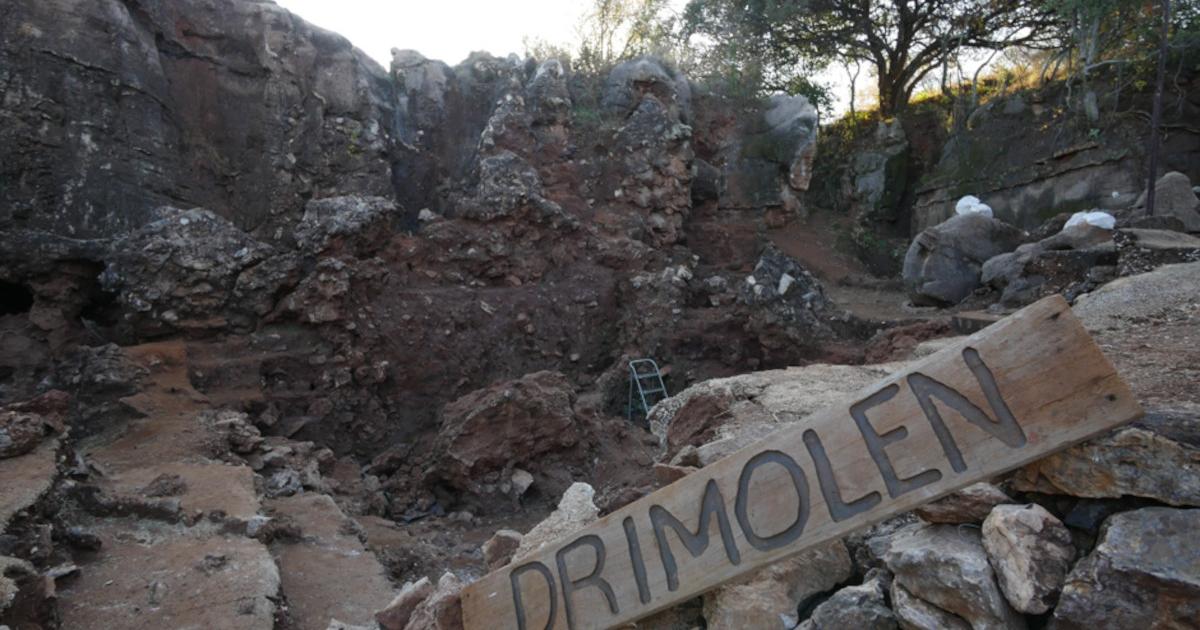
Drimolen Main Quarry lies inside South Africa's Cradle of Humankind, a belt of dolomite caves northwest of Johannesburg that has produced some of the world's richest collections of early human relatives. Digging began there in 1992 under the palaeontologist Andre Keyser, and by the time the last major season closed in 2019 the site had given up a dense pile of hominin remains. A surprising number had never been properly studied.
A team led by Dr Jesse Martin of La Trobe University, with colleagues from Johannesburg, the Witwatersrand and Washington University, has now described 18 cranial and mandibular specimens from those excavations. Fourteen belong to Paranthropus robustus, three are too fragmentary to assign to a species, and one is Homo erectus, as the original news report noted.
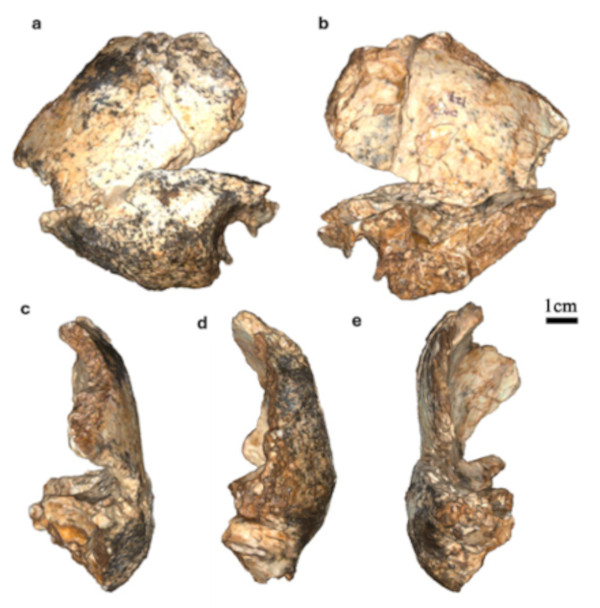
Homo erectus fossil DnH 127: a. DnH 127 lateral view; b. DnH 127 medial/internal view; c. DnH 127 posterior view; d. DnH 127 inferiorview; e. DnH 127 anterior view. (Annals of Human Biology)
Two Cousins, Two Very Different Futures
The Drimolen haul also gives an unusually detailed portrait of Paranthropus robustus, the heavy-jawed relative that dominated the landscape while Homo erectus was still getting established. Set against fossils from Swartkrans and Kromdraai, the Drimolen material shows the species changing over roughly 200,000 years: teeth grew larger, and so did the muscles that drove chewing.
"These two human species shared the same landscape and are both preserved in Drimolen cave," Dr Martin said in a La Trobe University announcement. "While we know that Homo erectus and the lineage leading to us was ultimately the successful one, 2 million years ago P. robustus outnumbered Homo erectus at Drimolen by more than 10 to one. During this time period it was our ancestors that looked like the outside long-odds chance to survive."
While Homo erectus built a larger brain and shed its big molars, P. robustus kept a brain only slightly bigger than a chimpanzee's and pushed its chewing apparatus further in the other direction, evolving what Dr Martin compared to a mortar and pestle for processing tough and hard foods. The team also backs the sub-species name Paranthropus robustus ukusa for the Drimolen population, a group already at the centre of fresh thinking about "nutcracker" teeth.
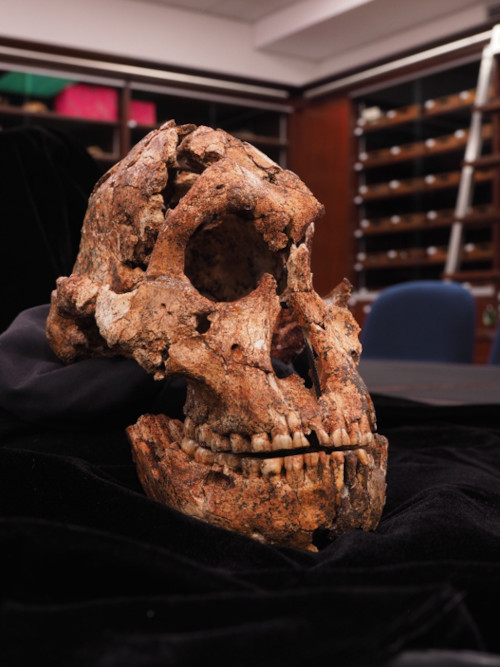
DNH 7, the most complete skull of Paranthropus robustus ever discovered and a rare female specimen from Drimolen Main Quarry. (Dr Herries / CC BY-SA 4.0)
Why the Missing Adults Mattered
The find fills a gap that had been open for years. Drimolen had already produced DNH 134, the partial cranium of a child aged between two and four, which pushed the earliest unequivocal appearance of Homo erectus sensu lato to about 2.04 million years ago. But a child's skull says little about adult anatomy, and with so few adult Homo fossils of that age in Africa, researchers could only guess at the grown-up form.
DNH 127 came from a breccia block that appears to have spalled off the same central pinnacle as DNH 7, the most complete Paranthropus robustus skull ever discovered, so the two are likely contemporary. Its features rule out P. robustus and every other australopith, leaving Homo erectus as the best fit. The authors note that no well-preserved adult Homo erectus cranium exists in the wider sample from Drimolen, Swartkrans and Sterkfontein, and that debate continues over whether fossils such as SK 847 and StW 53 represent one species of early Homo or more than one. The fragment sits on the same ancient timeline as early Homo erectus populations reaching Asia.
- A Snapshot of Our Mysterious Ancestor Homo erectus
- Homo Erectus: Why Did the Most Successful Early Human Go Extinct?
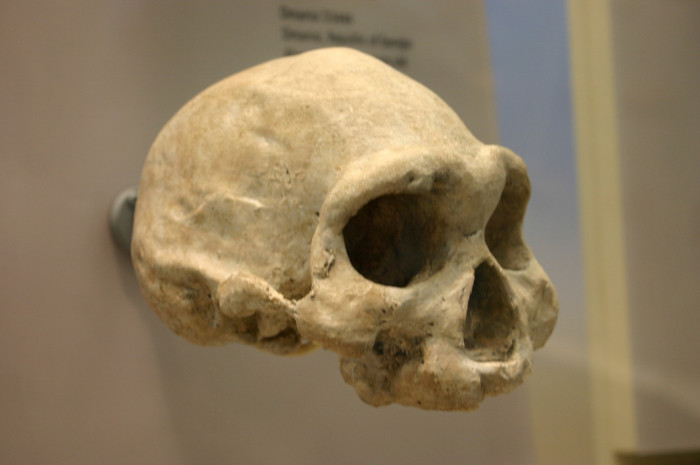
Skull D3444 from Dmanisi in Georgia, dated to about 1.8 million years ago, some 200,000 years younger than the new adult Homo erectus fossil from Drimolen. (Ryan Somma / CC BY-SA 2.0)
A Record That Is Still Being Read
For the research team, the wider lesson concerns what actually reaches print. Fragmentary fossils are routinely set aside because a single scrap preserves so little diagnostic anatomy, yet taken together they enlarge the sample available for testing biological hypotheses. Work on biases in the fossil record makes the same point from a different angle: where palaeontologists choose to dig shapes what they are able to conclude.
"We consider that the publication of all hominin fossils post-excavation, not just those that are well-preserved and/or relatively complete, is critical to ensuring that our collective understanding of human evolution continues to improve," the authors write. The Drimolen collection is curated at the University of the Witwatersrand and every fossil has been 3D scanned, with access granted on application. Given how much a single drawer-bound fragment has just changed, the quarry almost certainly has more to say.
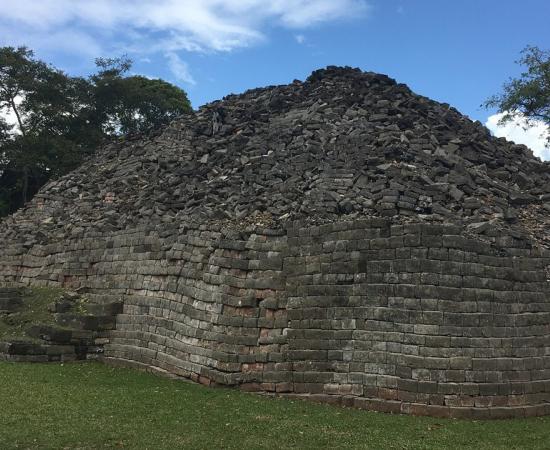
Top image: The fossil-bearing palaeocavern at Drimolen Main Quarry in South Africa's Cradle of Humankind. Source: Andy Herries / CC BY-SA 4.0
By Gary Manners
References
Archaeology Magazine. 2026. Homo erectus Lived in Africa Earlier Than Thought. Available at: https://archaeologymag.com/2026/09/homo-erectus-lived-in-africa-earlier-than-thought/
Herries, A. I. R. et al. 2020. Contemporaneity of Australopithecus, Paranthropus, and early Homo erectus in South Africa. Science. Available at: https://www.science.org/doi/10.1126/science.aaw7293
La Trobe University. 2026. Fossils confirm human ancestors first appearance. Available at: https://www.latrobe.edu.au/news/articles/2026/release/fossils-confirm-human-ancestors-first-appearance
Martin, J. M. et al. 2021. Drimolen cranium DNH 155 documents microevolution in an early hominin species. Nature Ecology & Evolution. Available at: https://doi.org/10.1038/s41559-020-01319-6
Martin, J. M., Leece, A. B., Baker, S., Herries, A. I. R., Strait, D. S. 2026. New hominin cranial and mandibular remains from Drimolen Main Quarry, South Africa. Annals of Human Biology. Available at: https://www.tandfonline.com/doi/full/10.1080/03014460.2026.2725046