
The animal kingdom may have begun far earlier than its fossils admit — perhaps between 800 and 700 million years ago, up to 200 million years before the oldest undisputed animal remains. A study led by the University of Oxford, published in Science Advances, argues that a key piece of evidence used to pin animal origins to the Ediacaran Period does not hold up — reopening one of evolution's great puzzles: why animals seem to appear so suddenly just before the Cambrian Period.

Estimated timeline for the origin of animals based on molecular clock analyses. The grey bar on the right of the image is the origin of animals based on an Ediacaran upper calibration. The grey bar to the left is the origin based on older deposits in the Tonian period, as suggested by the new study. (Orin Lole Durbin/Science Advances)
A Missing Chapter in the Fossil Record
For years, researchers treated the Weng'an Biota — a roughly 590-million-year-old deposit in southern China that preserves microscopic organisms in remarkable detail — as an effective ceiling on animal origins. No definitive animal fossils turn up there, so the reasoning went that animals had not yet appeared.
The Oxford-led team tested that logic against a younger site. More than 140 samples from Mongolia's Kheseen Biota, examined with scanning electron microscopy, produced beautifully preserved acritarchs and embryo-like fossils complete with internal cells. None, however, is an animal — even though animals certainly existed elsewhere by then.
"The Kheseen microfossils are just as well-preserved, yet animals continue to be absent — despite the fact we know at that point they existed," said senior author Ross Anderson of Oxford's Museum of Natural History.
- One of the Earth's Earliest Animals Discovered in Australia
- The Grand Canyon Was a 'Goldilocks Zone' For Evolution

Study author Associate Professor Ross Anderson (University of Oxford) in the mountains to the west of Lake Khuvsgul, Mongolia during fieldwork in summer 2017. (Ross Anderson/Science Advances)
Turning to the Molecular Clock
With the Weng'an argument weakened, the team recalculated the timeline. Molecular clock analysis compares genetic differences between living species and works backwards using dates from the fossil record as anchors.
Dropping the younger Ediacaran anchor in favor of older deposits in Norway, Australia and Arizona — dated to between roughly 850 and 730 million years ago — pushed the estimated origin of animals back by around 200 million years, as Live Science reported. Chemical fossils consistent with sponges living at least 650 million years ago fit that deeper timeline.
"Pre-Ediacaran animal body fossils still elude us, and this analysis does not prove that animals existed 800 million years ago," said first author Orin Lole Durbin, then an Oxford undergraduate and now at Virginia Tech. "Our molecular-clock analyses show how much further back their evolutionary history could extend."
- What Made Earth a Giant Snowball 700m Years Ago?
- 520-Million-Year-Old Fossil Reveals Arthropod Evolution
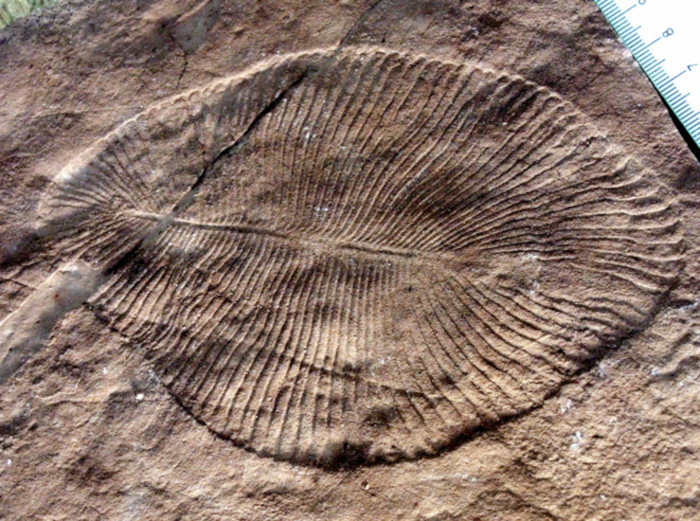
Dickinsonia costata, a ribbed Ediacaran organism that lived around 550 million years ago. (Verisimilus at English Wikipedia, CC BY-SA 3.0 /CC BY 2.5)
Did Animals Live Before Snowball Earth?
An origin between 800 and 700 million years ago would place early animals before or during the Cryogenian glaciations known as Snowball Earth, which took hold around 720 million years ago. Whether they weathered those conditions, or evolved in the run-up to them, is now wide open.
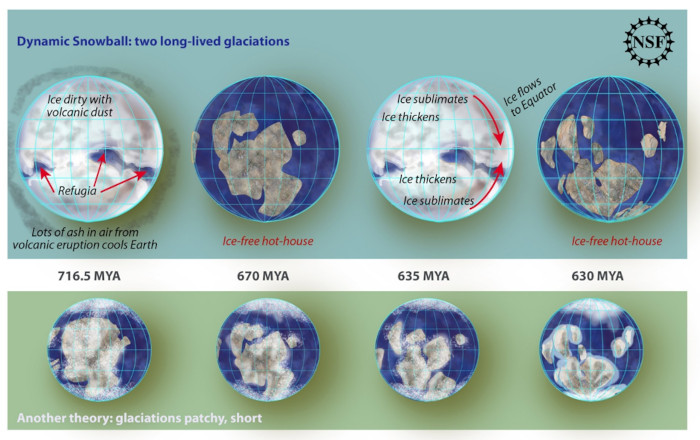
"Dynamic Snowball", an illustration of Earth during the Cryogenian glaciations between 716.5 and 630 million years ago. (National Science Foundation / Public Domain)
These first animals would have been small and soft-bodied, leaving little behind — a world away from the armored arthropods that followed. Co-author Derek Briggs of Yale University said the timing of animal origins throws light on "rates of evolution, the timing of biological innovations, and the processes leading up to animal diversification."
Anderson is careful about the limits of the work. "Until that evidence becomes available, the precise birth date of the animal kingdom remains uncertain," he said.
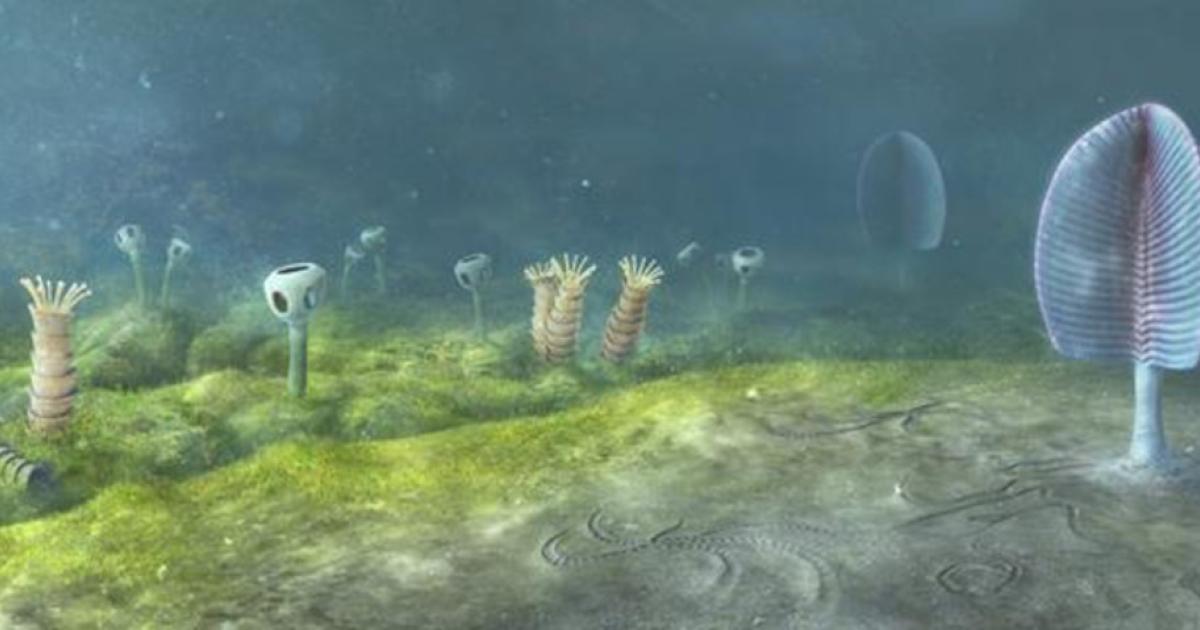
Top image: A reconstruction of Ediacaran sea-floor life, Namibia, South West Africa, roughly 543 million years ago. Source: Museum of Natural History, University of Oxford/Mighty Fossils/Science Advances
By Gary Manners
References
Hughes-Castleberry, K. 2026. Animals may have evolved 200 million years earlier than previously thought, new study suggests. Available at: https://www.livescience.com/planet-earth/evolution/animals-may-have-evolved-200-million-years-earlier-than-previously-thought-new-study-suggests
Lole Durbin, O. M., Anttila, E. S. C., Briggs, D. E. G., Macdonald, F. A. and Anderson, R. P. 2026. Re-evaluating molecular clock maximum age calibrations revives pre-Ediacaran divergence estimates for animals. Available at: https://www.science.org/doi/10.1126/sciadv.aeg6289
University of Oxford. 2026. New study suggests animals may have evolved vastly earlier than fossil evidence suggests. Available at: https://www.ox.ac.uk/news/2026-09-23-new-study-suggests-animals-may-have-evolved-vastly-earlier-than-fossil-evidence
Yale University. 2026. Moving back the clock: Did animal life begin 200 million years earlier than we thought? Available at: https://news.yale.edu/2026/10/02/moving-back-clock-did-animal-life-begin-200-million-years-earlier-we-thought