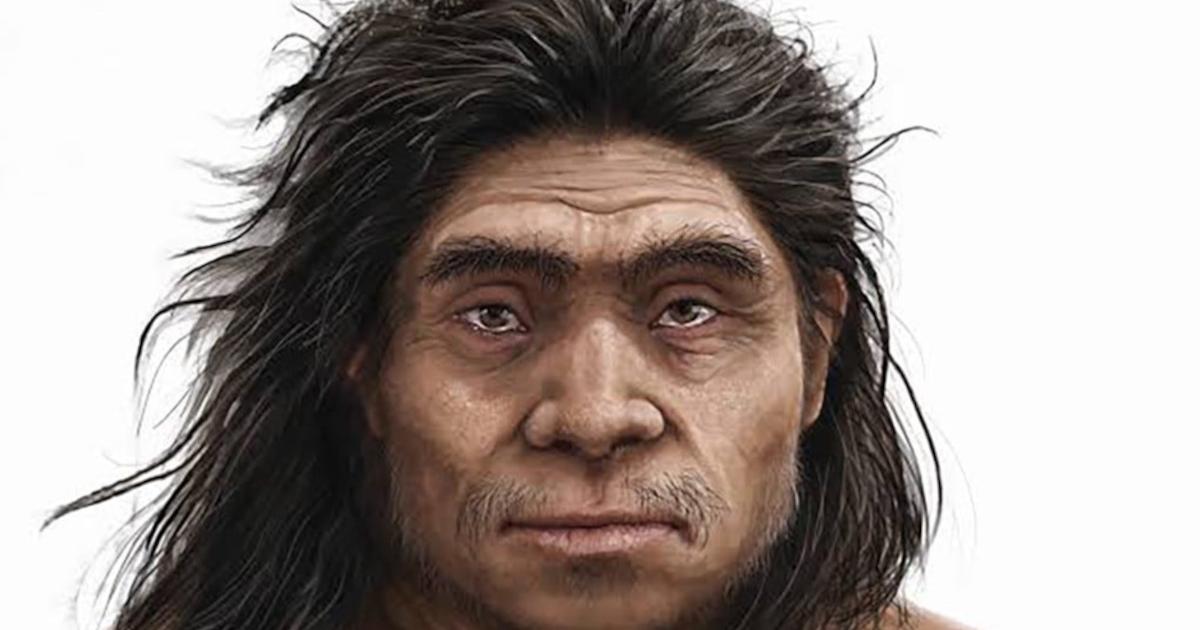

Chinese researchers have brought the mysterious Denisovans into sharper focus, identifying a 199,000-to-138,000-year-old fossil collection as members of the lineage and outlining the heavy-set features they shared. The Nature study, published on October 21, does not reveal a complete face, but it provides the strongest anatomical framework yet for imagining one. The findings, also reported by the South China Morning Post, help turn a people once known largely from DNA into an ancient human group recognizable from its bones.
The Denisovan story began in 2010, when genetic material from a finger bone found in Siberia’s Denisova Cave revealed an unexpected branch of the human family. Since then, researchers have linked Denisovan ancestry to populations across Asia and Oceania, while fragmentary fossils have slowly expanded the group’s known range. New research on inherited genes, including the Denisovan DNA that still lives on in Indigenous American populations, shows that this vanished population remains part of the human story.
- Denisovan DNA Gift Lives On In Modern Indigenous ...
- Denisovan Leg Bones Reveal Remarkable Body Size for ...
Protein Identifies the Xujiayao Group
The Xujiayao site in China’s Nihewan Basin was excavated between 1976 and 1979. Its 20 cranial, mandibular and dental fossils represent at least 16 individuals and were found with stone tools and animal remains. Dating places the assemblage in the late Middle Pleistocene, roughly 199,000 to 138,000 years ago, but its classification had remained controversial.
The team led by Song Xing and Qiaomei Fu extracted ancient proteins from two specimens. Across the samples, they identified 18 endogenous proteins and a Denisova-associated change in the collagen gene product COL1A2, known as the R>K mutation at position 996. Because proteins can survive in ancient bone when DNA has disappeared, the result gave the researchers a molecular way to settle the fossils’ identity.
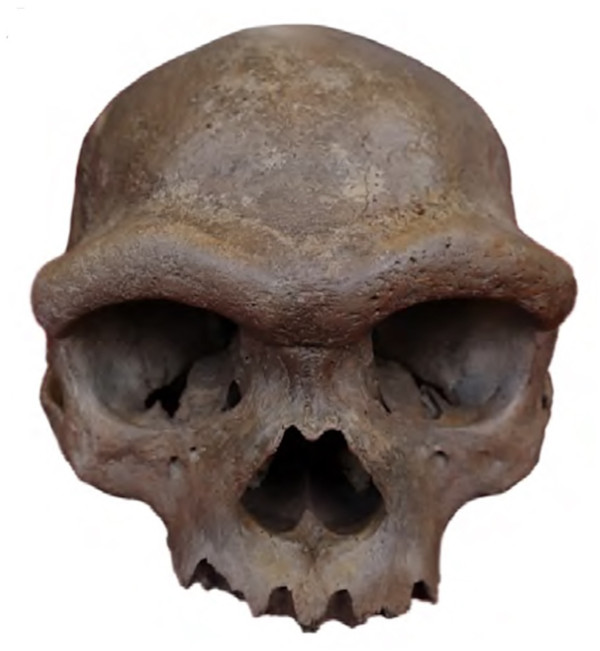
Holotype cranium of Homo longi, now discussed alongside Denisovan fossils. (Fu et al./CC BY 4.0)
A Shared Denisovan Look
With the Xujiayao fossils securely tied to Denisovans, the researchers compared their anatomy with other East Asian remains, including the Harbin cranium and fossils from Dali, Jinniushan and Hualongdong. They describe a low, broad skull with thick bone, nearly parallel sides, a massive brow ridge, flat cheek regions and only weak forward projection of the face. The profile is also consistent with a low, sloping forehead, prominent brow ridges, relatively square eye sockets and a moderately raised nasal bridge—features that give the Denisovan face its newly recognizable outline.
The researchers emphasize that the Xujiayao fossils themselves lack complete facial bones. The “face” is therefore a reconstruction from repeated anatomical patterns rather than a portrait of one individual, a distinction that matters when comparing this work with earlier DNA-based attempts to reconstruct a Denisovan woman. Future discoveries of better-preserved facial remains will be needed to test how closely this composite matches any single Denisovan.
- Denisova Cave DNA: Neanderthals, Denisovans and ...
- The Teeth Have It: Tracing the Denisovan Legacy Around ...
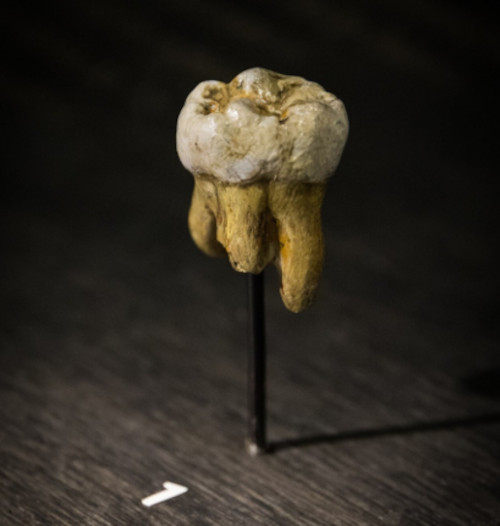
Replica of a Denisovan molar originally found in Denisova Cave. (Thilo Parg/CC BY-SA 3.0)
From a Cave Mystery to a Wider Asian Lineage
The study’s larger significance is geographic as much as anatomical. Denisovan fossils and genetic signals have now been reported from Siberia, the Tibetan Plateau, northern and southern China, Taiwan and parts of Southeast Asia, supporting the idea of a widespread and adaptable Asian lineage. The large-bodied Denisovans suggested by leg bones from the Taiwan Strait add another dimension to a population that may have occupied very different environments.
The new morphology-based framework should help researchers test whether other disputed East Asian fossils belong to the same lineage. It may also clarify how Denisovans relate to Neanderthals, Homo erectus and modern humans, whose histories repeatedly overlapped and sometimes intertwined. For now, the Denisovan face is best understood not as a single finished portrait, but as a composite assembled from proteins, skull fragments, teeth and jaws.
Top image: An illustrated reconstruction of a Denisovan, provided by the authors. Source: Institute of Vertebrate Paleontology and Paleoanthropology of Chinese Academy of Sciences/Nature
By Gary Manners
References
Fieldhouse, R. 2026. This is what the mysterious Denisovans looked like. Available at: https://www.nature.com/articles/d41586-026-03360-0
Global Times. 2026. Chinese scientists confirm Xujiayao hominins as Denisovans, revealing shared physical traits. Available at: https://www.globaltimes.cn/page/202610/1372751.shtml
South China Morning Post. 2026. Good to see you after all this time. Chinese scientists put a face to the Denisovans. Available at: https://www.scmp.com/news/china/science/article/3371949/good-see-you-after-all-time-chinese-scientists-finally-put-face-denisovans
Xing, S., Wu, Z., Shao, Q. et al. 2026. The proteome of Middle Pleistocene Xujiayao and common Denisovan morphology. Available at: https://www.nature.com/articles/s41586-026-11132-z