
Two leg bones dredged from the Taiwan Strait suggest that at least some Denisovans were exceptionally tall, powerfully built, and reliant on terrestrial meat. The specimens, named Penghu 2 and Penghu 3, are a partial right femur and a right tibia. Ancient proteins recovered from both bones include a Denisovan-associated collagen variant, while broader protein comparisons place them alongside the previously identified Penghu mandible and a Denisovan from Denisova Cave. That molecular evidence is significant because Denisovan anatomy has previously been known mainly from a skull, jaws, teeth, a finger bone, and other fragments.
The findings, are yet to be peer reviewed, but have been released in two new bioRxiv preprints and covered by Science. They offer one of the clearest glimpses yet of the bodies and daily lives of this enigmatic human relative.
A long-awaited look at Denisovan bodies
The researchers estimate that Penghu 2 belonged to an individual about 180 centimeters tall and weighing roughly 83 kilograms, while Penghu 3 came from someone around 190 centimeters tall and weighing about 91 kilograms. Those estimates would have placed the two individuals above the average stature reported for Neanderthals and Late Pleistocene humans in the region. As archaeologist Ben Marwick told Science, “They were very tall!”
- Study Shows Mysterious Denisovans Interbred with Modern Humans
- Evidence of Archaic Human Gene Now Detected In the Orient
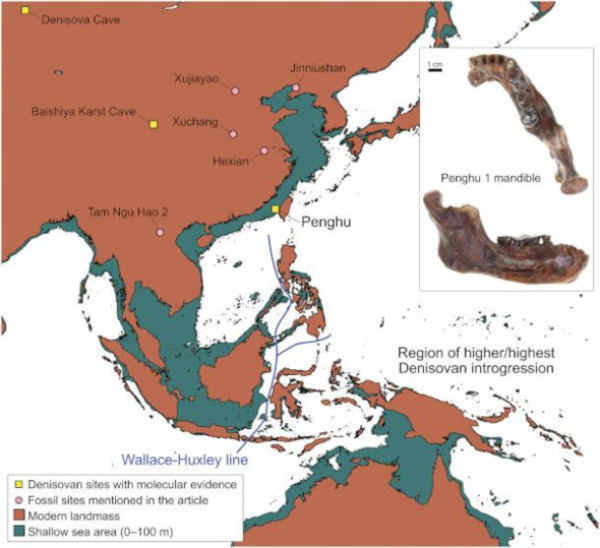
Map showing location where the Denisovan jawbone was found, plus other Denisovan fossil sites. (Tsutaya, et al./Science)
A seafloor archive in the Taiwan Strait
The bones came from the Penghu Channel, between Taiwan and the Penghu Islands, where an industrial trawler dredged fossil-rich material from the seafloor roughly 25 kilometers off Taiwan’s southern coast. Because the collection was removed from underwater deposits rather than excavated in place, the fossils lack a secure archaeological layer and cannot be assigned to a single event. Even so, collagen from Penghu 3 produced a calibrated radiocarbon age of about 45,600 to 44,500 years ago.
That date is much younger than an earlier uranium-series estimate of roughly 160,000 years. The preprint authors argue that the complex movement of uranium through bones submerged in seawater makes the older figure difficult to interpret, while the new collagen result fits the preservation and dating of associated fossils. It also places these Denisovans in eastern Asia at a time when modern humans were spreading through southern Asia, creating a plausible setting for contact and interbreeding, a subject explored in The Teeth Have It: Tracing the Denisovan Legacy Around the World.
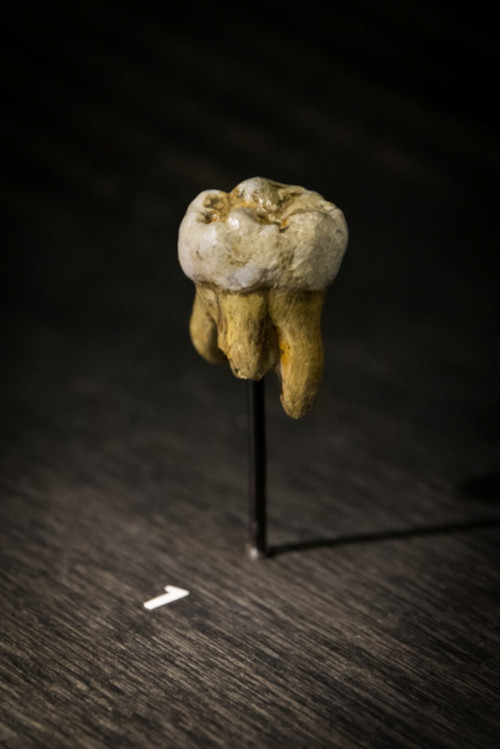
A replica Denisovan molar, illustrating the fragmentary fossil evidence that preceded the new leg-bone discoveries. (Thilo Parg/CC BY-SA 3.0)
A meat-heavy life on open ground
The second preprint, “Habitat and feeding ecology of a Denisovan from Late Pleistocene Taiwan”, examined collagen from Penghu 3 using carbon and nitrogen isotopes. Its carbon signature is consistent with a C4-dominated ecosystem, such as open grasslands, savannah-like terrain, or river floodplains. Nitrogen measurements place the individual high in the food chain, with a trophic position close to that of terrestrial carnivores.
The result suggests that animal protein made up a major part of this Denisovan’s diet, broadly resembling the meat-heavy diets documented for some European Neanderthals, as discussed in Neanderthal Diet Was Carnivorous. The same analysis found no clear evidence that fish or other aquatic foods contributed substantially to the individual’s protein intake, although the authors stress that seafood consumption cannot be ruled out entirely. That caution matters: the dietary conclusion currently rests on a single tibia, not a whole population.
What the fossils cannot yet tell us
The femur’s pronounced pilaster and the tibia’s healed injury may be consistent with a physically demanding, mobile life, perhaps including regular travel or hunting across open terrain. However, the researchers present those interpretations as possibilities rather than proof, and the bones do not reveal the individuals’ sex with certainty. The two preprints also remain outside the peer-review process, so their estimates and evolutionary implications will need testing against future discoveries.
The fossils nevertheless add body size, leg anatomy, age, and diet to the rapidly expanding Denisovan record. Chris Stringer, quoted by Science, called them “the youngest well-dated Denisovans so far,” while archaeologist John Hawks wondered what other clues may still be hidden in the Penghu collection. For now, the bones suggest that Denisovans were not simply large-brained members of an elusive lineage: in at least one corner of Ice Age Asia, they were tall-bodied hunters living on a changing human frontier.
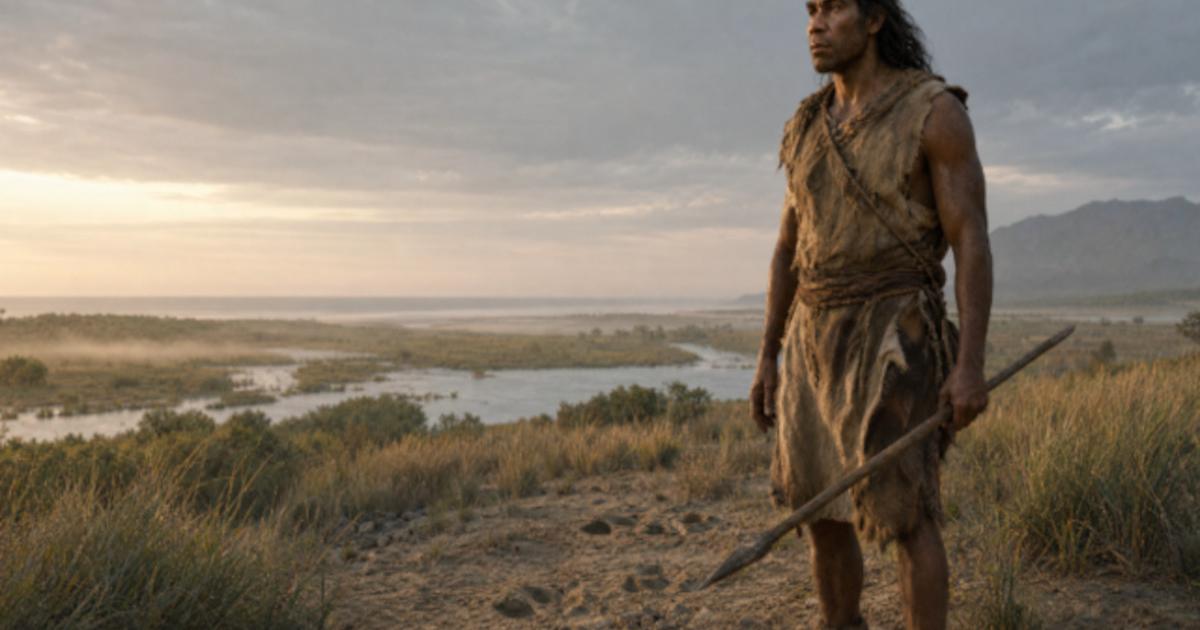
Top image: Representation of a Denisovan in an open landscape. Source: AI Generated/Ancient Origins
By Gary Manners
References
Brown, T. M. 11 August 2026. Denisovans towered over their contemporaries and munched a bunch of meat. Available at: https://www.science.org/content/article/denisovans-towered-over-their-contemporaries-and-munched-bunch-meat
Kaifu, Y. et al. 8 August 2026. Denisovan leg bones from Taiwan reveal large body size. Available at: https://www.biorxiv.org/content/10.64898/2026.08.07.743438v1
Yoneda, M. et al. 8 August 2026. Habitat and feeding ecology of a Denisovan from Late Pleistocene Taiwan. Available at: https://www.biorxiv.org/content/10.64898/2026.08.07.743455v1