
Fresh evidence has emerged that challenges the perception of the Amazon as an untouched wilderness prior to modern times. A study that has reconstructed 10,000 years of fire history using 1,361 radiocarbon dates obtained from both soil charcoal and archaeological finds from 303 sites shows that fire is predominantly a human-driven phenomenon in the Amazon. According to the authors of the study published in Frontiers of Biogeography, people did not merely inhabit the Amazon, but exerted their influence on the forest through their use of fire, equivalent to that of major climate changes that occurred during the ice ages.
A Forest That Never Knew Fire
In the earlier evolutionary history of these wet forests fire occurrence was extremely rare. Evidence from glacial periods at places such as Hill of Six Lakes in Brazil, and Serra Sul dos Carajás revealed little to no charcoal deposition before humans arrived. In the Andean region, for example, the core obtained from Campo Libre shows no fire for about 30,000 years before the arrival of humans roughly around the last 4,500 years.
The scientists have termed the arrival of human beings as the species that brought fire to a "naïve land." Because the plants of the Amazon have never developed resistance against fire, regular fires set by man changed a stable ecosystem in the region which had existed since the late Pleistocene.
The discoveries support the observations made by archaeologists, who have found evidence about the presence of large, lost civilizations of the Amazon to numerous geoglyphs discovered and examined by them under the canopy.
- Was the Amazon Rainforest Once Home to A Massive Lost Civilization?
- Hundreds of Amazonian Geoglyphs Resembling Stonehenge Challenge Perceptions of Human Intervention in the Rainforest
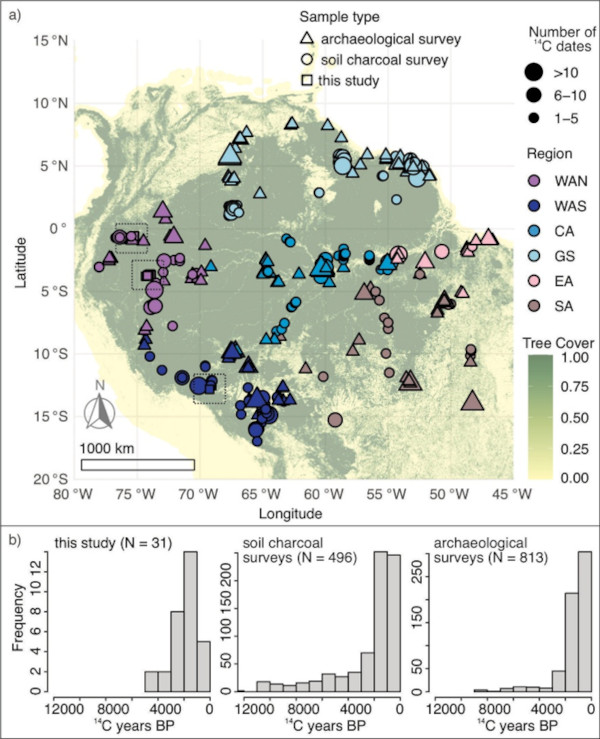
Map of Amazonian sites with ¹⁴C AMS dated charcoal fragments or burned archaeological material used in the summed probability analyses. (McMichael et al., 2026 / CC BY 4.0)
Ten Thousand Years of Spreading Flame
Through the collection and interpretation of dated fragments of charcoal, the group has been able to delineate the progression of fire through the ages in three different phases. The first period lasted between 10,000 and 6,000 years ago when fire was limited to the edges of the basin and the course of the Amazon River. The next phase between 6,000 and 4,000 years ago marks the rapid increase in the use of fire. This period coincides with the appearance of the first maize crops in northwestern and southwestern Amazon.
Finally, between 3,000 and 2,000 years ago, fire reached the deep interior of the basin. Central Amazonia had remained a relatively fire-free refuge while the periphery burned, but it too was transformed as human influence reached the heart of the forest. Such deliberate landscape management mirrors evidence that Amazonians drastically altered the rainforest 3,500 years ago with fire, raised fields and fish weirs, and that ancient farmers intentionally created the fertile dark soils known as terra preta.
Lastly, fire arrived to the interior of the basin between 3000 and 2000 years ago. Central Amazonia had managed to remain relatively free from fires while fires raged outside, but then the impact of human effort reached this part of the forest. The practices of controlled landscape burning are in line with the findings that the rainforest was heavily altered by the local people 3500 years ago through fire, special raised fields and fish traps. Moreover, it also holds true that terra preta was created intentionally by early farmers to make the ground as fertile as possible.
When the Fires Went Out
The history of human-induced fires in the Amazon ends with a sharp and rapid decline of fire activity over the past 700 years. The frequency of fires began to decline between 600 to 700 years ago, lending support to the notion that there was an "early abandonment" of areas long before European intervention in the region. Lake sediment data reveal a substantial "pollen influx" during this period, marking significant reforestation and an important shift in land use prior to Columbus – further evidence that the pre-Columbian Amazon was not so virgin after all.
The second, larger collapse followed the "Great Dying" after AD 1541, when disease, warfare and enslavement killed an estimated 90 to 95 per cent of Indigenous peoples in the Americas. As the population of people that could ignite fires vanished, the forest took the huge step forward into the next stage of recovery – an environmental catastrophe so vast that research suggests the colonization of the Americas caused climatic change on a global scale.
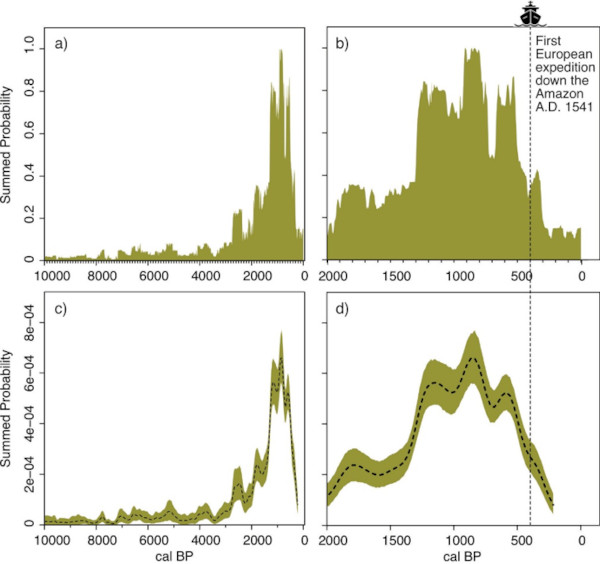
Summed probability distribution of ¹⁴C AMS dated charcoal fragments and burned archaeological material (N = 1329 dates over 303 sites) for the last 10,000 years. The ship icon marks the first expedition down the Amazon River in AD 1541. (McMichael et al., 2026 / CC BY 4.0)
A Forest Shaped by Human Hands
The environmental effects of the long-term fires have persisted until the present day. During the past two thousand years the rate of plant change in all regions of the forest increased, as plant species that can tolerate fires, such as palms took over from other vegetations that cannot withstand fire.
"The restructuring of Amazonian pyrogeography over the last 2,000 years has likely played a large role in shaping modern forests. The intensification of fire during this period induced rates and magnitudes of vegetation change that are comparable to major climatic shifts. The impact was subtle, favoring species that were already there but showed the most fire tolerance, such as some palms, but this pressure has undoubtedly changed the configuration of Amazonian plant communities," the team explained in their research article.
The study carries a sobering resonance for the present. The same forest that absorbed ten millennia of indigenous burning now faces industrial-scale Amazon rainforest fires set to clear land for cattle and crops – a very different kind of flame, in a forest whose ancient inhabitants knew fire as a tool rather than a weapon.
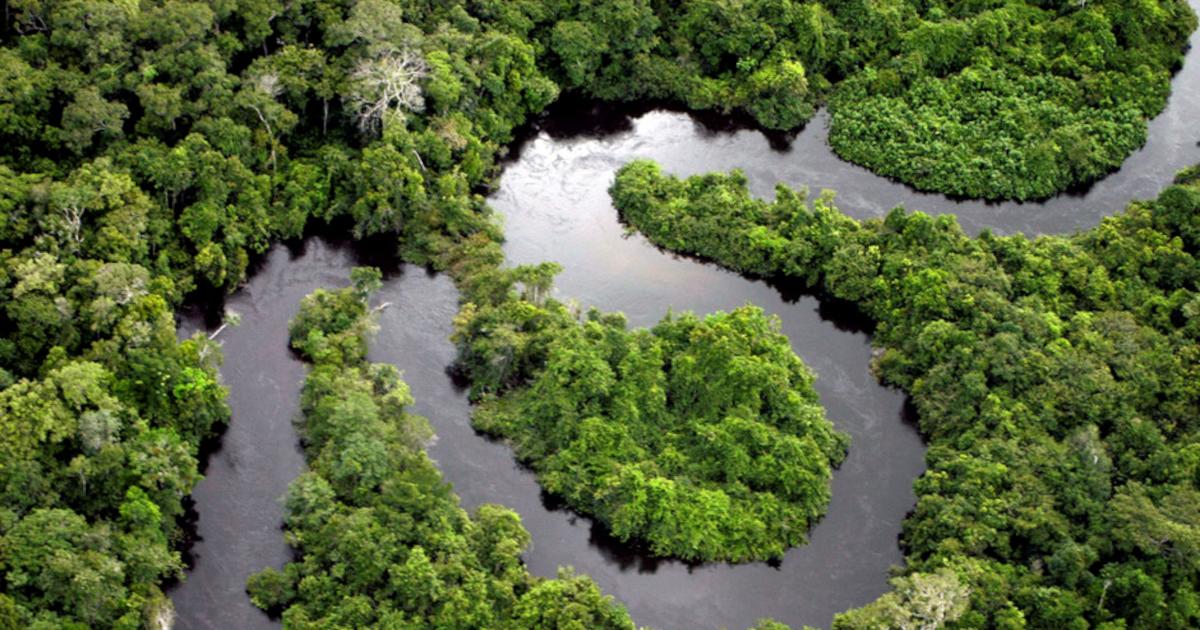
Top image: Aerial view of a river winding through the Amazon rainforest. Source: Jlwad /CC BY-SA 4.0
By Gary Manners
References
McMichael, C.N.H., Heijink, B.M., Witteveen, N.H., Zwarts, A. and Bush, M.B. 2026. The pyrogeography of Amazonia: a Holocene perspective. Frontiers of Biogeography, 19: e169863. Pensoft Publishers. Available at: https://doi.org/10.21425/fob.19.169863
Pensoft Publishers. 2026. Human-driven fires have shaped the Amazonian forest for over 10,000 years. Available at: https://www.eurekalert.org/news-releases/1141769
Phys.org. 2026. Human-driven fires have shaped the Amazonian forest for over 10,000 years. Available at: https://phys.org/news/2026-08-human-driven-amazonian-forest-years.html