
Archaeologists studying the Panga ya Saidi Cave in coastal Kenya step carefully among thick vines and flowers as they approach the half-mile of winding tunnels. Cool air and the smell of ferns and mosses rise from the forest floor, offering relief from the jungle humidity. Beneath tall limestone walls, they can enter the shadowy main chamber of the cave. Sunlight shines through pieces of the collapsed ceiling, but the cave still feels strong and stable, a hidden homesite on southern Kenya's Nyali Coast that has protected humans for 78,000 years. Like the cavesite, the landscape defines the timeless aspects of Kenya’s identity. Towering escarpments plunge hundreds of meters. Volcanic lakes host flocks of pink flamingos. Hot springs bubble through the lava flows of dormant volcanoes.
An interdisciplinary team of international scholars from the Max Planck Institute for the Science of Human History has worked on the cave site for over a decade, documenting the lives of hunter-gatherers and Iron Age communities. Their goal was to increase information about the last 78,000 years of East African life. Prior research focused on the Rift Valley and the use of migration pathways near the Indian Ocean.
- Hundreds of 4,000-year-old Mass Graves Found Hidden in the Sahara Desert
- Blades of Destiny: The Ancient Tools And Weapons That Crafted History
Environmental Stability Created Long-term Occupancy

Map showing the coastal location of the Panga ya Saidi Cave. (Ceri Shipton/CC-BY-SA 2.0)
One key aspect of the investigation explored the longevity of the cave’s human occupation. Beginning with an environmental analysis, the team noted the predictability of the tropical forest-grassland environment. Seasonal rains fed several river systems and lakes. Humans were able to hunt in large animal habitats, pick edible grassland plants, and gather shellfish from the nearby ocean shore. The team collected cave artifacts and examined an ancient human burial. Evidence from layers of sediment from the cave floor showed gradual changes and technological innovations. beginning 67,000 years ago. Like other similarly cave sites, researchers concluded that long human occupations occur in a persistent tropical forest-grassland environment. The team’s analysis of plant, animal, and shell remains from the sediment layers in the cave showed little variation over time. As other regions became inhospitable, the cave environment and landscape persisted.
- Yale Archaeologist Discovers Ancient Mancala Game Boards in Kenya's Highlands
- Ancient DNA is Restoring the Origin Story of the Swahili People of the East African Coast
Technological Innovations Increased 67,000 Years Ago
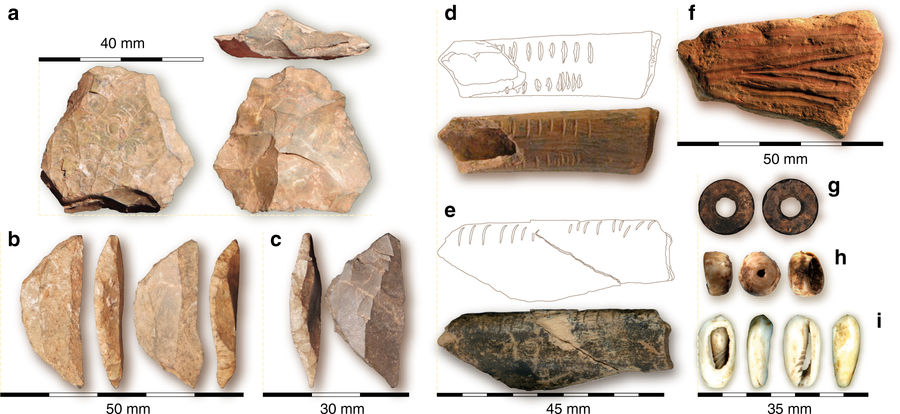
Artifacts from Panga ya Saidi Cave in Kenya, showing tools found in floor sediment. (Ceri Shipton, Patrick Roberts, Will Archer/CC-BY)
During cave floor excavation, the team noticed that each sediment layer produced similar artifacts. Beads made from sea shells and ostrich eggshells, bone tools worn by scraping, and pieces of red ochre were scattered randomly throughout many layers. Successive generations used these objects. There were even stone toolkits dating back 78,000 years,
Beginning 67,000 years ago, during the Later Stone Age, innovation and adaptation increased. The stone tools became smaller and more portable, adapted for changes in hunting methods. Overall, however, data showed that cave residents favored tried and true technology. Even during a volcanic winter caused by the Toba volcanic eruption 74,000 years ago, the occupancy of the cave site increased. Humans proved flexible and adapted practices for survival.
Artifacts Offer Evidence of Important Symbols and Cultural Practices
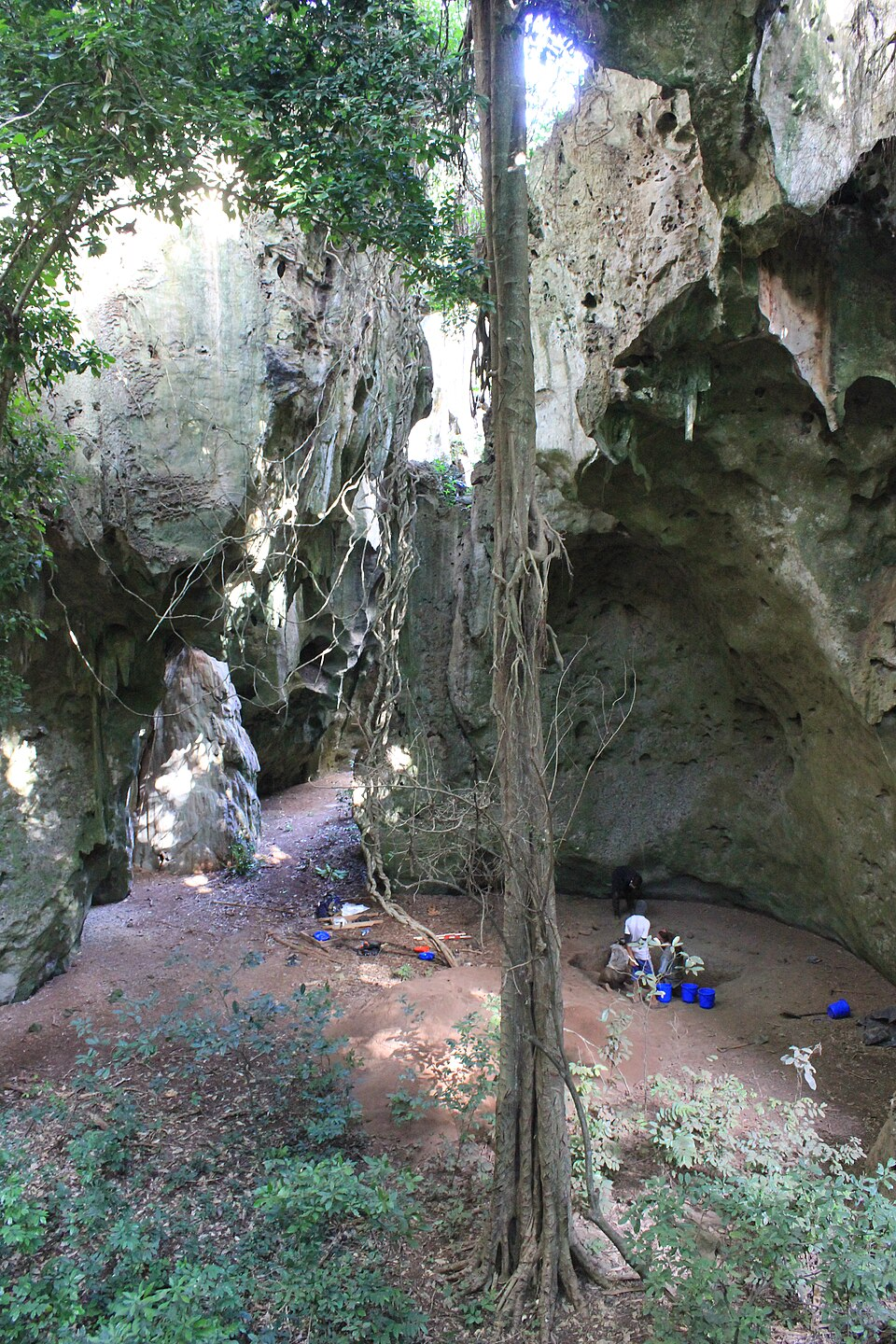
Panga ya Saidi Cave interior with ongoing excavations. (Ceri Shipton/CC-BY-SA 3.0).
Panga ya Saidi Cave contains a cultural record that spans thousands of years. The similarity of artifacts over the years demonstrates that crafts were passed from one generation to the next for centuries. The oldest bead in Kenya, dating to 65,000 years ago, came from Panga ya Saidi. For 40,000 years, most beads and jewelry came from coastal shells. About 25,000 years ago, ostrich shell beads were more common. Other than jewelry, there are few indications of the use of marine resources for food or crafts. The stability of the environment and of cave life lessened the need for revolutionary new tools or practices.
The most unique discovery in the cave is a child’s 78,000-year-old grave. It is Africa’s oldest intentional human burial. During excavations in 2021, archaeologists discovered the Middle Stone Age grave of a three-year-old child. According to researchers, the child’s head was placed on a pillow. The body was in a fetal position, covered with a cloth and layers of soil. The burial practice is similar to that of older burials at Skhul and Qatzeh caves in Israel, which were part of groups with the same African tool-making traditions.
Dr. Nicole Boivin, Project Principal Investigator and Director of the Department of Archaeology at the Max Planck Institute for the Science of Human History, emphasized the importance of cave discoveries: “The East African coastal hinterland and its forests have long been considered to be marginal to human evolution, so the discovery of Panga ya Saidi cave will certainly change archaeologists' views and perceptions." The lack of meaningful coastal connections refuted previous ideas about African migration, according to team member Professor Michael Petraglia: “The finds at Panga ya Saidi undermine hypotheses about the use of coasts as a kind of ‘superhighway’ that channeled migrating humans out of Africa, and around the Indian Ocean rim.”
By Ramsey Hardin
Top image: Towering escarpments plunge hundreds of meters in Kenya’s Great Rift Valley.Source: Anthony Trival/CC-BY-SA
References
Daley, Jason. 2018. “People Lived in This Cave for 78,000 Years.” Smithsonian Magazine, (May). https://www.smithsonianmag.com/smart-news/people-lived-cave-78000-years-180969051/
Faulkner, Patrick. 2023. “A cave site in Kenya’s forests reveals the oldest human burial in Africa.” History Guild. https://historyguild.org/a-cave-site-in-kenyas-forests-reveals-the-oldest-human-burial-in-africa/
Max Planck Institute for the Science of Human History. 2018. "78,000-year cave record from East Africa shows early cultural innovations.” Science Daily. www.sciencedaily.com/releases/2018/05/180509081956.htm, https://www.smithsonianmag.com/smart-news/people-lived-cave-78000-years-180969051/