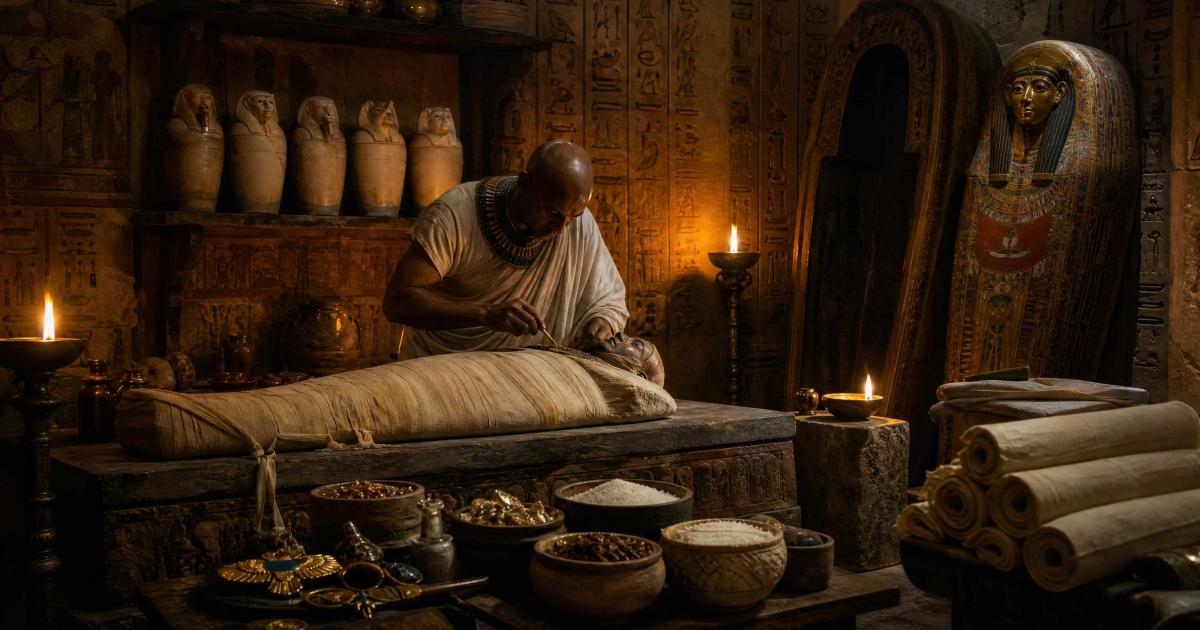

Somewhere in the Valley of the Kings, a family is bargaining with a man who has a mild scent of cedar oil and natron. The family head has just died. He was not a pharaoh; he was just a scribe, a medium-ranked official who lived a life hoping for good eternal life. The widow of the heads is now in the embalming section, watching the wooden model of the dead man, and the man who is doing the embalming is explaining things to her. The pricing of the different types of embalming is tremendous.
This has been occurring throughout ancient Egypt for thousands of years. Mummification was not just for rulers but a worker’s trade. Ancient Egyptians believed that a body is very important for a person to go to afterlife. If the person does not have a body, then the soul has no other place to go to during the afterlife.
What did that payment actually look like? How much did the linen cost? What did the embalmers charge? Who could afford the gold amulets, and what happened to those who couldn't? The answers, drawn from ancient records, recent archaeological discoveries, and the painstaking work of Egyptologists, are more specific, and more surprising, than most people realize.
The Three Tiers of Eternity
The Greek historian Herodotus, writing in the 5th century BC, was the first to document the commercial structure of Egyptian mummification in any detail. In Book II of his Histories, he described how embalmers operated much like modern funeral directors, presenting families with a choice of packages based on their financial means. The embalmers, he wrote, showed "wooden models of corpses made like reality by painting" and asked which method the family desired. Having agreed on a price, the family left, and the work began.
The Elite Package was the most expensive and most complete. The brain was extracted through the nostrils using a crooked iron hook. The embalmers then made an incision in the flank with a sharp Nubian stone and removed the entire contents of the abdomen. The cavity was washed with palm wine and then with bruised aromatics, before being filled with pure ground myrrh, cassia, and other spices — frankincense notably excluded. The body was then packed in natron for exactly 70 days. After washing, it was wrapped head to foot in fine linen bandages smeared with gum. The result was returned to the family, who enclosed it in a painted wooden coffin shaped like a human figure.