
The appearance of the Holy Grail was one of the great literary achievements of Medieval Europe and concerns one of the most fascinating, intriguing and enduring motifs of all time in Western thought. One of the great enigmas surrounding the Grail is what it actually pertains to and points at. Another closely related enigma concerns the fact that the Grail is in some instances, more particularly in the German version of the story, closely connected to the fall of Lucifer and his host of angels. The question is what does this mean and what are its implications.
In this essay the High Secrets of the Holy Grail associated with this Stone will be explored, secrets that were carefully hidden away and kept from prying eyes. The essence of this apparent dark and ominous mystery associated with the Grail involves a Stone and what it symbolizes, the so-called Grail Stone. According to a German tradition preserved in Der Wartburgkrieg this Stone once fell from Lucifer’s crown, a theme recently looked into by Dr Willem McLoud in his new book, A STONE FALLEN FROM LUCIFER’S CROWN: HIGH SECRETS OF THE HOLY GRAIL (Creative Texts, 2026). To gain a better understanding of this captivating issue, we have to more closely engage with the German tradition and literary accounts of the Grail.
The Wartburgkrieg
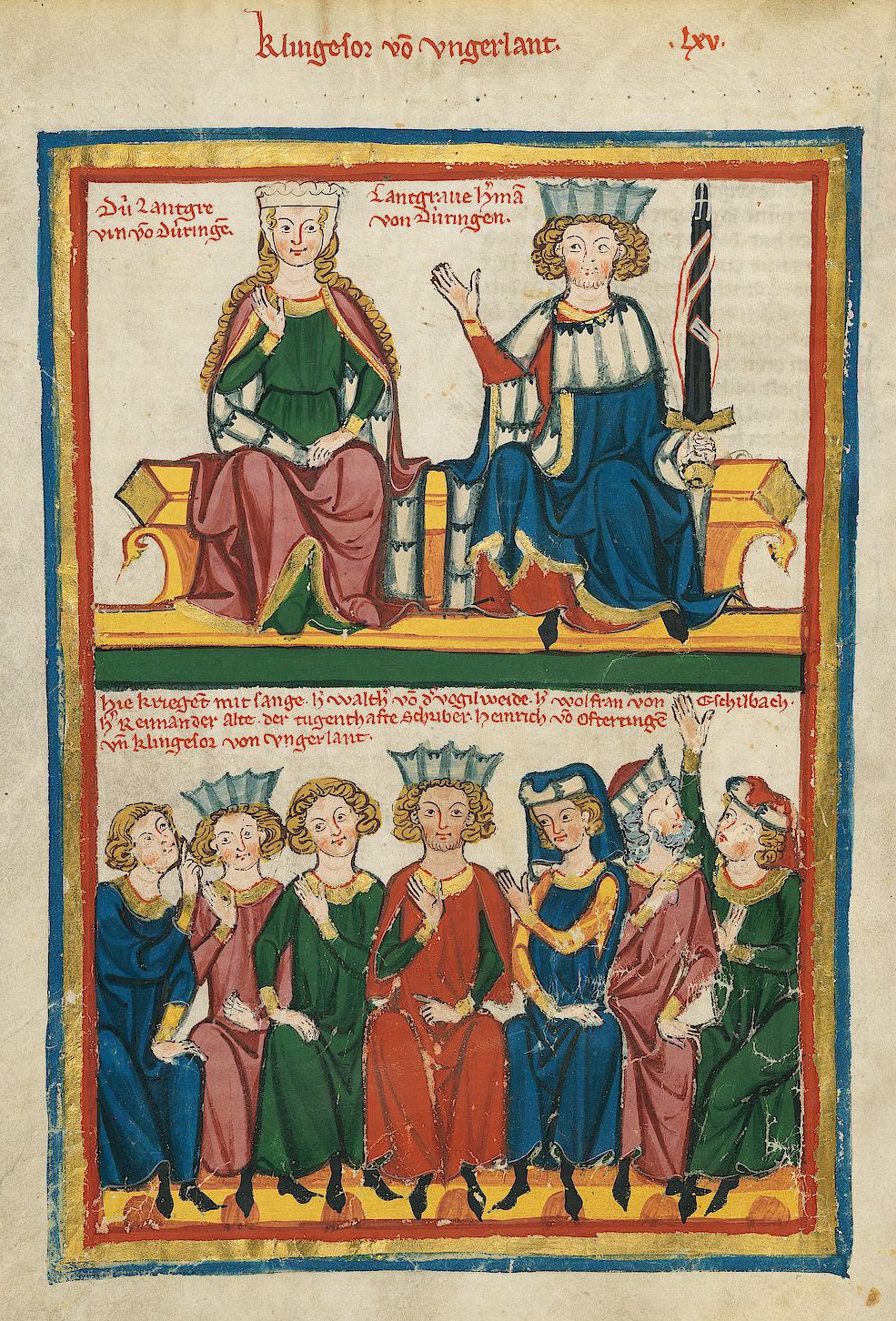
A contest among singers, called the Wartburgkrieg, was, according to tradition, held in the years 1206 and 1207 in the great hall of the Castle of Wartburg overlooking the city of Eisenach in the German state of Thuringia. The contest was hosted by the local landgrave, Hermann of Thuringia, patron prince of the German poetic movement, with many other lords and ladies of nearby lands in attendance.
The minstrels or master singers, six or seven of them depending on whether all of them are regarded as real historical personages or not, who competed with each other included among their circle the very best and most renowned of German poets. The presentations of the minstrels were, according to tradition, recorded and taken up in a collection of poetry called Der Wartburgkrieg, likely composed some decades later, of which the best known available German text was compiled by Karl Simrock in 1858.