
On November 26, 1922, British Egyptologist Howard Carter leaned against the walls of a dusty tunnel under exploration in the Valley of the Kings. He squinted through the dim light of a flickering candle and saw a “wonderful medley of extraordinary and beautiful objects heaped upon one another.” Waiting nearby with Carter’s assistant, Arthur Mace, were the local workers who helped with opening the tomb. At that moment, Carter was standing before more than the grave of an ancient Egyptian king. He was approaching the successful completion of a decades-long search in the Valley of the Kings.
Carter began his career in 1891, working as an artist for the Egypt Exploration Fund before working for the Egypt Antiquities Service. He met George Herbert, the Earl of Carnarvon, a collector of Egyptian art, in 1907, and began directing large excavations in the Valley of the Kings with him in 1914. On November 4, 1922, he happened to be nearby when a local boy carrying water for the workers noticed a step carved into the rock. The next day, the workers exposed the sealed door of a tomb. Carter immediately sent a cable to Carnarvon:
"At last have made a wonderful discovery in Valley; a magnificent tomb with seals intact; re-covered same for your arrival; congratulations."
- King Tut’s Centenary! 6 Fascinating Facts About Tutankhamun’s Tomb
- The Mystery of King Tut’s Death Finally Solved?
On November 27, Carter, Carnarvon, Carnarvon’s daughter Evelyn Herbert, Carter’s assistant Arthur Callender, and members of the excavation team returned to the tomb with additional lighting and candles. Carnarvon and his daughter were the first to enter the chamber with Carter. They shared in the excitement of being part of a major archaeological discovery. Just before they stepped carefully into the tomb, Carnarvon asked, “Do you see anything?” Carter replied simply, “Yes, wonderful things.”
Alfred Lucas, a chemist who helped preserve the artifacts found in the tomb, helped Harry Burton, the photographer who documented the tomb's contents and the opening process, with guidance on handling the fragile objects. Richard Bethell, Carter's secretary, who assisted in the logistics of the excavation, made careful notes about the variety of artifacts.
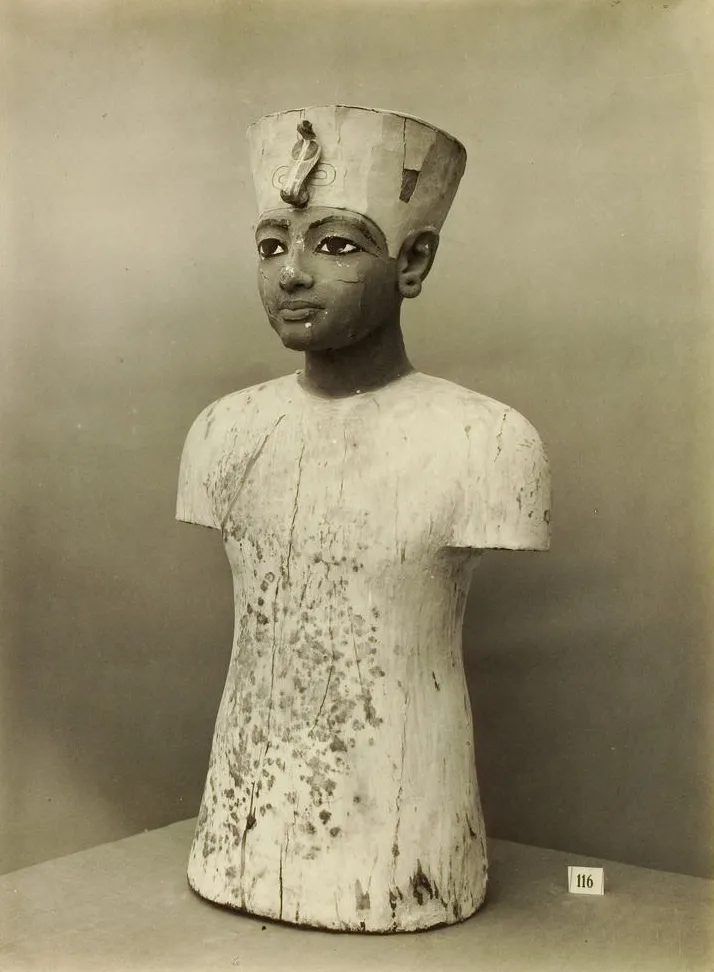
A painted wooden figure of Tutankhamun found in his tomb, (Harry Burton/Public Domain)
Carter noted in his diary that they were “astonished” by the array of treasures:
"Two strange ebony-black effigies of a King, gold sandalled, bearing staff and mace, loomed out from the cloak of darkness; gilded couches in strange forms, lion-headed, Hathor-headed, and beastly infernal lighting; exquisitely painted, inlaid, and ornamental caskets; flowers; alabaster vases, some beautifully executed of lotus and papyrus device; strange black shrines with a gilded monster snake appearing from within; quite ordinary looking white chests; finely carved chairs; a golden inlaid throne; a heap of large curious white oviform boxes", all piled randomly around the room. His first impression was that he had entered the property storage room of “an opera of a vanished civilization.” He and his colleagues were confused, wondering what all the objects meant. Everywhere, there were cartouches bearing the name of Tutankhamun. Suddenly, they noticed a sealed doorway between two statues and realized that the grave of the Pharaoh must lie beyond it.
- Amun, The Creator God Whose Supremacy Surpassed Egypt
- The Awe-Inspiring Karnak Temple Complex and Vatican of Ancient Egypt
The location of every object inside Tutankhamun's tomb tells a story. According to Carter’s notes, the arrangement of the artifacts reveals how the Egyptians prepared a king for eternity. The priests protected him with magic and surrounded him with the treasures and goods he would need for his afterlife in the Field of Reeds. Carter commented on discovering the tomb in pristine condition. In the early years after the tomb’s construction, there were unsuccessful burglary attempts. Officials had repaired the damage and covered points of entry. Carter's meticulous excavation of the tomb is one of history's greatest discoveries.
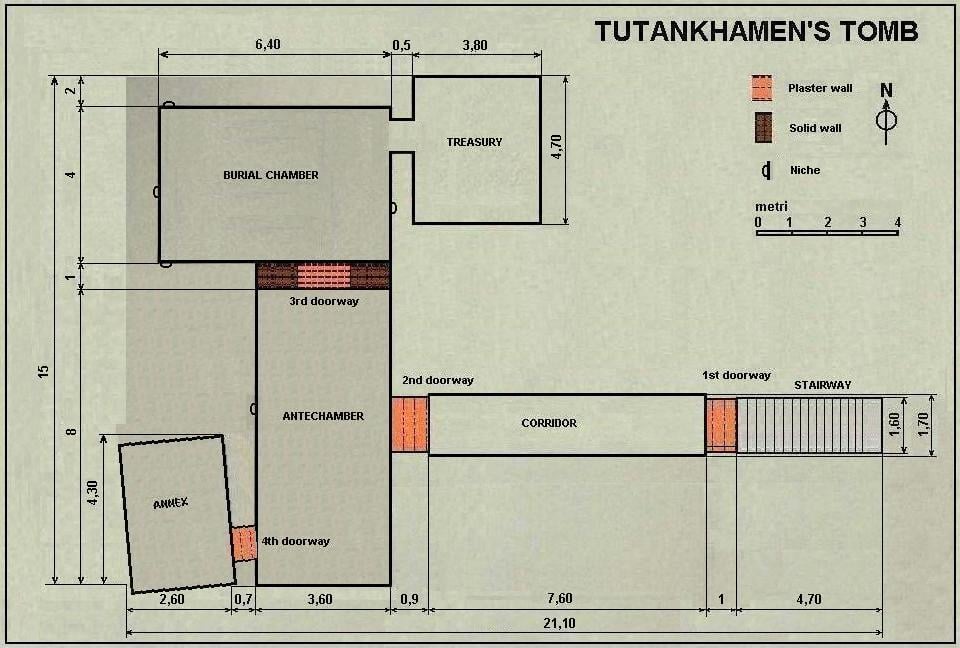
Layout of Tutankhamun's Tomb (KV62), Valley of the Kings, Egypt. (Roger469/CC BY-SA 3.0.)
The Floor Plan of the Tomb
The tomb was small and built rapidly because of Tutankhamun’s unexpected death. The four rooms include the Antechamber, the Annex, the Burial Chamber, and the Treasury. The Antechamber, the largest room in the tomb, was the main entryway. The Annex Room, entered through a small door in the Antechamber, was filled with a variety of objects. The Burial Chamber was the most elaborate of the four rooms. Its yellow walls were decorated with pictures of King Tutankhamun. The chamber was divided into four regions, like the points of a compass. It contained the King’s mummy, his coffin, and his death mask. The Treasury Room stored the most precious grave goods. There were four canopic jars, each guarded by goddesses to ward off evil. There were also 34 statues in the room.
The Antechamber: Controlled Chaos
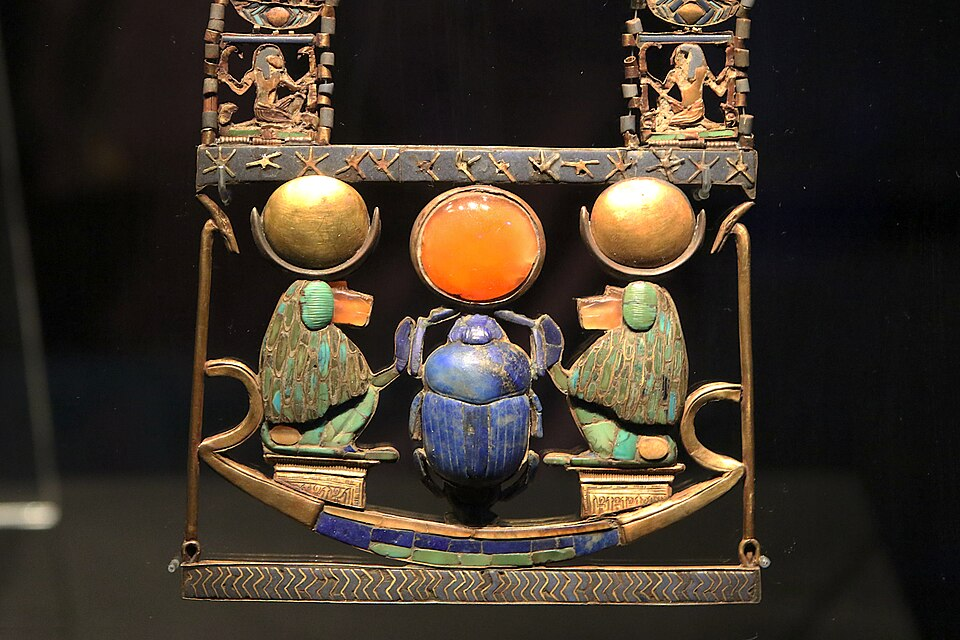
Scarab pectoral depicting Khepri supporting the solar disk, discovered in the tomb of Tutankhamun (KV62) in the Valley of the Kings. (Claude Valette/CC BY 2.0.)
The largest room in the tomb housed thousands of items, all associated with the transition to a new home. There were household goods, such as three ceremonial animal-headed beds against one wall, the golden throne near the burial chamber entrance, folding stools, and alabaster vessels. Boxes of clothing and jewelry were stacked together. If the King needed to protect himself in the afterlife, he was equipped with weapons, bows, shields, and quivers of arrows. He was honored with offerings of flowers, food, and scented oils. His transportation - two dismantled chariots - waited to be assembled.
- Intriguing Collection of Gold Jewelry Found at Amarna Burial
- Polytheistic Religion: How Pantheons Reigned in the Ancient World
The Annex: The Pharaoh's Storeroom
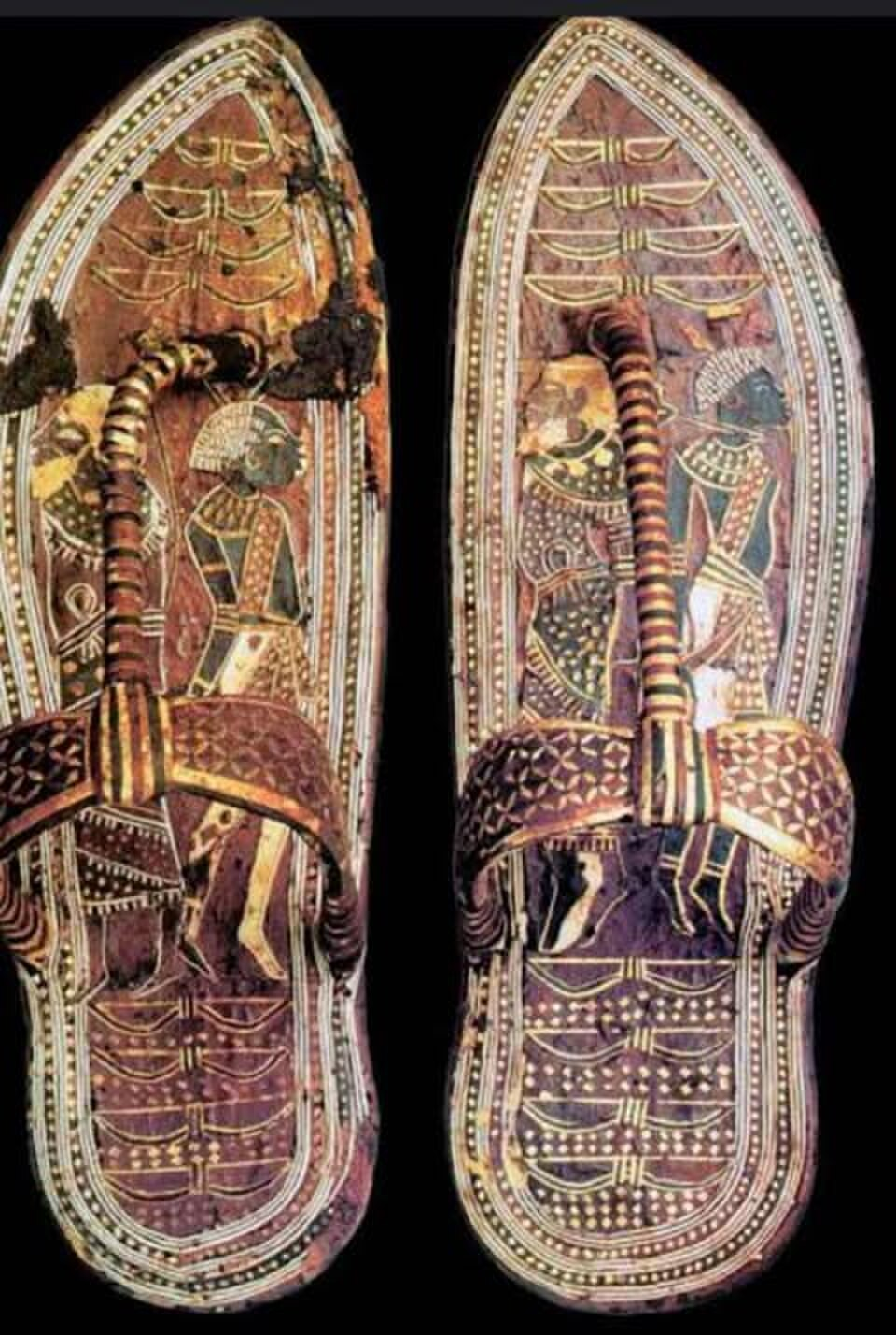
King Tutankhamun’s shoes were prepared for his use in the afterlife. (Erwin Muller Schneider/CC BY-SA 4.0)
The annex was a cramped space packed with more household items, like an overloaded moving van. Containers for the pantry (wine jars, cooking utensils, and food baskets), were prepared to hold the King's favorite foods. In case of illness in the afterlife, there was a box of medicine. Bed linens were folded neatly for the King's sleep, and textiles of many colors were prepared to construct new clothing. Since the King would need the best care, oils and perfumes were ready for his baths. Certainly, the King would enjoy games, so game boards await his pleasure, and for religious study and contemplation, ritual objects. Perhaps those who prepared Tutankhamun’s tomb considered his preferences during life since his burial goods included a bronze razor, a leopard skin mantle, soft robes and sandals, and even an alabaster cup with a saying,"Mayst thou spend millions of years...sitting with thy face to the north wind...beholding felicity."
The Burial Chamber: The King's Eternal Rest
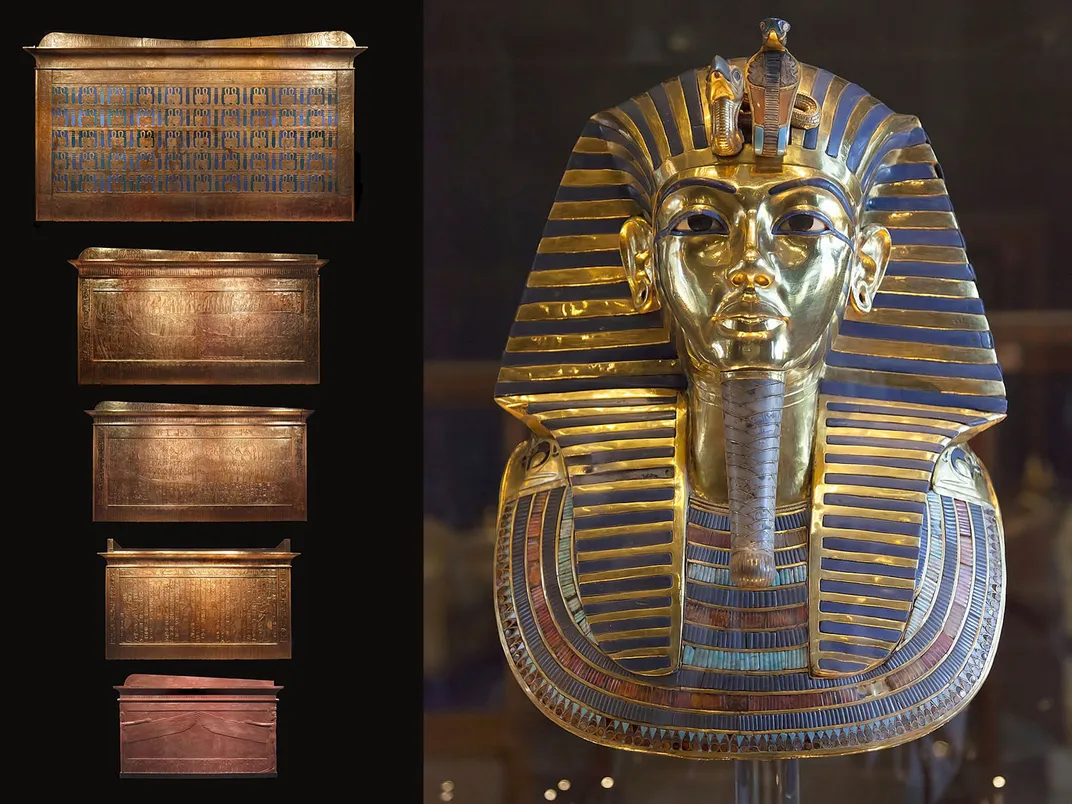
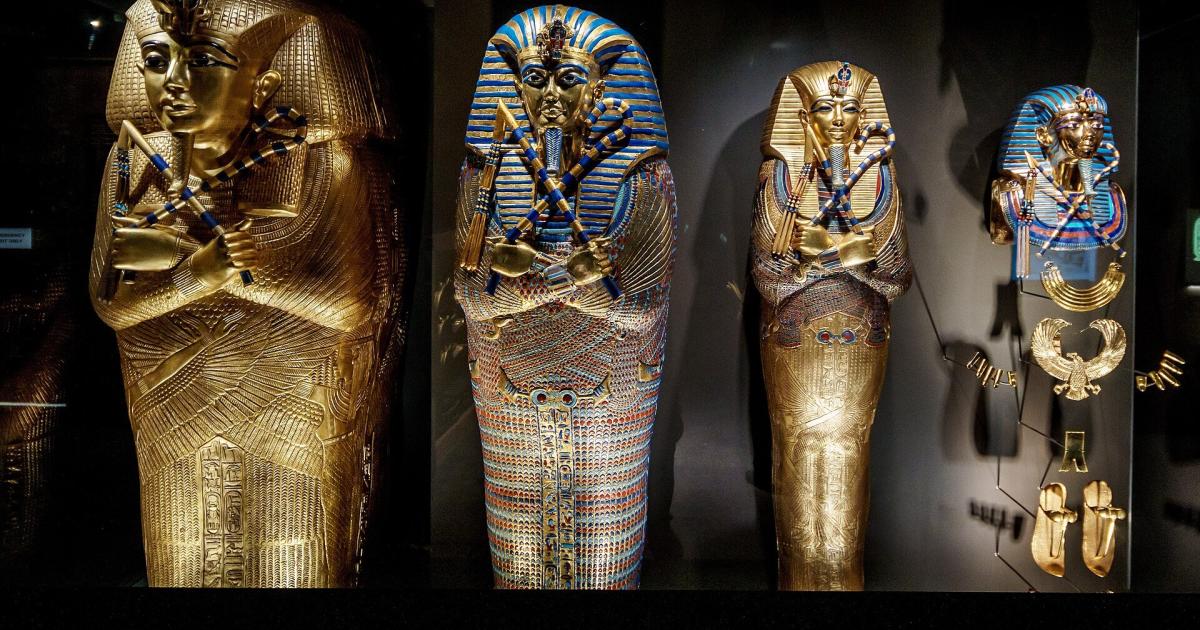
Tutankhamun's burial sarcophagus and nesting coffins (left) (Roland Unger/CC BY-SA 3.0) and right and his golden funerary mask (Mark Fischer/CC BY-SA 2.0)
The King’s burial chamber was filled with four golden shrines. In the center was a quartzite sarcophagus with a granite lid, carved with reliefs of goddesses on each corner, protecting the King with their winged arms. Later, as he opened the coffin to study the mummy, Carter recalled his “supreme and culminating moment” was raising the stone lid to see Tutankhamun’s golden coffin. Little space remained in the chamber. Canopies, amulets, and flower garlands covered every free area.
- Understanding the Monotheism of Akhenaten: Decay of a Dream and the Final Curtain Call–Part I
- Understanding the Monotheism of Akhenaten: Solar Disc Thrust into Eternal Darkness–Part II
The Treasury: Magic and Protection
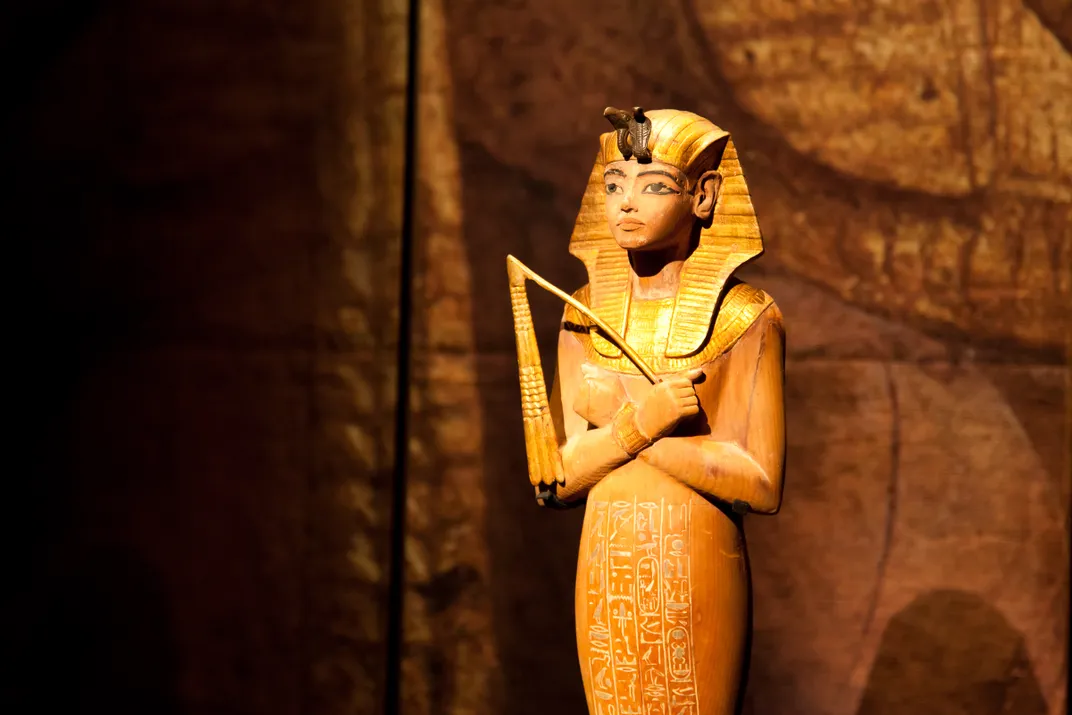
This is a partly gilded wooden ushabti found in the KV62 tomb of King Tutankhamun, from the 18th Dynasty of Egypt's New Kingdom, who reigned in the late 14th century BC. (Dave Nakayama/CC BY 2.0)
Inside the Treasury’s entrance stood a shrine to Anubis, the jackal god, presiding over a sacred space of magic and protection. Canopic jars held Tutankhamun’s internal organs. Model boats were prepared to sail with their King to the afterlife, and hundreds of shabti figures were ready to act as magical servants, answering the gods’ calls or doing manual labor. They would take the place of the King if the gods demanded that he perform any work. Chests of jewelry, amulets, and magical guardians filled the King’s spiritual vault.
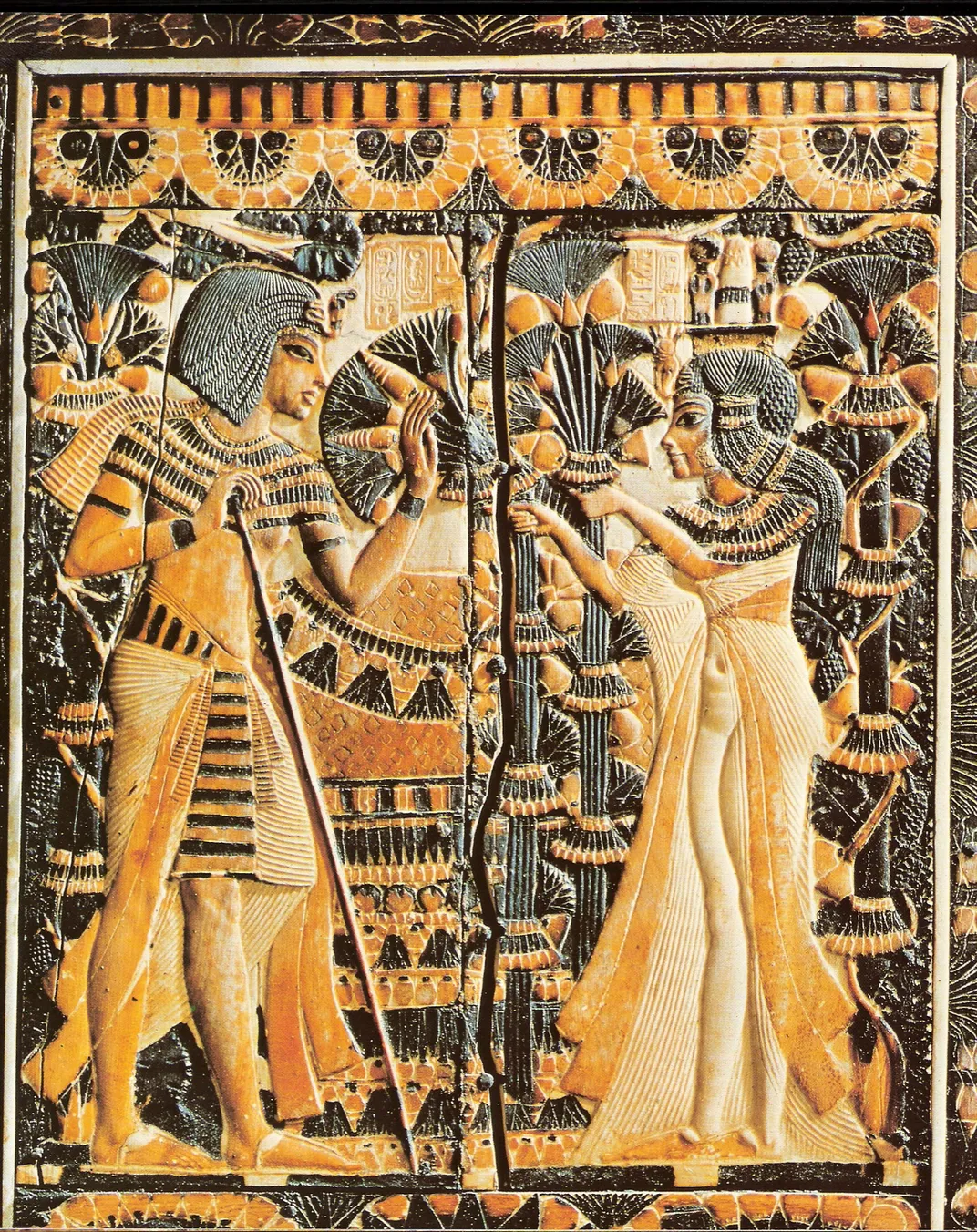
Tutankhamun and his half-sister (and wife), Ankhesenamun. (Tiger Cub/Public Domain)
Carter Believed the Tomb Was a Pathway to the Afterlife
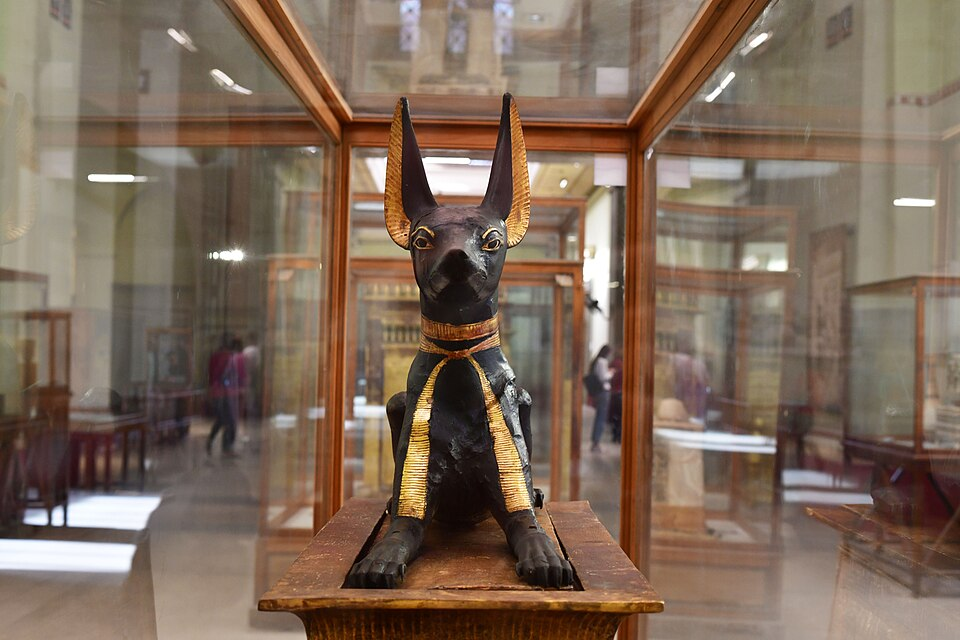
Jackal statues represented a path to the afterlife with spiritual protection (Panegyrics of Granovetter/CC BY-SA 2.0)
Carter interpreted the tomb as a ritual pathway meant to equip the deceased for the transition to the afterlife while allowing him to cherish the objects he had enjoyed in life. Walking through the tomb was an exploration of the aspects of preparation for the afterlife. The first room held the objects he would need in the afterlife and the means of transportation to the Field of Reeds. Other rooms held his supplies for his new existence, his spiritual protection, and reminders of his earthly existence. Tutankhamun’s tomb showed hurried burial preparations, with items stacked randomly rather than carefully displayed.
- The Boy King Behind the Mask: Tutankhamun’s Life and Legacy
- 28 ORIGINAL Photos from the Discovery of Tutankhamun’s Tomb
Carter's Excavation Still Shapes Archaeology Today
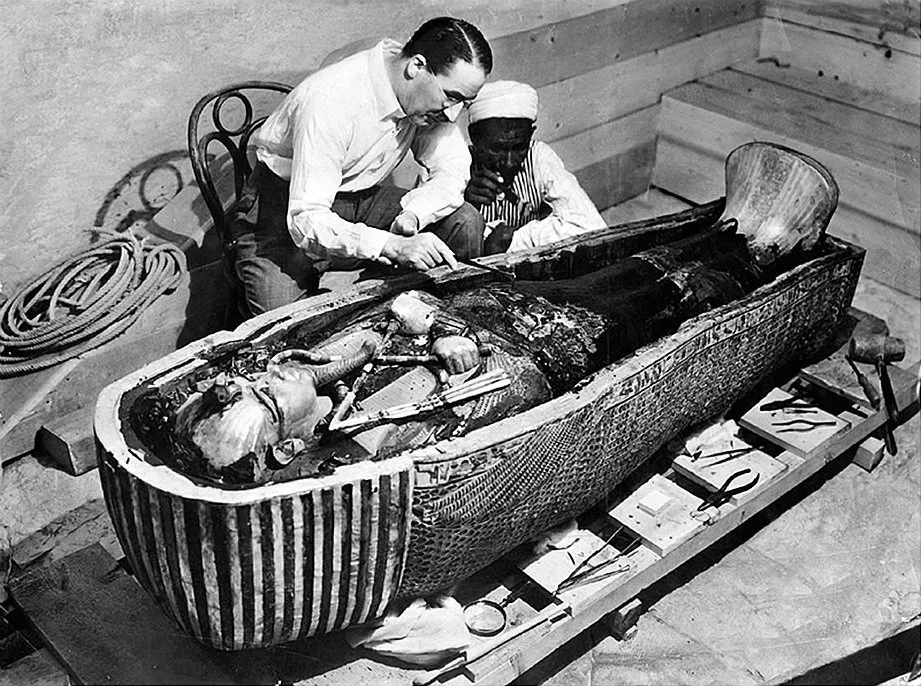
Howard Carter (left) and an unidentified Egyptian worker examine Tut's sarcophagus. (New York Times/Public Domain)
Howard Carter’s study of Tutankhamun’s tomb provides modern archaeologists with a model for analysis of sites and artifacts. His meticulous recording methods, coupled with Burton’s detailed photographs, provide the content that modern technology can enhance with 3D reconstruction and digital preservation. Today, those who cannot travel to Egypt can visit museums where they can view dramatic displays of the tomb and walk through virtual recreations of entering the tomb in 1922. Carter faced a challenge greater than any archaeologist before him. His record-keeping, artifact organization, and the recording and preservation of thousands of fragile artifacts were his gift to the study of the past.
Top Image: Tutankhamun's Nested Coffins and Royal Funerary Treasures. Source: Kenneth C. Zirkel/CC0 1.0
By Ramsey Hardin
References
Alchin, Linda. Facts about King Tut.
https://www.historyembalmed.org/life-of-king-tut/facts-about-king-tut.htm
Griffith Institute, University of Oxford. Burton Photographs: Discovering Tutankhamun in Color. Accessed June 26, 2026.http://www.griffith.ox.ac.uk/discoveringtut/burton5/burtoncolour.html
Griffith Institute. Tutankhamun Spatial Archive. University of Oxford. Accessed June 26, 2026.https://tutankhamun.griffith.ox.ac.uk/
Hawass, Zahi. King Tutankhamun: The Treasures of the Tomb. London: Thames & Hudson, 2022.
Pringle, Heather. "How Howard Carter Discovered King Tut's Golden Tomb." Smithsonian Magazine, November 3, 2022.https://www.smithsonianmag.com/history/how-howard-carter-discovered-king-tuts-golden-tomb-180981052/
Reeves, Nicholas. The Complete Tutankhamun: The King, the Tomb, the Royal Treasure. London: Thames & Hudson, 1990.
Wilkinson, Toby. A World Beneath the Sands: Adventurers and Archaeologists in the Golden Age of Egyptology. New York: W. W. Norton, 2020.