Sabine Hyland for The Conversation
Five centuries ago, the Incas ruled the western half of South America with the help of a unique form of writing based on coloured and knotted cords. These strings, called khipus, recorded major events, tracked economic matters, and even encoded biographies and poetry, according to the Spanish chroniclers who witnessed their use.
Most khipus have knots that indicate numbers that we can “read”, but we’ve lost the ability to interpret what those numbers mean. Recent discoveries are bringing us closer to deciphering these mysterious strings. In a remote community set high in the Peruvian Andes, my team and I have found khipus that were used by villagers to track climate change.
Annual Ritual Offerings and Sacred Spaces: A Tryst with Nature
Last year, I was invited to study the centuries-old khipus preserved in the village of Santa Leonor de Jucul in the Peruvian Andes. The 97 khipus conserved by villagers include the largest khipu in the world, which is over 68 metres long.
- Researchers Say New Find of Khipu Strings May Help Unravel the Inca Record-keeping System
- Silver cups from ancient Peruvian civilization change Chachapoya history
An elderly ritual specialist, Don Lenin Margarito, told me that the khipus recorded the annual ritual offerings given at different sacred places in the surrounding landscape. Miniature pink ritual bags stuffed with coca leaves and tobacco hang from the cords, representing the sacred purpose of these ancient strings. Rather than communicating through knots, the Jucul khipus record data with different kinds of tassels.

The gorgeous circular terraced bowl of Moray are thought to be an experimental agricultural nursery for the Incas, with different micro-climates allowing for different varieties of corn to be planted at deeper levels of the circular bowl. Others, both locals and foreign spiritually-minded, feel such a technical explanation fails to match the obvious effort, aesthetics and position the amazing circular site took. (Public domain)
For example, a tassel made of fuzzy beige llama tails indicates that an offering was performed at the sacred lake of Paccha-cocha, high in the mountains. The fluffiness of the llama tails is like a rain cloud, Don Lenin explained, representing the fact that offerings given at Paccha-cocha are thought to bring rain.
Different kinds of tassels indicate offerings made at other ritual sites, each one of which is thought to have its own effect on the local environment. Rituals involving the spirits of the dead, for instance, are thought to halt flooding. If you look at one of the Jucul khipus and you see that there were a lot of offerings to Paccha-cocha that year, you know that this was a time of drought since the offerings were given to increase the rain.
When speaking with community members, we learned that the khipus used to be kept in public so that they could be consulted by the elders. Andean people of the past looked at these khipus as a record of the climate, and they studied them to understand the patterns of what was going on, just as we do today.
New Methods for Dating: Ahead of the Curve
New methods for obtaining precise radiocarbon dates for khipus have been pioneered by a team headed by khipu researcher Ivan Ghezzi.
Efforts are now underway to get accurate radiocarbon dates for the Jucul khipus, which will provide a chronology of these climate-based offerings.

Painting of a man on horseback, facing the Peruvian Andes. (Alfred Thomas Agate/Public domain)
If we can chart the khipus and then date them, we will have a record of climate data from this region that was created by the local Andean people themselves. In their current state, the Jucul khipus are threatened by insects, mould and rodents. The British Museum recently granted funding to clean, preserve and display the khipus so that these precious objects from the Andean past will persevere into the future.
- A Step Closer to Reading the Inca Khipus Data Recording System
- Origin Myths of the Inca Civilization & Piecing Together Royal Heritage
There are only five villages in the Peruvian Andes where ancestral khipus are kept. These rare archives offer tantalising clues about how khipus encoded information.
Research in other villages with living khipu traditions has led to breakthroughs in the significance of khipu colour patterns and phonology. Many Inka khipus possess tassels which we believe may reveal the subject matter of the associated khipu. If we could unlock the significance of the tassels on the Jucul khipus, it might allow us to interpret more precisely the meaning of Inca cords.
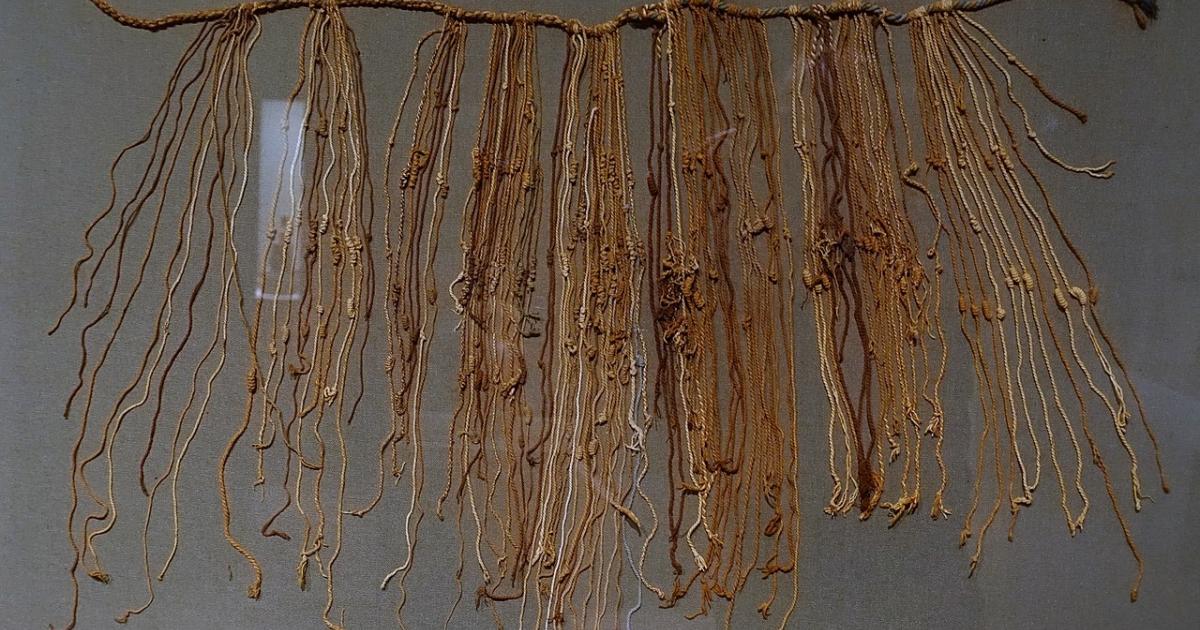
Top image: Fragmentary quipu (khipu), a main cord with top, subsidiary, & tertiary cords, Inca, Peru, Late Horizon, 1476-1534 AD, cotton, plant & camelid fiber. Source: Public domain
This article was originally published under the title ‘The Inca string code that reveals Peru’s climate history’ by Sabine Hyland on The Conversation, and has been republished under a Creative Commons License.