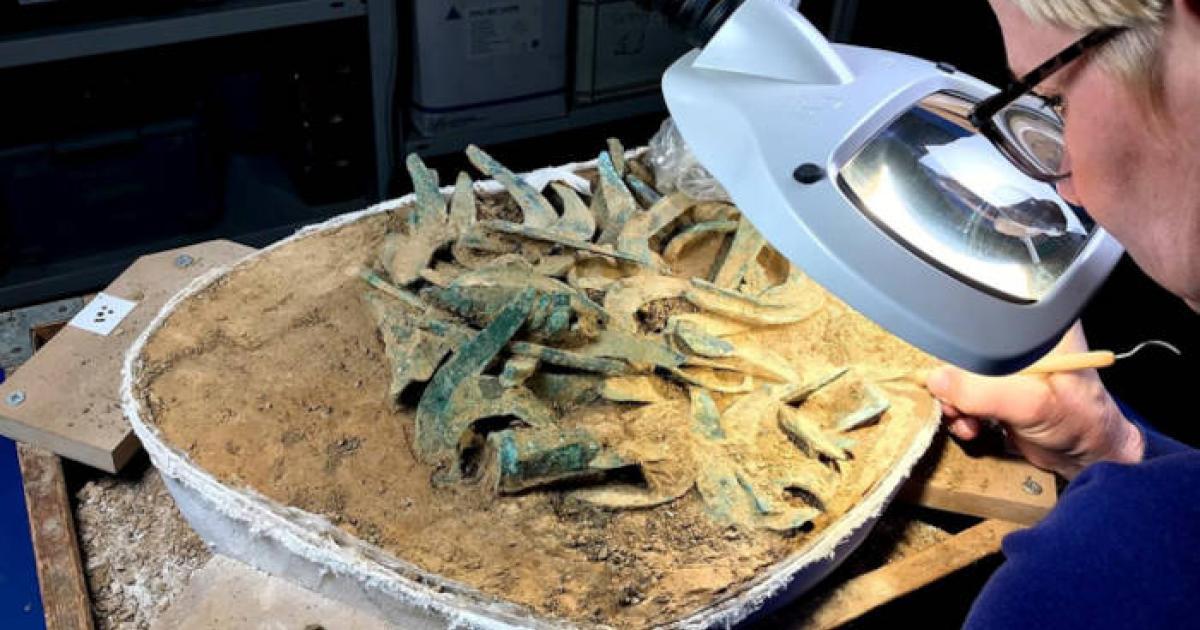

Archaeologists in eastern Germany have unearthed one of Saxony's most significant Bronze Age discoveries near Görlitz, uncovering 310 pieces of bronze artifacts dating to the 9th century BC. Weighing over 16 kilograms, this treasure trove represents the largest Bronze Age find ever made in Upper Lusatia and the second largest in all of Saxony, offering extraordinary insights into ancient ritual practices and Bronze Age craftsmanship.
Century-Old Mystery Finally Solved
The discovery in Klein Neundorf represents the culmination of archaeological speculation dating back over a century. In 1900, potato-harvesting children first found three bronze daggers in the area, with only one surviving today in the Görlitz Museum after the others disappeared during World War II. A socketed axe donated in 1902 led experts to suspect more artifacts lay hidden beneath the soil.
That suspicion proved correct when Dr. Jasper von Richthofen, director of the Görlitz Collections, led modern excavations in 2023 with the Saxony State Office for Archaeology. Metal detectorist Henry Herrmann initially found bronze sickle fragments, leading to the discovery of 108 scattered items disturbed by centuries of plowing. Soon after, the team revealed a dense cluster of artifacts preserved in their original context.
The concentrated deposit was excavated as a single block and analyzed in laboratory conditions from September 2023 to April 2024, revealing remarkable preservation and providing crucial data about Bronze Age metallurgy and ritual practices.
- What Did Bronze Age People Do With All That Bronze?
- Relics of Fallen Warriors in Germany Reveal Secrets of Bronze Age Battle
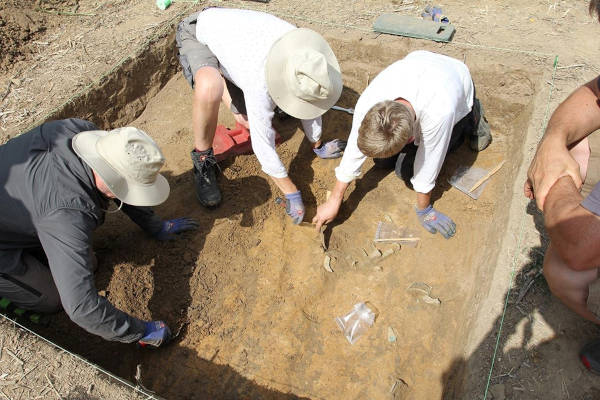
Archaeologists excavating the Bronze Age hoard. (Saxony State Office for Archaeology)
Treasures of Ancient Craftsmanship
The remarkable collection includes tools, weaponry, jewelry, garment fittings, and raw metal ingots. Among the most common finds are 136 sickles and 50 axes, demonstrating the agricultural and technological sophistication of Bronze Age communities. Notably, the hoard contains a Spindlersfeld-type brooch and a sword broken into four pieces, two of which were deliberately damaged in antiquity before deposition.
The reconstructed sword measures just 44 centimeters in length, featuring a pommel composed of two bronze shells enclosing an organic disc, likely bone or ivory. Specialists believe this weapon originated in southern Germany, indicating extensive long-distance trade networks throughout Central Europe during the Late Bronze Age.
Sacred Ritual Offering
Researchers determined the objects were carefully arranged in a pit measuring 30 to 35 centimeters wide and 50 centimeters deep. Although no container survived, ground impressions suggest the artifacts were organized in small, neat groups. Given bronze's rarity and value during this period, scholars believe the treasure was buried as a ritual offering rather than for safekeeping, reflecting Bronze Age spiritual practices and beliefs about divine appeasement.
Saxony's Minister-President Michael Kretschmer emphasized the discovery's significance:
"Already 3,000 years ago, the people in this area practiced various craft techniques and were in contact beyond their immediate area. These precious artifacts are now able to tell us much more about this era."
State Archaeologist Regina Smolnik noted the exceptional nature of the find:
"A discovery of a hoard is not a daily occurrence and presents us with special challenges in restoration, documentation, and analysis. Thorough research will bring us new knowledge about the rituals and relations of the Bronze Age Lusatian culture."
Scientific Legacy and Future Display
The artifacts are currently undergoing comprehensive restoration and scientific analysis, including corrosion examination and use-wear testing. A doctoral project at Ludwig Maximilian University in Munich focuses specifically on this assemblage, ensuring thorough scholarly investigation of the materials and their cultural context.
Once scientific work concludes, the hoard will be displayed in a special exhibition in Görlitz, returning these ancient treasures to the region where they were ceremonially interred three millennia ago. This discovery not only illuminates Bronze Age technological capabilities but also provides crucial evidence of the complex ritual and social systems that characterized early European civilizations.
Top image: The hoard still cased in the earth it was found in, being processed at the laboratory. Source: Saxony State Office for Archaeology
By Gary Manners