
A Giant Hidden in Gujarat
The discovery was described in the open-access Scientific Reports study by Debajit Datta and Sunil Bajpai. The fossils came from the Panandhro Lignite Mine in Kutch, where the bones were found in a grey shale layer dating to the early Middle Eocene, a warm interval when average temperatures may have reached about 28 degrees Celsius (82 degrees Fahrenheit).
The species name refers to Vāsuki, the mythical serpent associated with the Hindu god Shiva, while indicus identifies its country of origin. Its vertebrae were unusually broad and massive, suggesting a thick, cylindrical body rather than the slimmer build of a fast-moving snake. That anatomy is one reason the scientists think Vasuki was probably a slow-moving ambush predator, more comparable in strategy to a large python or anaconda than to an active hunter.
- Titanoboa: The Monster Snake that Ruled Prehistoric Colombia
- The Giant Anaconda: Is There a Monster in the Amazon?
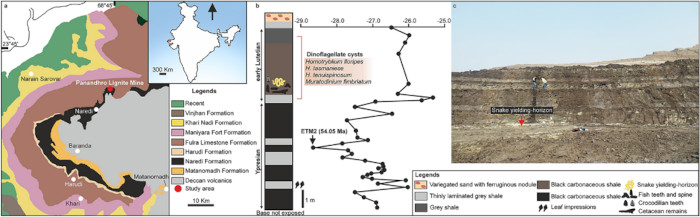
The Kutch Basin map identifies the Panandhro fossil locality. (D. Datta and S. Bajpai/CC BY 4.0)
What the Bones Reveal
The research team used two regression methods that compare vertebral measurements with the body lengths of living snakes. One produced an estimate of 10.9 to 12.2 meters, while the other gave 14.5 to 15.2 meters; the authors note that missing rear vertebrae and limited knowledge of variation within extinct madtsoiids make the larger figure provisional. In other words, Vasuki may have rivaled Titanoboa, but the fossil cannot yet prove that it was longer.
The bones also place the snake within Madtsoiidae, an extinct lineage that survived for roughly 100 million years across former Gondwanan regions. The lineage links Vasuki with Madtsoia from India and Gigantophis from North Africa, supporting the idea that giant snakes spread through southern Eurasia as India moved north and collided with Asia. The story adds a deep-time dimension to the Ancient Origins account of Titanoboa, which remains one of the best-known examples of prehistoric snake gigantism.
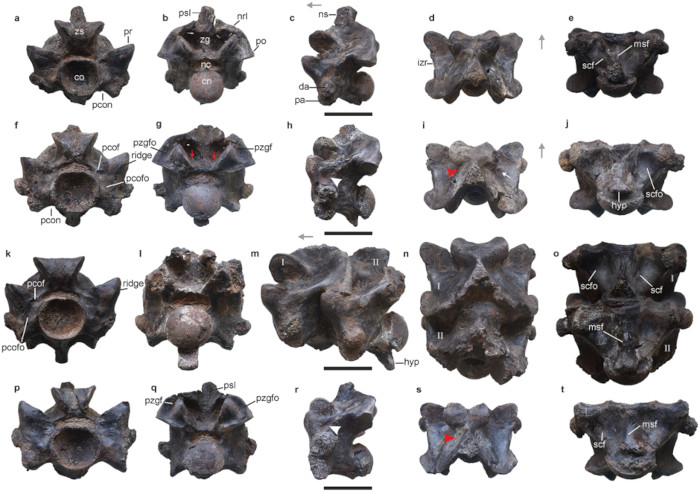
Fossilized trunk vertebrae assigned to Vasuki indicus. (Datta and Bajpai, Scientific Reports/CC BY 4.0)
An Ancient Wetland Predator
The fossil-bearing deposits point to a back-swamp marsh, an environment that could have supported a huge terrestrial or semi-aquatic snake. A 2025 Journal of Paleontology study by the same researchers found that Kutch held a diverse Eocene snake community, including aquatic species and another madtsoiid, suggesting that several snakes shared the wetlands while occupying different ecological niches. That wider fossil record complements other Ancient Origins coverage, including reptile fossils that pushed back the known history of reptiles.
The follow-up work suggests that some of Kutch’s ancient snakes lived in tidal settings, while others occupied marshes and swamps. Vasuki therefore appears to have been part of a layered ecosystem rather than an isolated curiosity. Its size was extraordinary, but the surrounding fossils show that the Eocene landscape supported a whole community of specialized reptiles.
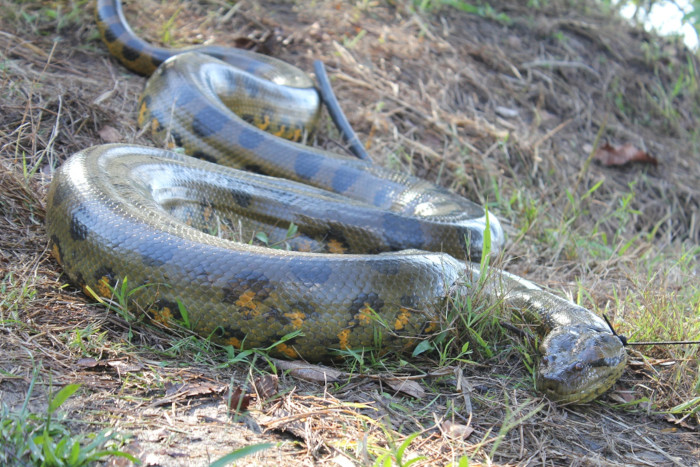
Modern green anaconda, shown as a comparison for the ambush-predator lifestyle proposed for Vasuki. (Tserres34/CC BY-SA 4.0)
A separate 2025 study of fossil anacondas found that the South American snakes had already reached impressive sizes by about 12.4 million years ago, offering another example of gigantism evolving in warm environments. But warmth alone cannot explain every giant snake: food supply, habitat, body design and ancestry also matter. For now, Vasuki indicus is best understood not as a proven record-breaker, but as a remarkable glimpse of a time when India’s wetlands were home to serpents on a scale difficult to imagine today, much like the colossal Yacumama serpent of Amazonian tradition.
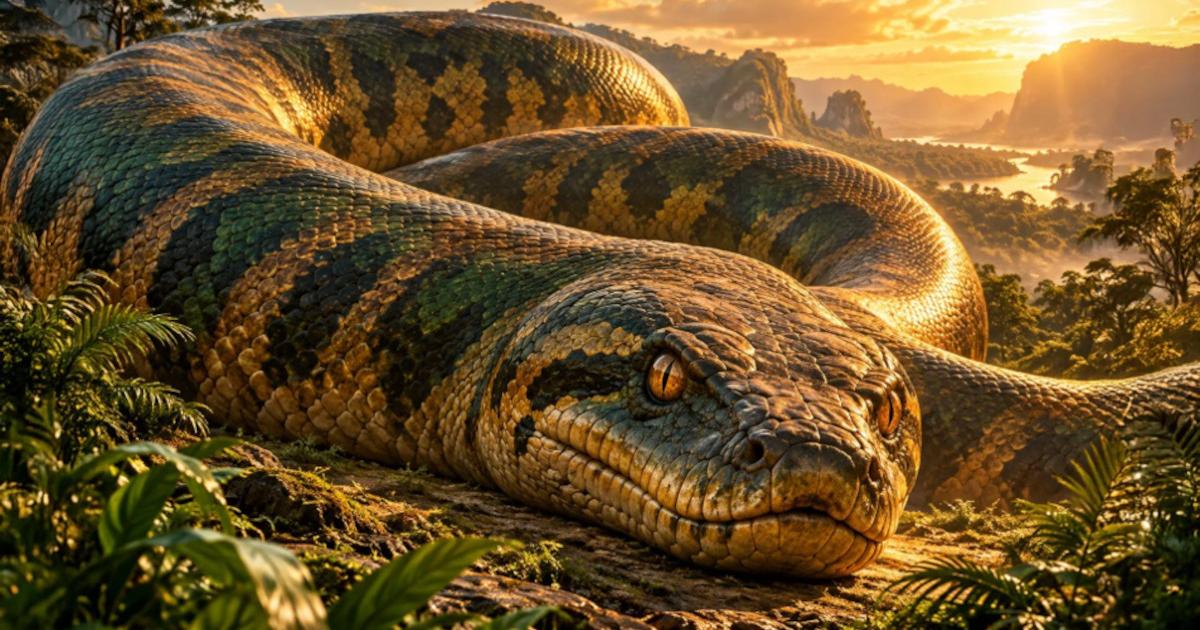
Top image: AI generated impression of Vasuki indicus. Source: AI/Science Daily
By Gary Manners
References
Alfonso-Rojas, A. F., Carrillo-Briceño, J. D., Sánchez, R., Sánchez-Villagra, M. R., and Head, J. J. 2025. An early origin of gigantism in anacondas (Serpentes: Eunectes) revealed by the fossil record. Journal of Vertebrate Paleontology. Available at: https://doi.org/10.1080/02724634.2025.2572967
Datta, D. and Bajpai, S. 2024. Largest known madtsoiid snake from warm Eocene period of India suggests intercontinental Gondwana dispersal. Scientific Reports. Available at: https://doi.org/10.1038/s41598-024-58377-0
Datta, D. and Bajpai, S. 2025. Fossil snakes from the Eocene of India: new material with comments on phylogenetic relations and biogeographic and paleoecological implications. Journal of Paleontology. Available at: https://doi.org/10.1017/jpa.2025.10101
ScienceDaily. 2026. Gigantic prehistoric snake discovered in India may have been one of the largest ever. Available at: https://www.sciencedaily.com/releases/2026/10/261014001406.htm