


For centuries, pilgrims, priests, and pharaohs brought gifts to Karnak, the vast temple complex that stood at the religious heart of ancient Egypt. Sacred vessels and statues had accumulated within its precincts over generations from the Middle Kingdom through the Ptolemaic Period. Some objects adorned living worshippers. Others decorated divine statues or accompanied ritual ceremonies dedicated to the god Amun. Many eventually vanished from sight, buried beneath the sands of Luxor and forgotten for thousands of years.
1903: The Karnak Cachette — 17,000 Bronze Statues Found Beneath the Temple
The story of Karnak's hidden treasures dazzled the world with beauty and wealth when the French Egyptologist Georges Legrain uncovered one of the greatest archaeological deposits ever found at the temple complex in Karnak, Egypt. While part of the temple complex was being cleared, a massive underground cache was found buried near the seventh pylon of the Temple of Amun. Known today as the Karnak Cachette, the treasure hoard included 17,000 bronze statues, 700 stone statues, stelae, and ritual objects spanning several centuries. The cachette actually consisted of numerous deposits of statues, bronzes, and religious monuments. The jewelry represented only a tiny portion of the cachette. The excavation showed that Egyptian priests had carefully buried the sacred items to provide protection and create more space in the temple precinct. Amongst the finds were gold amulets, gemstones, and ceremonial ornaments that could offer an in-depth understanding of the wealth and religious life of ancient Egypt.
- The Awe-Inspiring Karnak Temple Complex and the Vatican of Ancient Egypt
- Gold Amulets and Jewelry from Egypt’s 26th Dynasty Found at Karnak Temples
2025: A Ceramic Vessel Reveals 2,600-Year-Old Gold Jewelry
More than a century later, Karnak continued to share breathtaking treasures. In 2025, archaeologists working near the northwestern sector of the temple uncovered a ceramic vessel containing Saite Period gold jewelry, such as beads, small figures, and amulets. The discovery showed that even after several generations of continued excavation, Karnak still hides spectacular artifacts beneath its ancient foundations. Unlike the 1903 cachette discovery, this discovery represented a specific deposit of valuables stored in a pottery vessel rather than a massive ritual burial of thousands of temple objects.
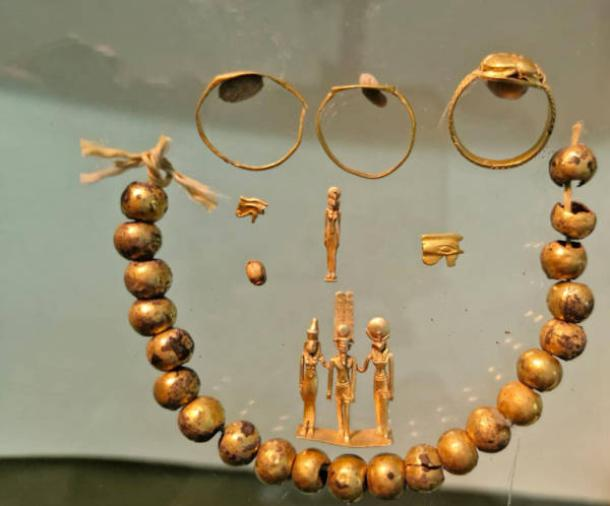
Golden jewelry and amulets discovered in Karnak Temples in 2025. (Ministry of Tourism and Antiquities of Egypt)
The discovery followed ongoing excavations in the far northern area of the Temple of Karnak, where the team has uncovered large mudbrick structures once believed to have served as workshops or storage facilities during the early period of the 26th dynasty.
“This specific part of Karnak has yielded significant evidence of the temple’s economic activities during the Late Period,” said Dr. Jérémie Hourdin, co-director of the mission from the French side.
What the 2025 Find Reveals About Karnak's Economic Life
The discovery has revealed a growing body of evidence suggesting that Karnak remained not only a principal center of religious worship but also a hub of economic and artisanal activity well into the first millennium BC. While earlier phases in Karnak’s history - such as its lavish expansions during the New Kingdom - have long attracted significant scholarly attention, the new finds underscored that the Temple of Karnak remained significant well into later periods.
The jewelry is now undergoing conservation. The pieces will soon be on display at the Luxor Museum, offering visitors a glimpse into the artistry and devotional traditions of ancient Thebes.
“This discovery reminds us that Karnak still holds countless secrets beneath its sands,” said Dr. Abdel-Ghaffar Wagdy, Director General of Luxor Antiquities and co-director of the mission.
“Each find brings us one step closer to understanding the life of the people who served the gods here across millennia.”
A Guide to Ancient Egyptian Jewelry: What Each Piece Meant
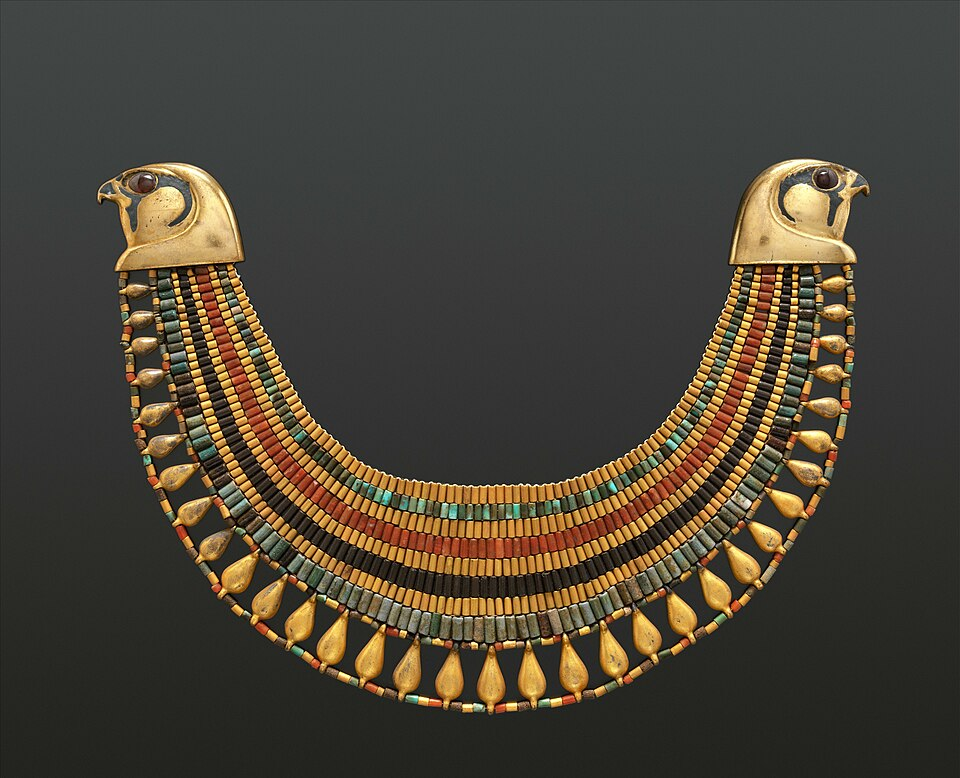
Ancient Egyptian broad collar (wesekh collar) featuring falcon-head terminals and multicolored beadwork. (Rogers Fund, 1908/CC0 1.0)
Among the most easily distinguished pieces of Egyptian jewelry is the wesekh, or broad collar. These elaborate necklaces are composed of multiple rows of beads fashioned from precious materials such as gold, faience, lapis lazuli, carnelian, turquoise, and glass. Principally worn by royalty, elite officials, and priests, broad collars were once considered status symbols and sacred objects.
- Karnak Obelisk Built for Legendary Queen Hatshepsut Re-erected in Egypt
- Dress Like an Egyptian: Fashion, Style, and Simplicity in Ancient Egypt
Within temple art, gods and goddesses alike frequently wore magnificent collars, linking these pieces of jewelry directly to divine power. Wealthy Egyptians would often commission broad collars for funerary use, believing these sacred symbols would protect them in the afterlife.
Pectorals: Sacred Stories in Gold
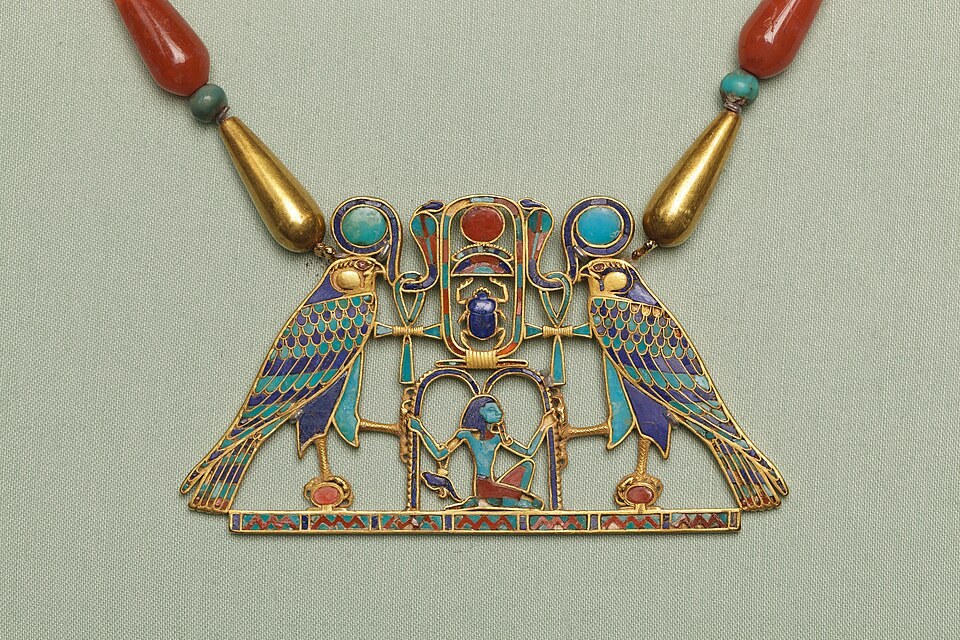
Pectoral and Necklace of Sithathoryunet with the Name of Senwosret II. Egyptian pectorals transformed precious metals and gemstones into visual statements of divine kingship and cosmic protection. (Metropolitan Museum of Art/CC0 1.0)
Pectorals were among the most sophisticated pieces of jewelry produced in ancient Egypt. Suspended from the neck and worn over the chest, these ornaments often showed quite detailed scenes rendered in gold and semi-precious stones.
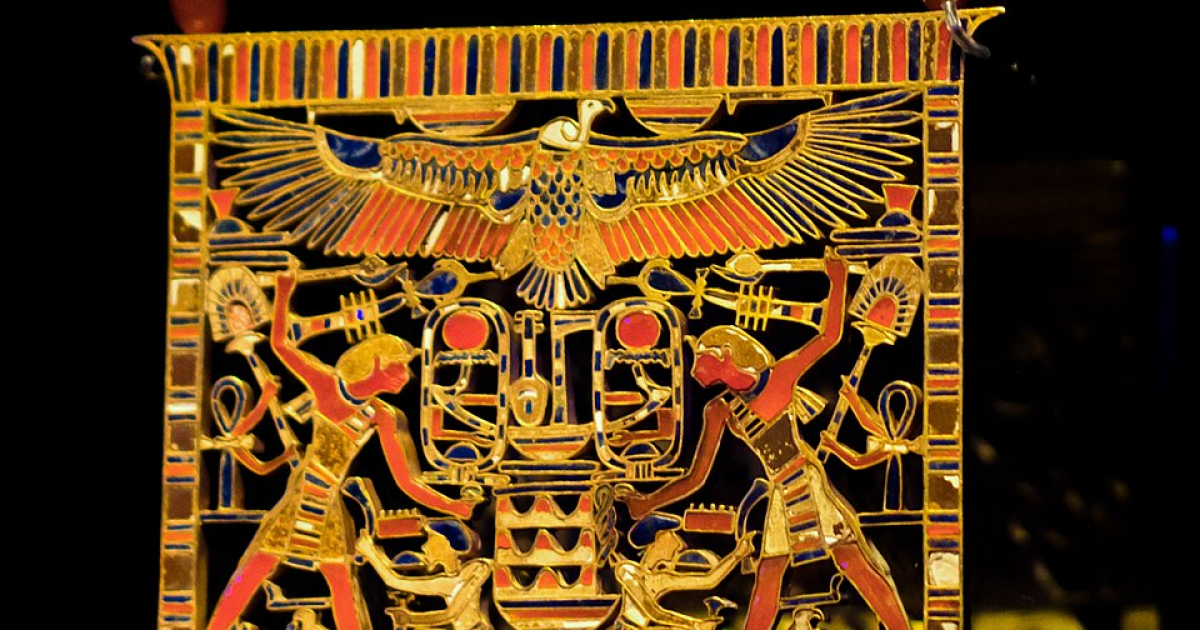
Many different types of pectorals would also be formed in the shapes of solar symbols, protective deities, or royal names enclosed with several cartouches. Some pectorals even celebrated the divine authority of pharaohs, while others could invoke the protection of Amun, Isis, and Horus.
- Dazzling Nebmaatre: Queen Tiye, the Matchless Matriarch
- The Brilliantly Blue Lapis Lazuli: Precious Gem Prized by Elites
Ancient Egyptian goldsmiths combined gold with imported lapis lazuli from Afghanistan and carnelian from Egypt's deserts to create miniature masterpieces that conveyed both religious devotion and political power.
Scarab Rings: Symbols of Renewal
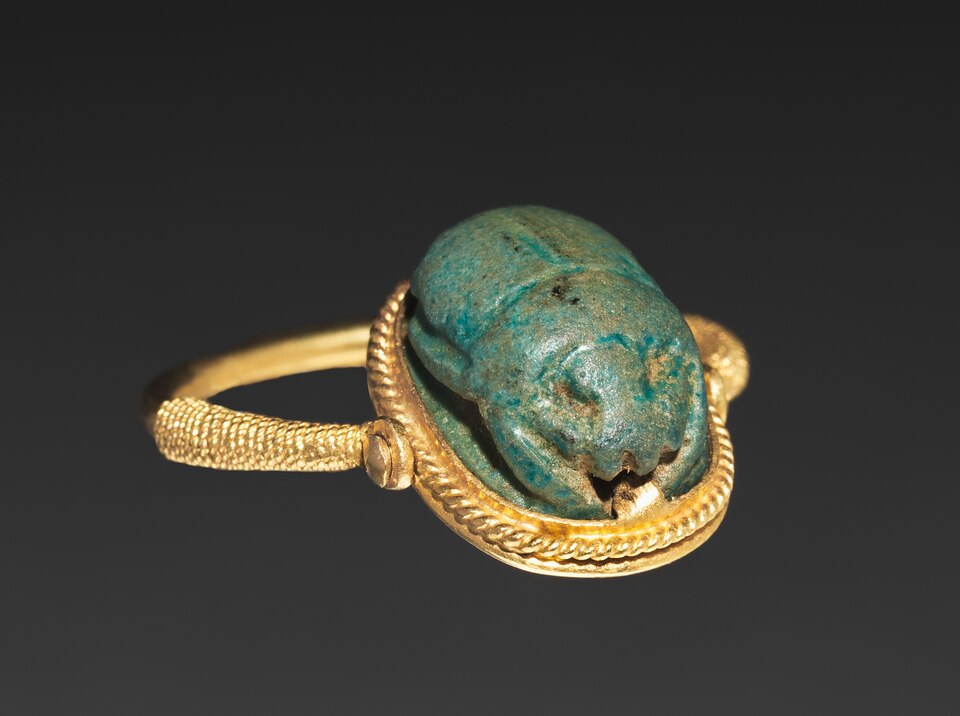
Gold scarab ring from Ancient Egypt's New Kingdom period (1540–1069 BC). The scarab symbolized Khepri, the god of rebirth and the rising sun. (Eva Catherine Brown /CC0 1.0)
The scarab beetle occupied a special place in Egyptian religious tradition. Inspired by the behavior of dung beetles rolling spheres across the ground, Egyptians associated scarabs with Khepri, the god of the rising sun and daily rebirth.
Due to this deeply embedded religious tradition, Scarab rings became popular among both Egyptian elites and temple staff. Some even bore royal names, while others were inscribed with texts primarily intended to safeguard the wearer from danger. Examples of scarab jewelry recovered from the Temple of Karnak reveal how jewelry served as a crucial part of Ancient Egyptian cultural traditions and social status. A scarab ring was never merely decorative. It also served as a portable symbol of one’s faith.
Amulets Worn by Priests and Sacred Statues
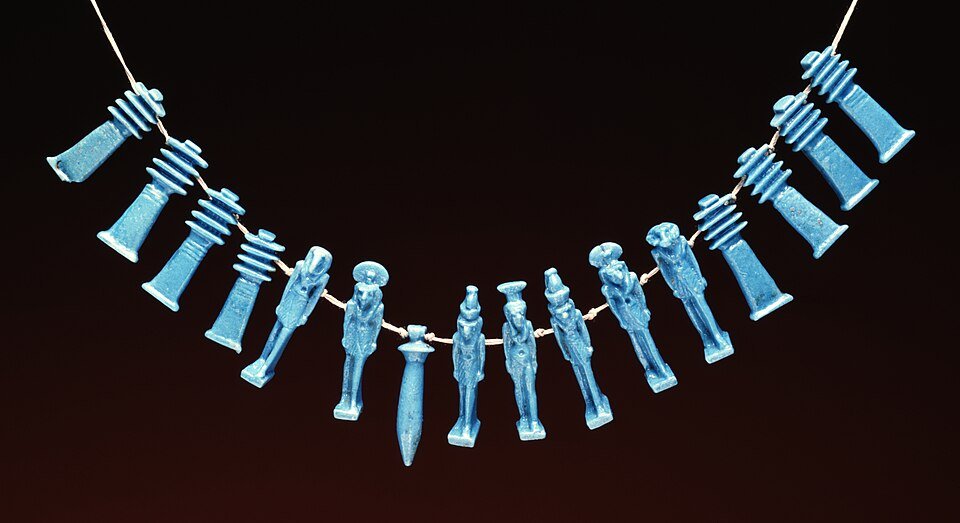
Ancient Egyptian faience necklace featuring amuletic pendants and symbolic figures. (Henry Walters/VRT Permission)
Not all jewelry that’s been recovered from Karnak was ever intended for humans to wear. Priests would routinely adorn cult statues of their gods with these precious amulets, necklaces, and ornaments during sacred temple rituals.
The 2025 discovery uncovered several amulets that may once have belonged to temple personnel or formed part of specific ritual offerings dedicated to the Egyptian pantheon.
- Lustrous Gems As Amulets And Talismans Of Ancient History
- Think Egypt Think Magic: Essence of Spells, Incantations, Amulets and Absolute Faith
Amulets depicting the all-seeing eye of Horus, the djed pillar, and the ankh symbol were also believed to possess certain protective powers. These objects played an active role in religious ceremonies and were treated as sacred instruments rather than mere decorations.
Necklaces Symbolized Power and Status
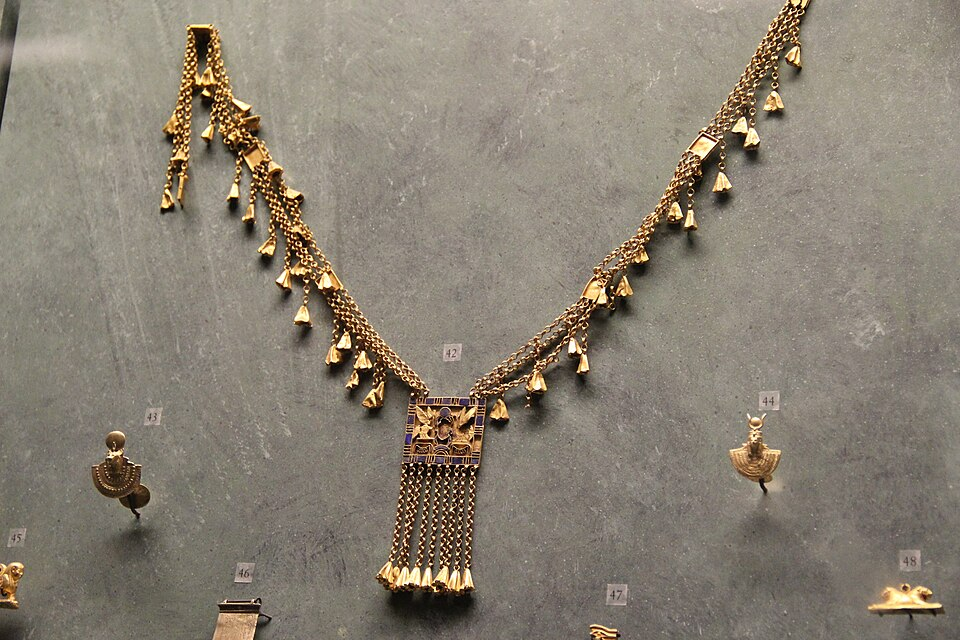
Ancient Egyptian Gold Necklace (Pectoral Necklace with Pendant) (Gary Todd/CC0 1.0)
Necklaces filled with brightly colored stones were popular with all Egyptians. Pharaohs and nobles wore elaborate necklaces as symbols of power and status. Priests appeared in the temple, adorned with specific necklaces during religious ceremonies to signify their role. Necklaces often represented protection, fertility, and the divine connection to the gods.
Necklaces could also be less serious. Women wore jewelry for beauty and as a display of wealth, often made of gold and precious stones. Even children sometimes wore simpler necklaces as protective amulets or for adornment. They were frequently bought for a funeral, where they were included in burial items to accompany the deceased in the afterlife.
The 2025 Ring and Amulet Discovery in Detail
The 2025 find contained an impressive collection of gold rings, beads, and amulets preserved within a ceramic vessel. Archaeologists believe the objects may have been intentionally deposited during the Late Period or the early Ptolemaic era. Professor Mohamed Abdel Badie, Head of the Egyptian Antiquities Sector, indicated that the jewelry collection includes rings made of gold and metals, small golden amulets, including a triple statue of the ancient Egyptian gods Amun, Mut, and Khonsu, in addition to a metal brooch, amulets representing the gods in animal forms, and a large number of beads, some of which are plated with gold.
Unlike royal tomb treasures discovered elsewhere in Egypt, these artifacts offer an incredible insight into the religious community centered directly around Karnak. The jewelry also appears directly connected to temple life, ritual activity, and the priestly elite who could manage one of the ancient world's most sacred religious spaces.
- Questing the Most Impressive Ancient Religious Temples in the World
- Amun, The Creator God Whose Supremacy Surpassed Egypt
This recent archaeological discovery also demonstrates the extraordinary wealth that flowed through Egypt and, by extension, Karnak during such a long history.
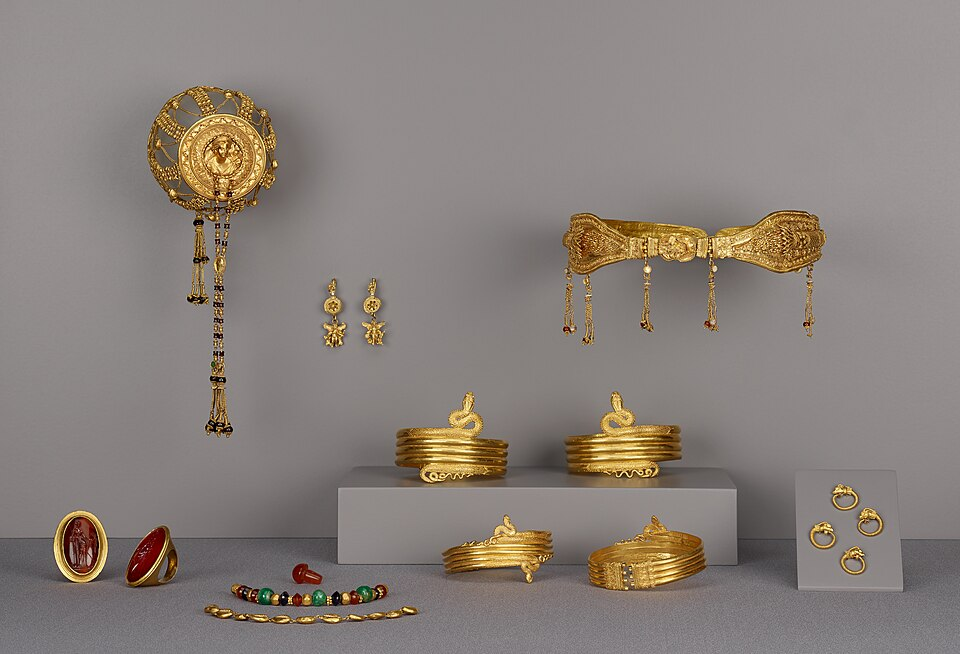
Collection of Ptolemaic Jewelry, (Getty Villa/J. Paul Getty Museum, Getty Research Institute Open Content Program)
A New Style for a New Egypt
What must be distinguished is that by the Late Period and the Ptolemaic era Egyptian jewelry was influenced by the entire Mediterranean world. Egyptian symbols would remain important, but the artists could at last experiment with so many new decorative styles and myriad techniques.
Some pieces recovered from the recent excavations at Karnak combined centuries-old traditional religious imagery with artistic elements introduced by expanding international markets now open to Egypt’s Mediterranean ports. The most famous of these port cities would be Alexandria, the capital of the first Ptolemies and later the administrative center of the Roman Empire in Egypt. These same objects show the transition in Egyptian culture, adapting but still preserving its core religious traditions.
At the Temple of Karnak, such breathtaking jewelry illustrates a rich and dynamic civilization that remained deeply connected not only to its ancient heritage but also to foreign influences that reshaped the political landscape of this ancient land.
Where Karnak's Treasures Are Today
Today, many incredible treasures from Karnak are preserved in the Egyptian Museum in Cairo, the Luxor Museum, and other collections throughout Egypt itself. Together, they reveal a world in which jewelry served more than personal decoration.
- Amenhotep III, the Man and his Monuments: Sparkling Glories of the Magnificent One – Part I
- Amenhotep III, The Man and his Monuments: Age of Empire and Architecture –Part II
Whether buried by priests in the Karnak Cachette of 1903 or recovered from the newly discovered vessel in 2025, these remarkable objects continue to illuminate the lives, beliefs, and ambitions of the people who served one of ancient Egypt's greatest temples. More than beautiful artifacts, they are enduring reminders of a priestly elite whose wealth and religious devotion helped make Karnak the spiritual center of a civilization that still captivates the modern world.
Top Image: A 12th dynasty Egyptian Middle Kingdom pectoral made of gold and semi-precious stones (carnelian, turquoise, and lapis lazuli) belonging to Mereret, the daughter of King Senusret III and sister of King Amenemhat III. Source: D. Denisenkov/CC BY-SA 2.0.
By Ramsey Hardin
References
Bard, Kathryn A., ed. An Introduction to the Archaeology of Ancient Egypt. 2nd ed. Hoboken, NJ: Wiley-Blackwell, 2015.
Blyth, Elizabeth. Karnak: Evolution of a Temple. London: Routledge, 2006.
Centre Franco-Égyptien d'Étude des Temples de Karnak. Centre Franco-Égyptien d'Étude des Temples de Karnak. Accessed June 30, 2026. Available at: https://www.cfeetk.cnrs.fr/
Chen, Min. "Archaeologists Uncover 'Important' Stash of Gold Jewelry in Ancient Egyptian Temple." Artnet News. March 5, 2025. Accessed June 29, 2026. Available at: Artnet News article
Dodson, Aidan. Afterglow of Empire: Egypt from the Fall of the New Kingdom to the Saite Renaissance. Cairo: American University in Cairo Press, 2012.
Egyptian Ministry of Tourism and Antiquities. "Egyptian-French Archaeological Mission Discovers Gold Jewelry Cache at Karnak Temples." 2025. Accessed June 30, 2026. Available at: https://egymonuments.gov.eg/.
Georges Legrain. Les Temples de Karnak. Cairo: Institut Français d'Archéologie Orientale, various volumes, 1903–1929.
Gifford, Claire. "2,600-Year-Old Jewelry Stash from Ancient Egypt Includes Gold Statuette Depicting Family of Gods." Live Science. March 5, 2025. Accessed June 29, 2026. Available at: Live Science article
"Gold Jewelry Found at Karnak Temple." Archaeology Magazine. March 3, 2025. Accessed June 29, 2026. Available at: https://archaeology.org/news/2025/03/03/gold-jewelry-found-at-karnak-temple/
Griffith Institute. Griffith Institute, University of Oxford. Accessed June 29, 2026. Available at: Griffith Institute.
Shaw, Ian, ed. The Oxford History of Ancient Egypt. Oxford: Oxford University Press, 2000.
Sullivan, Erin Blakemore. "See the Stunning Golden Jewelry, Amulets and Small Statues Unearthed at an Ancient Egyptian Temple." Smithsonian Magazine. March 12, 2025. Accessed June 29, 2026. Available at: Smithsonian article.
University of California, Los Angeles. UCLA Encyclopedia of Egyptology. Accessed June 29, 2026. Available at: UCLA Encyclopedia of Egyptology
Wilkinson, Richard H. The Complete Temples of Ancient Egypt. London: Thames & Hudson, 2000.
























