

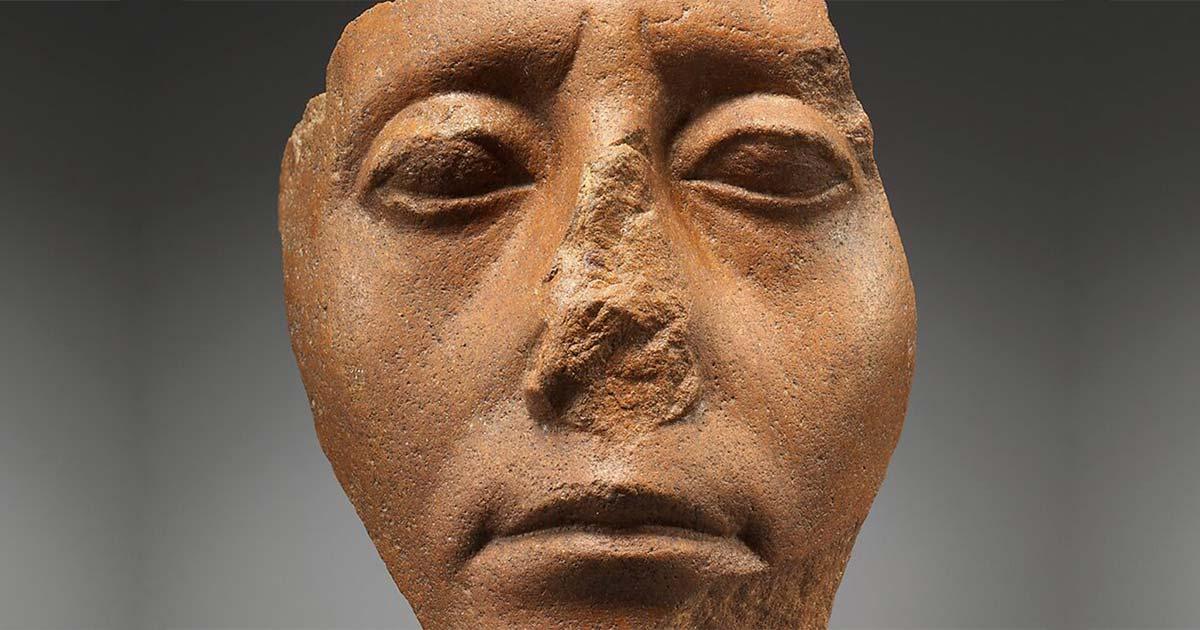

The missing noses on ancient Egyptian statues have been a topic of discussion and curiosity within art history circles for many years. It is a common question that many people ask: why are the noses missing from so many of these ancient artifacts? Some wonder if it is simply a coincidence or if there is a deeper, more sinister reason behind the phenomenon.
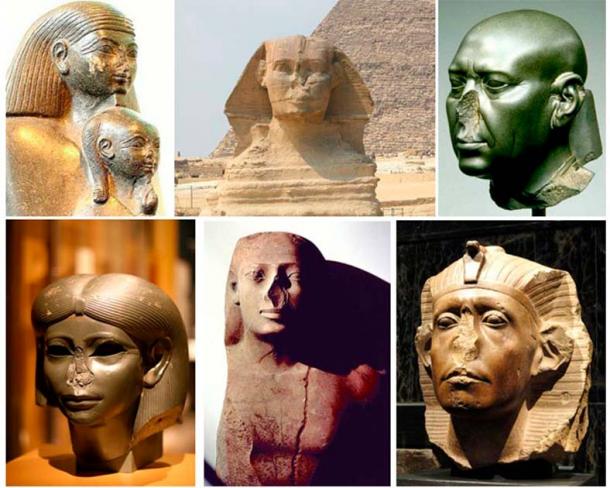
Some of the many Egyptian statues missing their Egyptian noses - Neferure and Senenmut (CC BY SA 3.0), Great Sphinx of Giza (Diego Delso / CC BY SA 3.0), 'Green Head' of a statue of a priest (Society for the Promotion of the Egyptian Museum Berlin), Head from a female sphinx (Brooklyn Museum), statue of a Man (Public domain), and Senusret III (Public domain).
Has Natural Erosion Played a Role in Creating Noseless Statues?
Several archaeologists have suggested erosion could be one of the main reasons for the missing Egyptian noses. Harsh winds, shifting mud and sand dunes, the flowing of water and thousands of years of feet and hands pitter-pattering over relatively delicate materials such as marble and stone will most likely have a pretty damaging effect.
- Why No Nose? The Ancient Breath of Life and Remarkably Powerful ‘Living Statues’
- Saint Aebbe Cut Off Her Nose to Spite Her Face
Many of these ancient Egyptian statues have been exposed to these elements for a very long time, while others have been buried under tons of mud and sand for centuries. In these cases, it's usually the extremities, such as arms, legs and noses that get damaged the most and eventually disappear. But, is this really the reason for why so many ancient Egyptian statues are missing their noses?
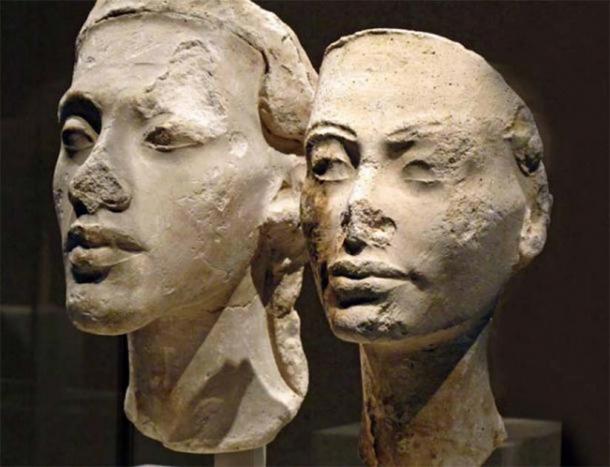
Busts of Akhenaten and Nefertiti, both displaying missing Egyptian noses. (kairoinfo4u / CC BY NC SA 2.0)
Human Intervention as a Major Factor Behind Missing Egyptian Noses
The frequent occurrence of missing noses on ancient Egyptian statues has also been attributed to vandalism. This phenomenon is not unique to Egypt and can be observed in other historical sites. For instance, the statue of the renowned philosopher Aristotle, situated at the entrance of the ancient Assos site in Turkey, was vandalized in 2015.
The statue, erected in 2009 by the Culture Ministry of Turkey, had its right arm removed, and severe distortion was evident on the face. Aristotle, who founded the first philosophy school in history, became a victim of deliberate destruction.
Notably, during the late 19th and early 20th centuries, many archaeologists lacked the advanced tools and techniques available today. These researchers, eager to make groundbreaking discoveries, sometimes caused extensive damage to classical sculptures. In their haste to be the first to uncover the "next big thing," they committed some of the most egregious acts of destruction in the field.
Religion has undoubtedly played a significant role in the de-nosing and dismembering of cultural and historical treasures. This has not just taken place thanks to the activities of extremist Muslims, as many may assume. Over the centuries, individuals of various religious beliefs, including Christians, Jews and others, have been responsible for acts of vandalism. These shameful acts have resulted in the destruction of countless valuable cultural and historical treasures.
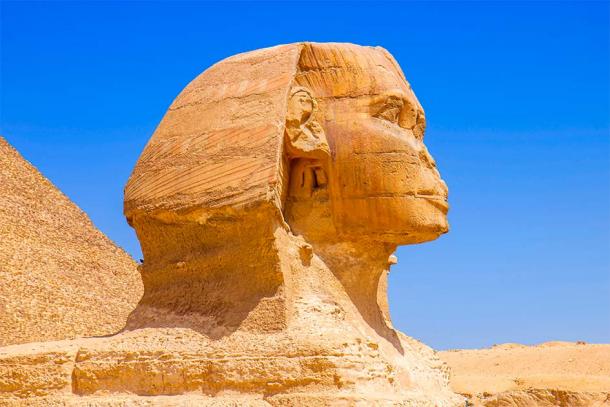
Stories explaining the missing Egyptian nose of the Sphinx of Giza abound. (Vladislav Gajic / Adobe Stock)
Could Noseless Ancient Egyptian Statues Be the Product of Racism?
According to some scholars, there was a deliberate attempt by early Egyptologists to deny and hide that ancient Egypt was an African culture. According to the written account of Vivant Denon, a French artist, writer and archaeologist who etched the image of the Sphinx of Giza around 1798, the facial features of the famous monument appeared to be of African origin;
“…Though its proportions are colossal, the outline is pure and graceful; the expression of the head is mild, gracious, and tranquil; the character is African, but the mouth, and lips of which are thick, has a softness and delicacy of execution truly admirable; it seems real life and flesh. Art must have been at a high pitch when this monument was executed; for, if the head wants what is called style, that is the say, the straight and bold lines which give expression to the figures under which the Greeks have designated their deities, yet sufficient justice has been rendered to the fine simplicity and character of nature which is displayed in this figure.”
However, the theory that vandalism is the sole explanation for the missing noses on ancient Egyptian statues falls short when considering the prevalence of de-nosed and dismembered ancient Greek and Roman statues. The majority of stone sculptures from these civilizations also lack noses. While some may have been accidentally damaged, a significant number of them were undoubtedly targeted intentionally.
It is historically, archaeologically, and scientifically established that the ancient Greeks and Romans were of European (Caucasian) origin. Therefore, racism is an unlikely reason for the intentional de-nosing of those statues. So, what is the reason for the noseless statues left behind by these ancient cultures?
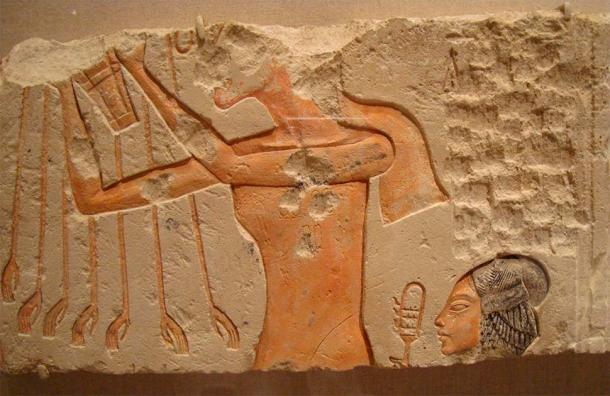
The deliberately destroyed face of Akhenaten from a relief depicting him and his daughter making an offering to Aten. (Neil R / CC BY-NC 2.0)
Deliberate Destruction of Egyptian Noses to Humiliate and Diminish Power
It has been recorded that later Egyptian dynasties would often deface statues of past monarchs in order to erase or diminish their legacy. In these cases, the removal of the nose would be accompanied by other, more extensive facial disfigurements, as well as the destruction of inscriptions and symbols of office.
In 2019, CNN reported on an exhibition, entitled Striking Power: Iconoclasm in Ancient Egypt, which brought together a striking selection of ancient Egyptian masterpieces from the Brooklyn Museum chosen to highlight their deliberate destruction. From missing noses, to damaged heads and vandalized inscriptions, the exhibition was curated by Edward Bleiberg in an attempt to understand patterns within this wanton destruction.
Bleiberg has hypothesized that, in a culture that placed such a huge amount of importance on the creation of these artworks, this deliberate vandalism was a way to “deactivate an image’s strength.” This all makes sense within the ancient Egyptian world view whereby art was used to manifest reality through representation. In other words, images had the ability to contain a human’s or deity’s essence, or to provide protection and assistance in the afterlife.
- Ancient Egyptian Carving of Couple Defaced in Revenge Attack to Deny Them a Happy Afterlife
- Inside Rhinocolura, The City Of Noseless Criminals
According to Bleiberg, new rulers or invading cultures trying to establish themselves wanted to disrupt this power by destroying its conduit: art. Artnet describes examples from the exhibit, including that of Thutmose III and his deliberate destruction of artworks representing his stepmother Hatshepsut.
In later years, Christians began to deface statues of ancient Egyptian deities to prevent them from being worshipped and destroy these remnants of their power. The nose was an obvious target for such campaigns of destruction, providing a clear and visible reflection of the supposed triumph of a new world order.
While legend has it that Napoleon had the Sphinx’s nose blown off with a cannonball, a more likely version of events is that the one-meter-wide nose was deliberately destroyed by a Sufi Muslim enraged by the affection showered on the massive statue in the hope of successful harvests. Originally built by Pharaoh Khafre around 2600 BC, studies conducted by Mark Lehner have concluded that the nose was intentionally eliminated.
Top image: The statue of pharaoh Senwosret III, who ruled from 1878 BC to 1839 BC, is another in a long line of missing Egyptian noses. Source: Public domain




















Comments
I agree with your assessment!
Permalink
In reply to Perspective by iclife (not verified)
I agree with your assessment! The articles author at least had the guts to note the saying of vivant denon, but quickly delved right back into a denial archetype of saying that the other two great civilizations of the world have been historically and scientifically proved to be Caucasian. Which is not true being they were all originally African. Until the world is taught that the African is their forefather and creator of original civilizations, the quicker the madness can stop and everything return to a balance.
Perspective
Permalink
The reason the noses and other ethnic features are missing from the Greek and Roman statues is the same as that for the African statues. We're forgetting that ancient Roman and Greeks still had more African in them. In essence, they were more African than the Greeks and Romans of today. The dominant narrative, the media, evolution and race mixing has changed our perception of what ancient people looked like.
It's not an easy subject to discuss, however, we have to acknowledge the brutality and the commitment of Caucasians to show the world that they were superior in every way. Imagine the shock of those individuals when they found out they were not superior, but actually inferior. I feel sorry for them, but their response to that knowledge is unforgivable by human standards. It is so unfortunate for the world, including Caucasians, who are also deprive of authentic history. We can not begin to imagine things that were done to history that render's it, as it is told, unreliable. We have to agree to believe a lie. So, yes. i am saying that there is a single explanation for the degree of destruction of history doe by individuals and cultures who just had to be better than everyone else.
It's difficult to see that the article started off telling the truth,but quickly devolved into the dominant narrative by attempting to take away the stigma carried with the actions of our predecessors. The Europeans are equal to none! They got what they wanted by any means necessary, and that carried with it, consequences and accountability. This is history as well. However, we have to remember that they were doing what they thought was best. The same as every civilization that has ever lived before them. They evolved last, were they youngest child and the had to fight hard to survive and so will the next rulers of this world. The next ruler is already fighting hard and will eventually become the rulers of this world.
Nose Removal
Permalink
In the ancient world...and particularly in Egypt, removal of the nose was a prescribed by law as a punishment for infidelity. This procedure was likely to prevent a repeat offence since the effect was truly hideous. It also served as a warning to others as well as a type of 'rap-sheet' on open display to anyone an offender would thereafter encounter. The practice was applied to statues of ruling monarchs, pharaohs and deities as the ultimate form of dishonour. Trust me...this is the true reason so many noses were removed in ancient times.
Nose removal
Permalink
You are missing perhaps the most plausible reason why the noses were often removed. In Ancient Egypt...and in the greater Ancient World removal of the nose was a prescribed punishment for infidelity. A man or woman caught in adultery would bear the outward mark of their 'indiscretion' for the remainder of their lives. This no doubt reduced the incidence of adultery...but it also carried over to the desecration of statues and murals. Defacing a statue or mural by removal of the nose (and often the genitalia) was a very direct and unmistakable method of discrediting and diminishing the reputation of a ruling monarch, Pharaoh or deity.
O que significa caucasiano?
Permalink
O que significa caucasiano? Como podemos sabe que os gregos e romanos eras albinos?, sabemos que genética não tem nada haver com fenótipo. Sem dúvidas algumas esculturas mostra vários romanos e gregos com que hoje chamamos de cranio negroide, e a genética Europeu tem em vários povo pretos da Índia, então a genética não e Europeu, e sim asiática, então não podemos basear os romanos e gregos como albinos, já que tem negros com essa genética.