

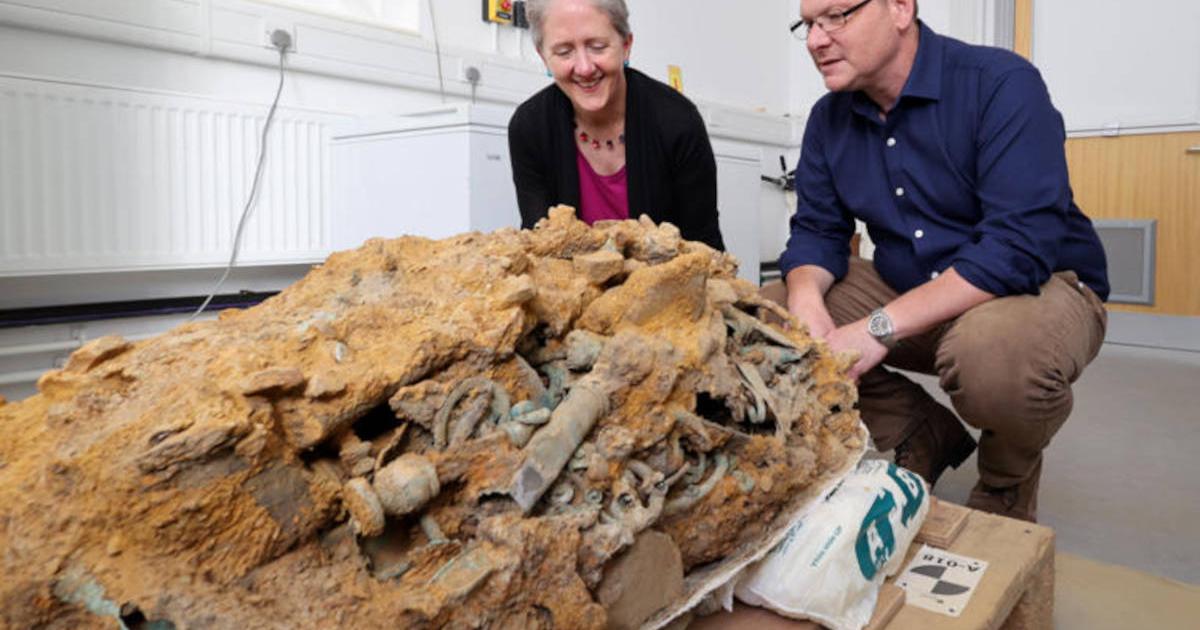

A huge and exceptionally valuable Iron Age hoard, discovered in a Yorkshire field, is offering archaeologists fresh insights about the distribution of wealth and power in northern Britain in the first century AD.
The impressive cache of ancient artifacts has been dubbed the Melsonby Hoard, after the nearby village of Melsonby in North Yorkshire where these treasures were found. Among the artifacts included in the hoard are remnants of wagons, ceremonial spears, and pony harnesses, which were all items that would have belonged to wealthy and powerful elites living in this part of Britain nearly 2,000 years ago.
While the collection was ultimately excavated and salvaged by archaeologists from Durham University, it was an amateur metal detectorist, Peter Heads, who first discovered the hoard in 2021, in the bottom of a pair of adjacent ditches. The collection of artifacts was simply massive, which suggested to the experts that it was all buried deliberately in a ceremony or observance that must have had profound meaning to the people living in that era. Notably, many of the items seem to have been deliberately broken or burned before burial, making it clear that their was a ceremonial aspect involved in their disposal.
Whatever else can be said, there is no question that the Melsonby Hoard is one of the most impactful archaeological discoveries in the United Kingdom in quite some time, based on its size, its value, and the historical period from which it comes.
- Boudicca: The Celtic Queen Who Unleashed Fury on the Romans
- Hoard of Roman Coins Leads to the Discovery of Important Site in England
Rediscovering the Lost Wealth of the Ancient British Nation
This discovery promises to upend previous ideas about wealth and power in pre-Roman Britain. It had previously been thought that the richest and most powerful aristocrats were confined to the south of England, but the Melsonby Hoard offers convincing evidence that this is not true.
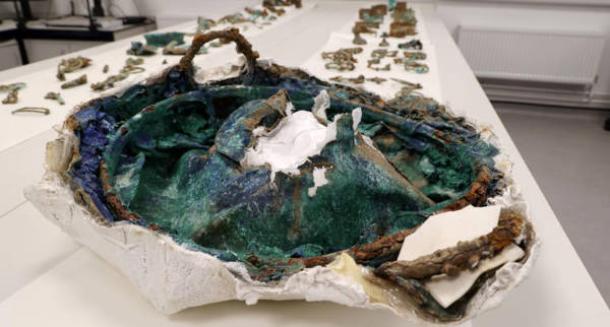
Crushed and broken cauldron, plus smaller artifacts on the table behind, recovered during Melsonby Hoard excavations. (Durham University).
Professor Tom Moore, head of archaeology at Durham University, described the hoard as a "once-in-a-lifetime discovery.”
“Whoever originally owned the material in this hoard was probably a part of a network of elites across Britain, into Europe and even the Roman world,” he stated in a Durham University press release. “The destruction of so many high-status objects, evident in this hoard, is also of a scale rarely seen in Iron Age Britain and demonstrates that the elites of northern Britain were just as powerful as their southern counterparts.”
Among the hoard's contents are the partial remains of more than seven four-wheeled wagons or two-wheeled chariots, rare artifacts seldom unearthed in Britain. Elaborate harnesses for at least 14 ponies, three ceremonial spears, and two ornate cauldrons or vessels, one of which was decorated with a mask-like human face and was likely used for mixing wine, were also included in the hoard, highlighting the variety and diversity of the hoard.
These items clearly came from a sophisticated society that possessed abundant wealth, and were able to secure the resources and hire the skilled craftspeople required to produce so many refined and valuable artifacts.
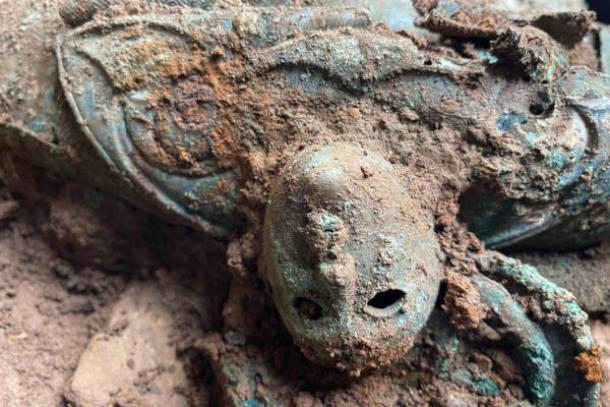
One of the two mask-like human faces decorating the shoulder of the vessel or cauldron from the Melsonby hoard. (Durham University).
Some of the harness pieces were adorned with Mediterranean coral and colored glass. These items, and some of the others, were likely imported from elsewhere on the European continent, by people who could afford to purchase expensive objects that had traveled long distances along ancient trade routes.
- Mighty Cartimandua, Queen of the Brigantes Tribe and Friend to Rome
- The Silures Tribe: Rome’s Biggest Headache Hailed from Wales?
Melsonby is just a mile away from Stanwick, the power center of the Brigantes tribe that controlled a large part of what is now Yorkshire before the arrival of the Romans. Presumably the elites responsible for the buried objects were from this tribe, which was clearly more resource-rich than had previously been supposed.
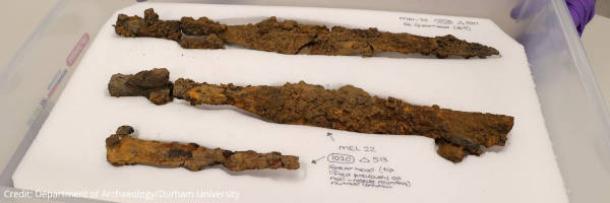
Iron spearheads found among the objects in the Melsonby Hoard. (Durham University).
“Whoever is doing this is incredibly wealthy and it challenges the idea that northern Britain was a backwater, when it clearly was not,” Professor Moore stated.
Why Were the Artifacts Destroyed?
The destruction of these items was one of the more fascinating and revealing aspects to emerge from the close study of the Melsonby Hoard. Iron tires, which were attached to the outside of wooden wagon wheels, had been purposely bent out of shape, while many other items had been burned or broken into parts (but not carelessly smashed).
What was the purpose of such acts? Professor Moore theorizes that it might have been a way for people who donated items to the hoard to show off how wealthy they were, that they could afford to destroy and sacrifice pricey objects without feeling the loss.
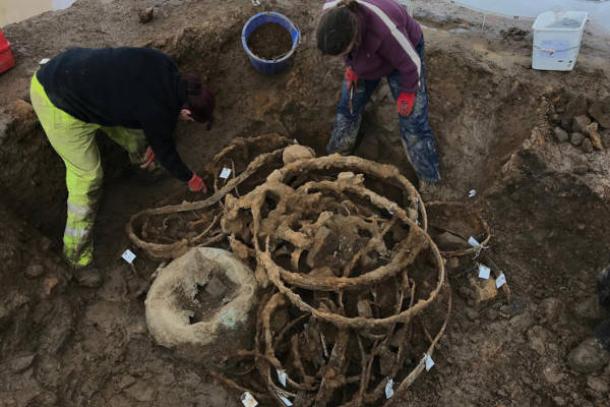
The bent iron tires and cauldron at the excavation site. (Durham University).
So far, no human remains have been found during excavations associated with the Melsonby Hoard. This would tend to contradict any suggestion that the buried items might have been grave goods connected to the death of the elites that owned them—although this possibility can’t be entirely ruled out just yet.
Preserving the Hoard for the Benefit of the Nation
As a part of the analysis of the find, the objects in one of the ditches was carefully examined on site, while another was removed as a block so it could be X-rayed using a large scanner at Southampton University. The latter set of objects will be kept intact, as a block, to best preserve what is inside.
The dig was supported by a £120,000 grant from Historic England, and the Yorkshire Museum is launching a fundraising campaign to purchase the entire hoard on behalf of the United Kingdom (the total value of the collection has been calculated at £254,000, the equivalent of $329,000).
Top image: Tangled block of Iron Age artifacts from Melsonby Hoard, removed en mass to be studied in a laboratory.
Source: Durham University.
By Nathan Falde






















