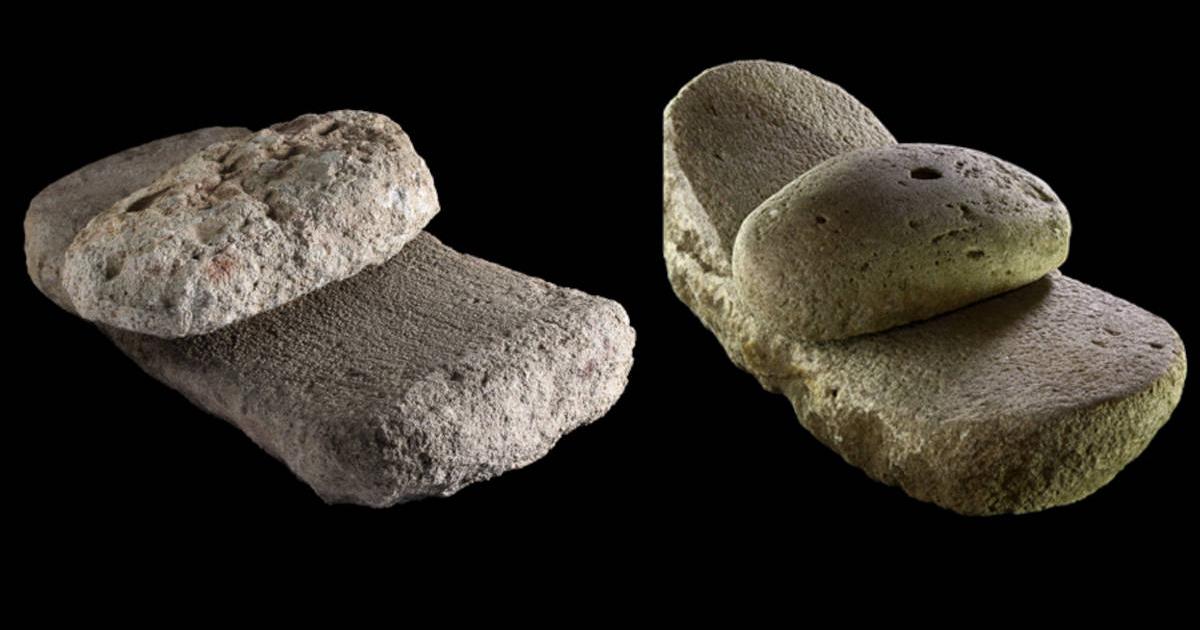
Archaeologists have discovered that the first European Neolithic societies buried hand-held grinding tools used to process cereals, oftentimes long before they were used up. According to a team of researchers from the Autonomous University of Barcelona (UAB), these tools had a high symbolic value for the women who used them, related to time and the cycles of human life, nature and settlements.
The UAB researchers reached this fascinating conclusion following their study of deposits of grinding stones recovered from three ritual sites in Germany.
“The condition of the tools—ranging from new to nearly worn-out—adds layers of meaning, suggesting cycles of creation, use, and obsolescence,” the study authors wrote in an article about their research published in the Journal of Archaeological Science: Reports. “These symbols, such as fertility, life cycles, and territorial markers, mirror the daily and yearly rhythms of agrarian life. Additionally, they represent human biographies and social relationships, often emphasizing transitional moments such as birth, marriage, and death.”
It seems the sacred relationships the settlers at these German sites had established with nature and the deities that governed it were a central part of their lives, infusing every aspect of their existence wih meaning. Consequently they were motivated to perform rituals of sacrifice involving items they valued, and had invested a lot of time in creating.
- Taking a ‘Knapp’ With Our Ancient Ancestors - Stone Tools Through the Ages
- Previously Unknown Neolithic Society Discovered in Morocco, Fills Gap
Honoring the Cycles of Nature
Two of the deposits studied are located in Goseck (Saxony-Anhalt), one of the oldest ritual sites in Europe, and a third one in Sömmerda (Thuringia). The three deposits belong to the beginning of the Neolithic period (4900 and 4650 BC) in Central Europe. Researchers studied the technical, functional and morphological characteristics of the tools they contained—14 sets of grinding tools—as well as the arrangement and orientation of the items inside the deposits, in order to further decode their symbolic meaning.
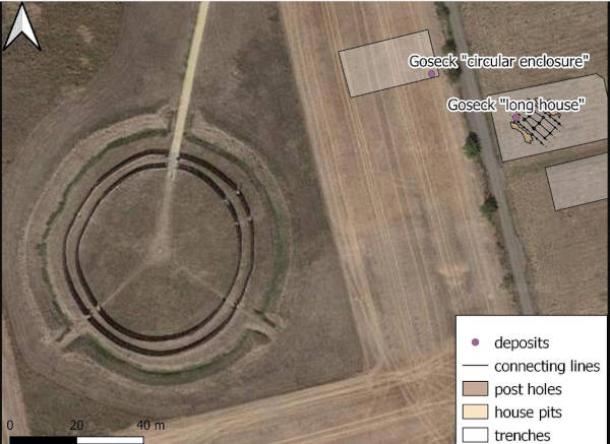
Location of the grinding stone deposits close to the circular enclosure of Goseck. (E. Zamzow/)Journal of Archaeological Science: Reports).
The study indicates that some grinding stones were withdrawn from the domestic context practically new, others in the middle of their useful life and others were completely worn-out. The artifacts were carefully placed in pairs, with the working parts in contact and oriented from east to west. They were made with materials located at a distance from the deposits and a great deal of time was spent producing and curating them, both in the case of the grinding slab and the grinder.
“These results reflect the high social value that these objects had and lead us to consider that the notion that is at the heart of the ‘biography’ traced by the tools is time. A concept embodied in stages of production, use, reproduction and burial, which suggest cycles of birth, life and death, and contemplated from the perspective of women, the main users of these stones”, explained Erik Zamzow, doctoral researcher at the Department of Prehistory of the UAB and first author of the study.
The use and maintenance of the grinding stones in the domestic context would represent the basic daily tasks of women of the Linear Pottery culture. The selection of new, used and almost worn-out tools would symbolise the group and transmission from generation to generation. The levels of wear would be related to the human life cycles, as an allegory of birth, life and death. Finally, the tools and their ritual deposit may also reflect the life of the Neolithic populations, which changed their location every few years, possibly also every generation or two.
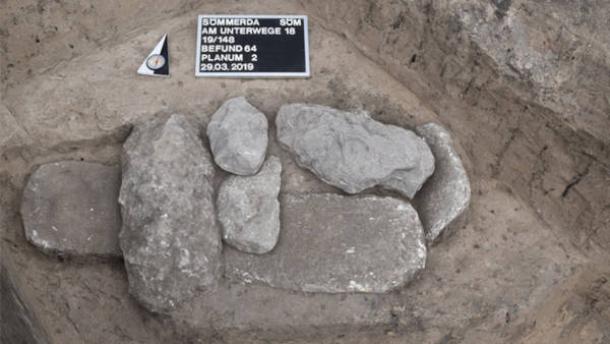
A grinding stone deposit excavated at Sömmerda with the first layer of tools. (S. Schneider/Journal of Archaeological Science: Reports).
“The intention conveyed by the deposits is a complex and polyhedric notion of time, which goes beyond the rhythm of annual harvests with which they have been related until now”, said Roberto Risch, researcher at the Department of Prehistory of the UAB and coordinator of the study. “The symbolism would be related to the life of specific women, such as those who still today make use of these types of grinding stones for hours a day in self-sufficient agricultural societies. Each grinding stone would be the result of a daily adjustment between a woman's body and her tools for years and decades.”
- Stone Age people were eating porridge 32,000 years ago
- Hard-Working Prehistoric Women Had Stronger Arms Than Modern Elite Athletes
A Widespread Practice in Neolithic Europe
The samples analysed in the research are similar to others that have been found in France and Belgium. With some differences, others have also been found in several Central European regions.
In total, 20 deposits and 89 tools are known, attributed to 13 settlements or ritual enclosures. Previous studies on the symbolism of these deposits have made temporal references to day and night, the agricultural year, fertility and festivities. The present study shares some of these interpretations, but researchers highlight that it adds a new layer of symbolism, with the lifetime of women as a central theme.
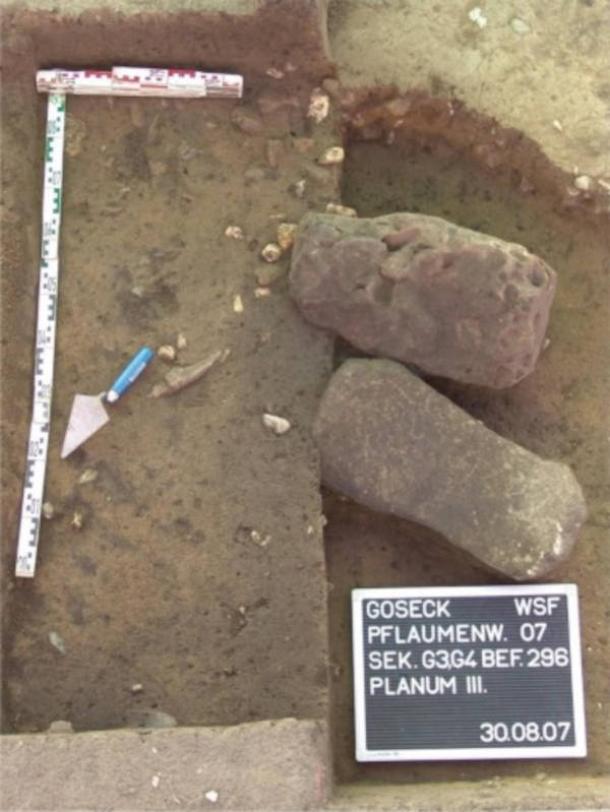
Grinding slabs of the deposit of Goseck in the longhouse pit. ( Journal of Archaeological Science: Reports).
“The techno-functional evidences of the tools have almost not been taken into account to explore the symbolic meaning of these types of deposits. Future studies incorporating the methodology we have applied here could serve to contrast our hypothesis”, said Marina Eguíluz, also author of the study and doctoral student at the Department of Prehistory.
In any case, researchers emphasize that the intention of these deposits, the selection of objects and their placement appear as an important issue in the economy, ideology, and spirituality of Early Neolithic peoples. They reflect the practices, values and beliefs of the first agricultural communities of Central Europe and highlight their complex perception of time.
Top image: Left: Fitting pair of the grinding stone deposit of Sömmerda. Right: Fitting pair of the grinding stone deposit of Goseck circular enclosure.
Source: J. Soldevilla/Autonomous University of Barcelona.
This is an edited version of a news release originally published by the Autonomous University of Barcelona, entitled ‘Time and life cycles reflected in the grinding stones of Europe's earliest Neolithic communities.’