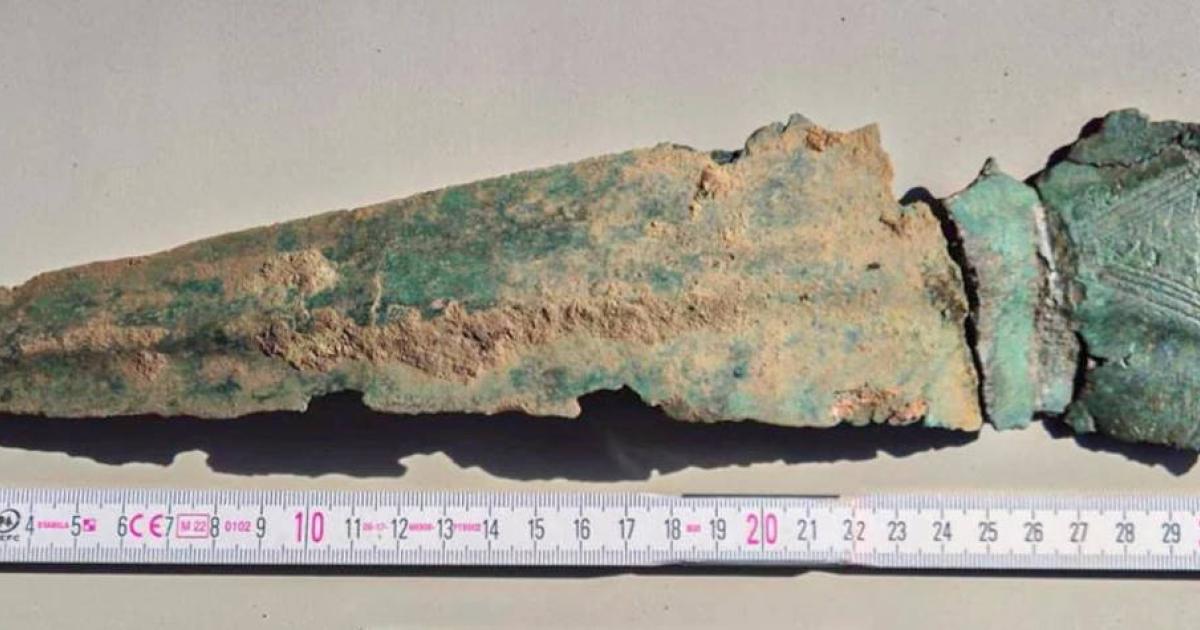

Two remarkably well-preserved daggers from the Bronze Age have been uncovered in a field in the municipality of Kutenholz in the Stade District, located in Lower Saxony, Germany. These artifacts, estimated to be over 3,000 years old, are among the earliest Bronze Age finds in the region. Their discovery has provided archaeologists with new insights into the ritual practices and belief systems of ancient communities in this part of Central Europe, as the daggers have been linked to certain Bronze Age sacrificial traditions.
‘A Stroke of Luck’ Reveals Bronze Age Ritual Practices
The precursor to this significant find occurred in 2017, when metal detectorist Frank Hoferichter unearthed an assortment of bronze fragments in the field. Recognizing the potential importance of the discovery, Hoferichter contacted local authorities and later collaborated with Stade District archaeologist Daniel Nösler to further investigate the site.
- What Did Bronze Age People Do With All That Bronze?
- Bombshell Study Calls Astronomical Theories of the Nebra Sky Disk “Obsolete”
In 2023, researchers from the University of Hamburg employed geomagnetic surveys to analyze the field without disturbing the soil, as they hoped this method would help them find artifacts that their previous excavations might have missed. This non-invasive technique allowed them to detect subterranean anomalies, which suggested the presence of large buried objects.
Encouraged by these findings, archaeologists proceeded with a targeted excavation, which led to the successful retrieval of two bronze dagger blades at a depth of approximately 11 inches (30 centimeters).
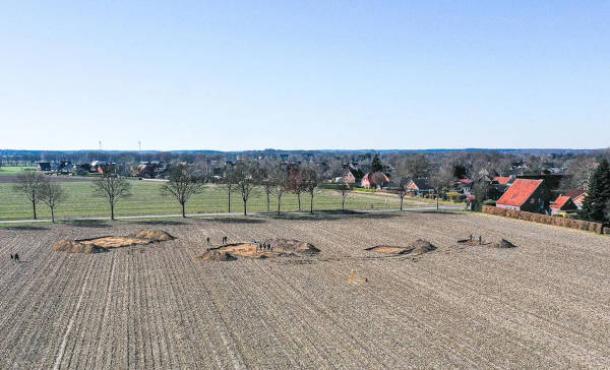
The dagger discovery sites and other archaeological investigation sites on a 28-meter-high hill near Kutenholz. (Archaeology Group Stade District).
"With geomagnetic prospection, archaeological structures in the ground can be made visible even without excavation," Nösler explained in a statement released by Stade district officials.
The researchers carefully dug in four designated sections of the harvested maize field, eventually uncovering the two daggers. "One of the blades was stuck vertically in the ground, another was also lying almost vertically in the sand, possibly hit by a plough," Nösler added.
Despite the passage of time and the shallow depth at which they were buried, the blades were still straight and well-preserved. This is particularly surprising given that the field has been actively farmed for many years. The discovery has raised speculation that numerous other historical artifacts in the area may have already been lost to plowing, making the survival of these daggers even more extraordinary.
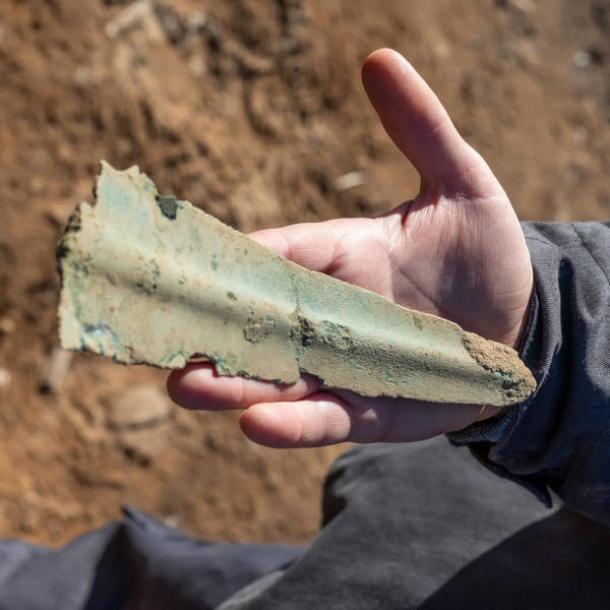
One of the bronze blades found in the field in Kutenholz. (Archaeological Group Stade District).
"It is a stroke of luck that the daggers were not destroyed at such a shallow depth in the area, which has been cultivated with agricultural equipment for years," Nösler remarked. The fortunate preservation of these artifacts allows researchers to further analyze Bronze Age craftsmanship and cultural practices.
The daggers, made from a copper-tin alloy known as bronze, date back to around 1500 BC. This places them in the same era as the famous Nebra Sky Disc, an artifact discovered in 1999 in Nebra, Germany. The Nebra Sky Disc, measuring approximately 12 inches (30 centimeters) in diameter, is a circular bronze object adorned with golden shapes that reflect an early interest in astronomy. At over 3,600 years old, it is considered the oldest known depiction of the cosmos found anywhere.

The Nebra Sky Disc. (State Office for Heritage Management and Archaeology, Saxony-Anhalt—State Museum of Prehistory/J. Lipták, Munich/Nature).
Ritual Offerings or Functional Weapons?
Experts believe that the daggers were originally equipped with wooden handles, which have long since decayed. However, rather than being used as weapons in battle, the evidence suggests that these blades were intentionally buried as part of a ceremonial practice.
- Dropped Your Bastard Sword? Then Whip Out Your Bollock Dagger
- Discovery of Ancient Indian Daggers may push back Start of Iron Age by Hundreds of Years
Professor Tobias Mörtz, an expert in Bronze Age weapon deposits at the University of Hamburg, supports this theory.
"The daggers likely had ritual significance with a religious or ideological background," he stated.
One of the most intriguing aspects of the discovery is the position of the blades. Both daggers were found at the highest elevation in the Kutenholz area, at 90 feet (28 meters) above sea level. One was discovered standing upright, while the other was slightly tilted—likely displaced by centuries of plowing. The absence of human remains or additional artifacts in the immediate vicinity suggests that these daggers were not part of a burial site, but were instead symbolic offerings.
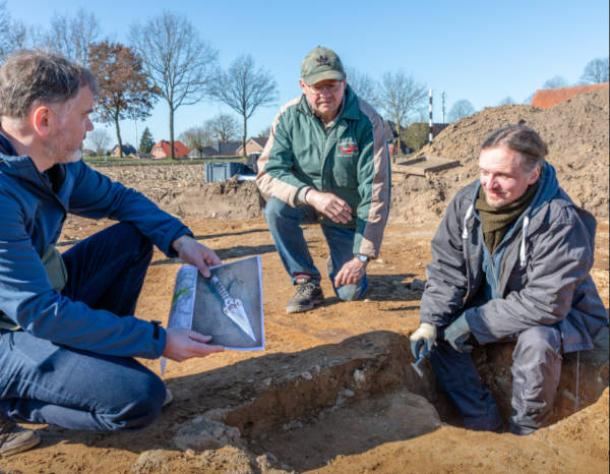
What the daggers could have looked like in the original: District archaeologist Daniel Nösler, detectorist Frank Hoferichter and Professor Tobias Mörtz (from left) at the site near Kutenholz. (Archaeological Group Stade District).
The use of valuable objects as sacrificial offerings was a common practice in the Bronze Age. While many people associate sacrificial rituals with the killing of animals or, in extreme cases, human sacrifices, it was also customary to offer tools, weapons, and other cherished possessions to the gods in this era. These items held significant value to their owners and played a crucial role in daily life, making them meaningful tributes to deities who were believed to influence harvests and provide protection and prosperity.
The Race to Find More Ancient Artifacts is On!
Following their excavation, the daggers were transferred to the University of Hamburg for further examination and restoration. Researchers hope that additional analysis will provide deeper insights into the religious and cultural traditions of Bronze Age societies in this region.
The discovery has also sparked interest among local landowners and amateur archaeologists. With increased publicity surrounding the find, more farmers in the Kutenholz area may now be motivated to inspect their land for previously undiscovered ancient artifacts. This newfound attention could lead to further archaeological discoveries and a broader understanding of early European civilizations.
Top image: One of the Bronze Age daggers found in a field in Lower Saxony, dating to 1,500 BC.
Source: University of Hamburg.
By Nathan Falde