
Thousands of years of maritime traffic have left the seabed around Elba Island scattered with evidence of ships that once carried goods through the Tyrrhenian Sea. Now, underwater archaeological investigations have documented a massive Roman dolium as well as mysterious wooden remains that may belong to a shipwreck from a very different period. Together with previously known Roman wrecks around Elba, the discoveries highlight the island's long importance within Mediterranean maritime trade.
Massive Ceramic Vessels Built into Roman Ships
The recent discovery of a dolium, wooden structures, and bronze nails initiated research to solve a maritime mystery. Unlike most amphorae, which were moved individually during loading and unloading, the dolium held large amounts of liquid or foodstuffs. On some Roman merchant vessels, the ceramic containers were even installed within the hull and functioned as large storage tanks. Roman dolia varied in size, with some of the larger containers holding up to 2,000 liters – roughly equivalent to 75 standard Roman amphorae. A dolium could be used for transport or partially buried in the ground to hold agricultural supplies.
- Hundreds of Roman Wine Amphorae Found in Underwater Cave
- Scientists Track Silver Trade From Trojan War to Roman Republic
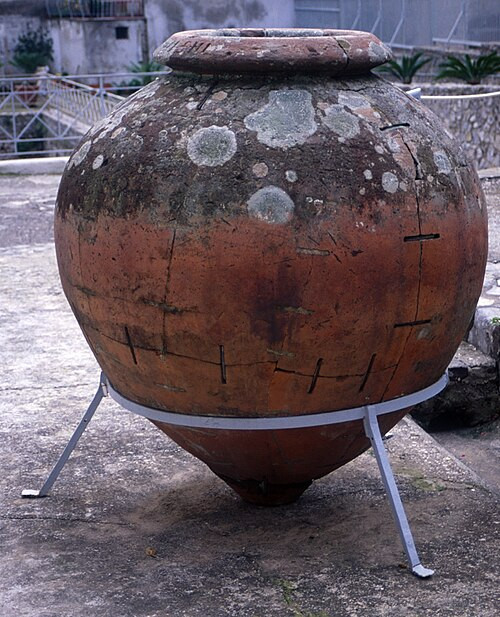
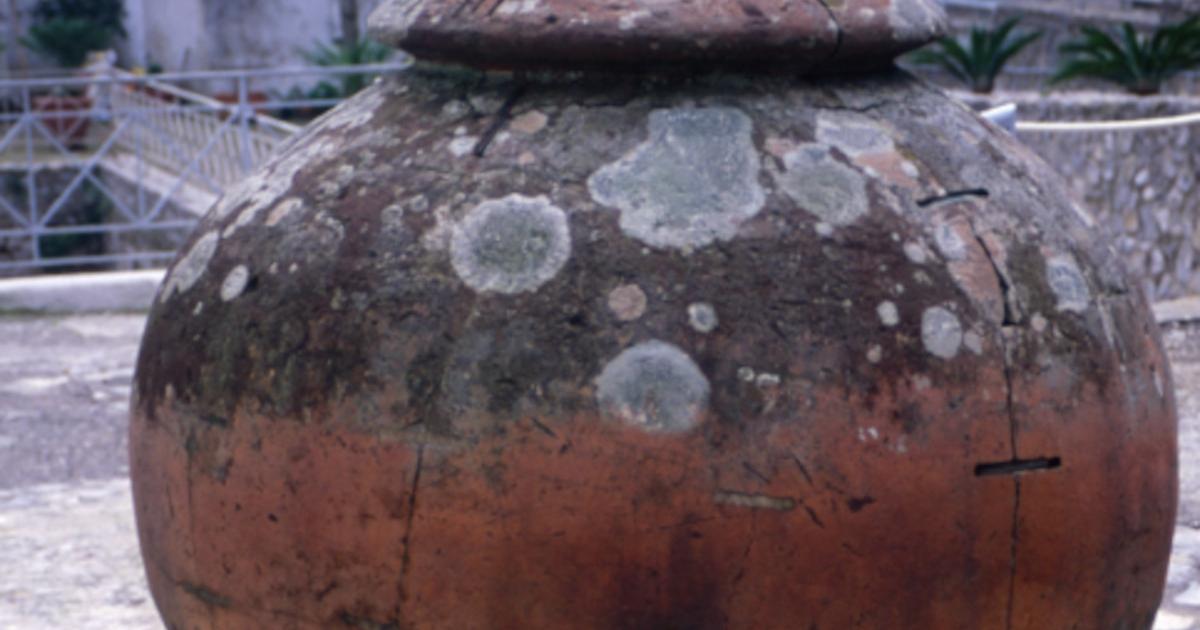
Representational image - A large Roman dolium from the Roman villa at Minori in Campania, Italy. These enormous ceramic vessels were used in the Roman world for storing bulk commodities and provide a comparison with the massive Roman vessel recently discovered underwater off the coast of Elba. Source: Tyler Bell/CC BY 2.0
Does a Roman Wine Ship Lie Beneath the Waters of Elba?
According to the Soprintendenza Archeologia. Belle Arti e Paesaggio for the provinces of Pisa and Livorno, the newly documented dolium is consistent with Roman examples associated with maritime transport between the 1st century BC and 1st century AD. However, archaeologists have not established that the nearby wooden remains belong to the same period, or even to the same wreck. Comparable Roman dolia carriers were used particularly for transporting bulk wine along Mediterranean trade routes. Underwater surveys off Italy’s Elba Island revealed the large Roman dolium and the remains of a wooden vessel that archaeologists are working to identify and accurately date. These discoveries were made during an underwater archaeological monitoring program led by the Soprintendenza, in collaboration with the Carabinieri Cultural Heritage Protection Unit in Florence and the Carabinieri Divers Unit in Genoa.
The Underwater Survey Includes a Comprehensive Records Review
The investigation began in May 2026 and included waters between the Piombino Channel and the islands of the Tuscan Archipelago. Archaeologists are now reviewing previously recorded sites, updating underwater maps, and investigating recent reports of possible archaeological remains. One of the most significant finds was the dolium, an exceptionally large terracotta container, accompanied by wooden planks and bronze nails. Researchers pointed out that the comparable dolium at the Museo Archeologico di Populonia (Collezione Gasparri) was recovered decades ago by fishermen's nets in the same waters.
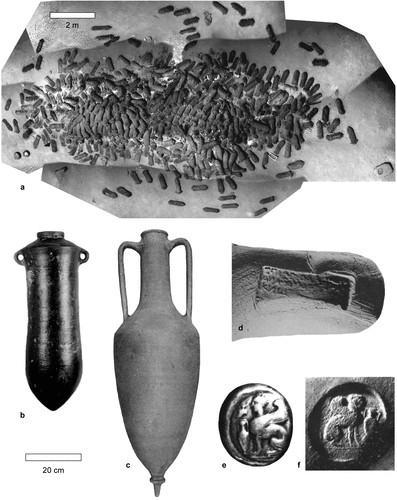
Archaeological evidence for ancient Mediterranean maritime transport includes a shipwreck cargo and specialized transport amphorae. Such vessels formed an essential part of the Mediterranean trade in commodities including wine and olive oil. (Andrew Bevan/Current Anthropology)
The Roman Ships Were Designed to Carry in Bulk
Dolia carriers represented a specialized approach to bulk maritime transport, allowing merchants to move large quantities of liquid cargo without relying entirely on hundreds of individual amphorae. Large dolia required considerable space and careful positioning within the hulls of the merchant ships. This ability to store multiple dolia allowed the merchants to move large amounts of wine without packaging the entire cargo in thousands of individual containers.
One Giant Dolium, but Many Questions Remain
At present, archaeologists from the research team have identified only Roman dolia. More evidence is required before the site can be identified as the remains of a Roman dolia carrier. Underwater investigations also revealed what appears to be part of a major wooden shipwreck. This visible structure measures between five meters long and two meters wide, though it is obscured by marine mucilage that makes detailed examination very difficult. Divers have identified certain sections of the hull planking, along with other wooden structural elements and a large assemblage of bronze nails. Unfortunately, researchers have not confirmed the age of any of the wooden elements.
- Dozens of Shipwrecks Dating Back Thousands of Years Found in the Aegean Sea
- The Roman Republic – Was It Truly A Republic?
Two Mysteries Separated by Centuries
The Soprintendenza notes that the surviving construction could date to any time between Late Antiquity and the Middle Ages. At this stage, researchers haven’t yet established whether the wooden remains and Roman dolium are connected to the same maritime event. That distinction is quite important. A Roman-period container lying near a wooden structure does not confirm that both reached the seabed at the same time.
Elba was a Maritime Crossroads Long Before Rome
A second underwater investigation campaign planned for autumn 2026 will include targeted archaeological testing to establish the nature, chronology, and extent of this possible wreck. These discoveries add to a long list of ancient maritime activity around Elba, an island positioned just off the Tuscan coast in the northern Tyrrhenian Sea. Long before the Roman Republic, Elba was known for its iron deposits and its close links to the Etruscan center of Populonia on the mainland. During the Roman Republic and later Empire, mining continued while agriculture, wine production, coastal settlements, and maritime trade became increasingly important elements of the island’s economy.

Roman amphora types used for transporting wine, olive oil, fish products, and other commodities across the western Mediterranean. The changing vessel forms illustrate the diversity of Roman maritime containers over several centuries. (Andrew Bevan/Current Anthropology)
From Roman Farms to Mediterranean Trade Routes
Archaeological sites near Portoferraio and elsewhere in Elba have already yielded Roman residential sites and agricultural complexes. At the same time, the surrounding seabed preserves evidence of ships that once moved goods through this heavily traveled stretch of the Mediterranean. One of the best-known examples is the Roman wreck found off Procchio in 1967, while other ancient maritime remains have been recorded in various parts of the island. These recently uncovered Roman dolia can fit into a much broader archaeological landscape in which land-based production and sea transport were closely connected.
- 2,200-Year-Old Roman Wreck Reveals Hidden Repair Trick
- Rome Reopens its Historical Imperial Port to the Public
The Exact Location of Elba’s Wreck Remains a Secret
To protect these vulnerable sites, officials have not yet disclosed the exact locations of the wrecks. The Soprintendenza collaborates with Italy’s National Superintendency for Underwater Cultural Heritage to ensure careful monitoring and preservation, highlighting the importance of safeguarding Elba's underwater archaeological treasures for future research and public education.
- Phantom islands on ancient maps dismissed as mirages, myths, or mistakes
- Barbarians versus Romans: Violence and Urban Life in Late Antiquity
The next major campaign will be crucial for the recently found unidentified wooden structure. Excavation may reveal whether archaeologists are examining a major section of a larger vessel, a smaller craft, or remains from an entirely different time period than the Roman dolium. Until then, the two separate discoveries will simply remain as pieces of evidence taken from a seabed that has preserved centuries of maritime traffic around the island of Elba.
Top Image: A large Roman dolium from the Roman villa at Minori in Campania, Italy. These enormous ceramic vessels were used in the Roman world for storing bulk commodities and provide a comparison with the massive Roman vessel recently discovered underwater off the coast of Elba. Source: Tyler Bell/CC BY 2.0
By Ramsey Hardin
References
ProMare. n.d. Italy: Underwater Archaeological Projects. Available at:https://promare.org/italy/
ProMare. 2008. Dolia Shipwreck: The Roman Shipwreck of Punta del Nasuto (Elba Island, Tuscany). Available at:https://promare.org/elba/
Raneri, S., Barone, G., Mazzoleni, P., Leon, M., Pagliantini, L., and Giamello, M. 2016. The Island of Elba (Tuscany, Italy) at the Crossroads of Ancient Trade Routes: An Archaeometric Investigation of Dolia Defossa from the Archaeological Site of San Giovanni. Archaeological and Anthropological Sciences. Springer. Available at:https://www.researchgate.net/publication/299275242_The_island_of_Elba_Tuscany_Italy_at_the_crossroads_of_ancient_trade_routes_an_archaeometric_investigation_of_dolia_defossa_from_the_archaeological_site_of_San_Giovanni
Scaradozzi, D. 2012. Tools and Techniques for 3D Documentation of Underwater Sites. VIPS 2012 ROV Conference. Available at:https://videoray.com/images/VIPS_presentations/VIPS_2012/PDFs/120918_VIPS2012_Scaradozzi.pdf
Venturini, D. 2016. Valorización y gestión de los sitios arqueológicos sumergidos en el Archipiélago Toscano: El caso del naufragio romano en la localidad “Il Nasuto” de Marciana Marina en la Isla de Elba. Universitat Politècnica de València. Available at:https://dialnet.unirioja.es/servlet/tesis?codigo=102276
Virtual Elba. n.d. Relitto di Chiessi con oltre 3000 anfore. Available at:https://www.virtualelba.it/conoscere-scoprire-elba/relitti-grotte/relitto-di-chiessi/
Virtual Elba. n.d. Relitto del Nasuto: Nel relitto del Nasuto troviamo enormi anfore. Available at:https://www.virtualelba.it/conoscere-scoprire-elba/relitti-grotte/relitto-punta-nasuto/
Virtual Elba. n.d. Il Relitto di Procchio, nave Romana affondata alla Guardiola. Available at:https://www.virtualelba.it/conoscere-scoprire-elba/relitti-grotte/relitto-di-procchio-nave-romana/