
For nearly two millennia, a set of ancient scrolls has remained sealed, last seen when the Roman Empire held dominion over Europe. Now, thanks to a special program using artificial intelligence, researchers have found a way to "virtually unfurl" one of the Herculaneum scrolls—documents that like Pompeii were buried beneath layers of volcanic ash when Mount Vesuvius erupted in AD 79.
This particular manuscript, known as PHerc.172, is safeguarded at the Bodleian Libraries in Oxford. It is inscribed in ancient Greek using carbon-based ink, a medium that, until recently, has proven extremely difficult to detect beneath the scroll’s charred exterior. But modern technologies have dramatically expanded the tools in the archaeologist’s arsenal, and in this instance they opened a door of understanding that would have remained shut forever without their assistance.
- Restoring The Roman Retreat Of Herculaneum Beach, Buried By Vesuvius
- Hiding From Mount Vesuvius Prolonged Victims' Deaths
"It's an incredible moment in history as librarians, computer scientists, and scholars of the classical period are collaborating to see the unseen,” said Richard Ovenden, a senior executive at the Bodleian Libraries, in an interview with the Daily Mail. “The astonishing strides forward made with imaging and AI are enabling us to look inside scrolls that have not been read for almost 2,000 years."
The Challenge of Deciphering Fragile Scrolls
The Herculaneum scrolls consist of more than 1,800 papyrus sheets rolled into bundles, which were unearthed in the 18th century in the Villa of the Papyri in the village of Herculaneum, a neighboring settlement to Pompeii. They had been buried in ash by the eruption of Mount Vesuvius in 79 AD, and were preserved in a badly burned and delicate state.
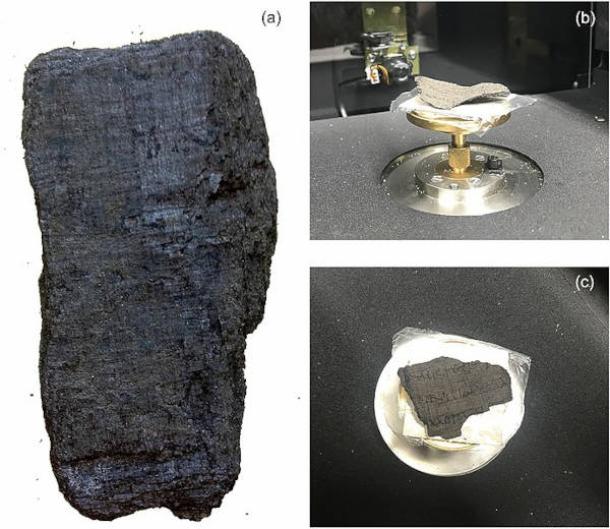
Photos of the papyrus fragments PHerc.1103 (a) and PHerc.110 (b,c)., which are in the same state as Pherc. 172. (Sara Stabile, et.al/Scientific Reports).
The Herculaneum scrolls are believed to contain invaluable philosophical and literary works from the ancient Greek and Roman worlds. However, their extreme fragility makes any physical attempt to unroll them nearly impossible, as doing so would cause the to disintegrate in an instant. Scientists have therefore turned to innovative digital techniques, such as x-ray scanning, specialized ink-detection software, and AI-driven reconstruction, to reveal the texts hidden beneath the scrolls’ charred surfaces.
Using Diamond Light Source technology, experts generated detailed 3D scans of PHerc.172, one of three Herculaneum scrolls housed at the Bodleian Libraries. AI then helped to detect traces of ink embedded in the layers of papyrus—a plant-based writing material resembling paper. Due to the charring caused by the eruption, these ink marks are invisible to the naked eye, making the use of AI a crucial step in deciphering the text.
This methodology worked a true archaeological miracle, as some of the words of the scroll could finally be detected and deciphered.
One of the first words identified is διατροπή, which has appeared in other Herculaneum scrolls and may mean "confusion, agitation, or disgust." Another set of letters, τυγχαν, could be the beginning of the verb τυγχάνω, meaning "to happen." Researchers also noted that the ink is more clearly visible in the outer layers of the scroll, and, intriguingly, the writing appears to have been applied with the scribe dipping their pen once every two lines.
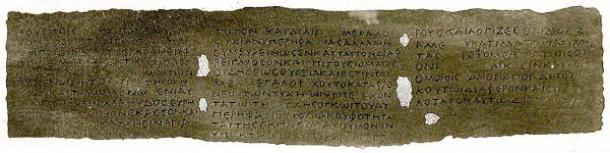
Example of carbonized papyrus, from a Herculaneum scroll that was fairly well-preserved and could be physically unrolled (photograph from book entitled “Literary treasure of Herculaneum” published in 1858). (Public Domain).
The Vesuvius Challenge and Future Discoveries
Scientists hope to decipher the entire scroll, particularly its innermost layers, over time.
'This scroll contains more recoverable text than we have ever seen in a scanned Herculaneum scroll,' said Dr Brent Seales, co-founder of the Vesuvius Challenge, which offers cash prizes to anyone who can find a way to decipher these hidden masterpieces of ancient literature. “Despite these exciting results, much work remains to improve our software methods so that we can read the entirety of this and the other Herculaneum scrolls.”
In conjunction with the Vesuvius Challenge, the experts are seeking engineers capable of refining AI techniques to decode more of these charcoal-wrapped writings. Earlier this year, a team of students won $700,000 (£550,000) for using AI to decipher another scroll held at the Institut de France in Paris.
- AI Unlocks Secrets from Charred Herculaneum Scroll
- World’s Oldest Surviving Amphitheater Preserved at Pompeii
A Long-Buried Treasure of Knowledge
The story of the Herculaneum scrolls goes back nearly 2,000 years to when the Roman settlements of Pompeii, Torre Annunziata, Stabiae, and Herculaneum were obliterated by Vesuvius, leading to the deaths of approximately 16,000 people. Among the ruins of Herculaneum was a grand villa believed to have belonged to Lucius Calpurnius Piso Caesonius, father-in-law to Julius Caesar. This estate housed an extensive library containing over 1,800 papyrus scrolls, which were transformed into brittle carbonized relics by the eruption.
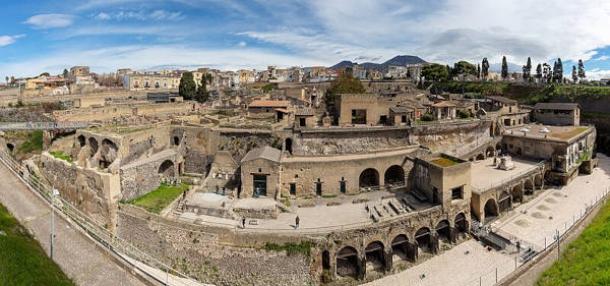
Ruins of the ancient city of Herculaneum in Italy. (Diego Delso/CC BY-SA 4.0).
During the 1750s, excavations began at the villa, but many scrolls were mistakenly discarded, deemed worthless due to their charred appearance. Hundreds more were lost when foolish individuals tried to unroll them by hand, leading to their inevitable destruction. The majority of the surviving scrolls are now kept at the National Library in Naples, with some remaining unopened, awaiting future breakthroughs that may finally unveil their contents.
In 1756, Abbot Piaggio, a Vatican Library conservator, devised a machine capable of unrolling a single scroll over four years. Unfortunately, this method caused significant damage to the carbonized papyrus. In the early 1800s, a few of the scrolls, including Pherc.172, were given to the future King George IV of England by Ferdinand IV, the King of Naples and Sicily, and at some point they were sent to the Bodleian Library for safekeeping.
Modern researchers are determined to unlock these ancient texts without physical intervention, in an effort to recreate at least some of the rich and diverse library that was collected by Lucius Calpurnius Piso Caesonius . The "virtual unrolling" approach relies on X-rays, shortwave infrared hyperspectral imaging, and other scanning technologies to distinguish ink from papyrus.
One particularly fascinating discovery from these efforts is a passage revealing that the philosopher Plato spent his final night criticizing a slave girl’s "lack of rhythm" as she played the flute. Suffering from a fever, he had been listening to music and entertaining guests before his death at the age of 80 or 81 in 348 BC. The same scroll ( PHerc.172) also confirms that Plato was buried at the Academy of Athens, adding the detail that his resting place was within a designated garden on the university grounds.
With each technological advancement, researchers move closer to unlocking the full knowledge hidden within the Herculaneum scrolls. These relics could provide a wealth of insights into ancient philosophy, literature, and history, revealing more of the wisdom of ancient intellectual life.
Top image: AI-generated image of Mount Vesuvius eruption of 79 AD, with doomed Pompeii in the foreground.
Source: Author-created.
By Nathan Falde