

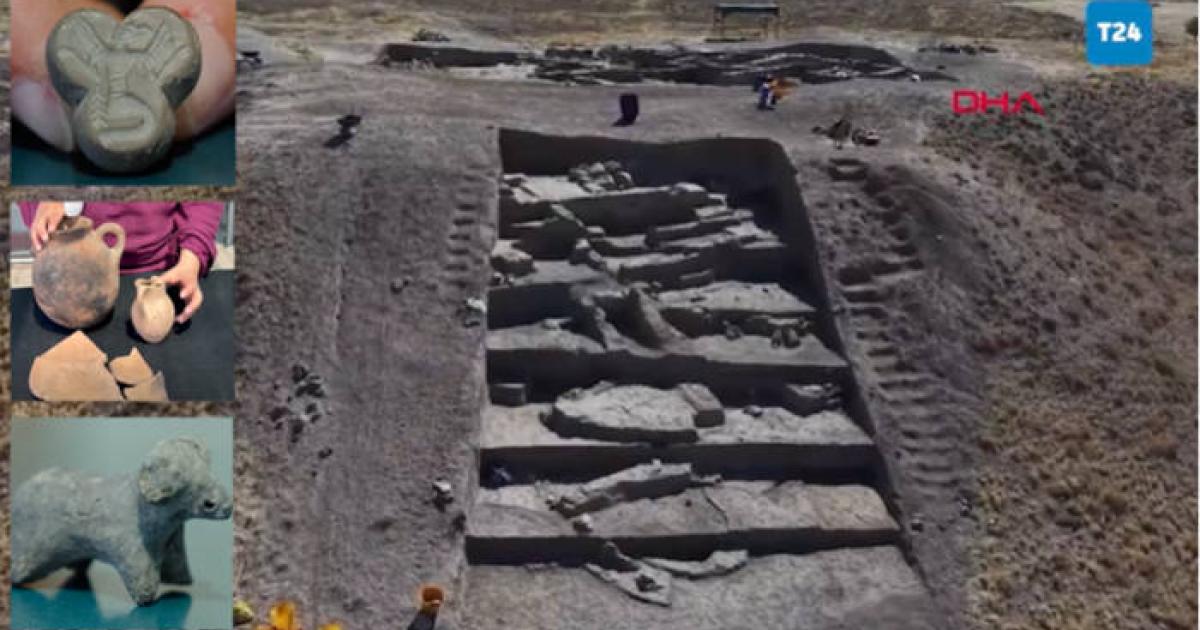

Archaeological excavations at Konya's Karahöyük have yielded three remarkable discoveries that are rewriting our understanding of Bronze Age life in central Anatolia. A 3,500-year-old dining set, an enigmatic eagle-headed human seal, and a 2,000-year-old bone pen represent different periods of this ancient settlement's rich history. These finds, uncovered by Associate Professor Dr. Gonca Dardeniz Arıkan from Istanbul University, offer unprecedented insights into daily life, religious practices, and administrative systems of ancient civilizations that flourished in what is now Turkey's Konya province.
Located in the Meram district just seven kilometers southeast of Konya city center, Karahöyük covers approximately 30 hectares and has been revealing its secrets since initial excavations began in 1953 under Prof. Dr. Sedat Alp. The site contains 27 cultural layers spanning from the Chalcolithic period through the Late Bronze Age, making it one of Anatolia's most significant archaeological mounds. The current excavations continue to uncover structures, artifacts, and public buildings that illustrate the region's complex social and economic evolution.

The current excavation site at Karahöyük. (Screenshot)
1.Ancient Culinary Traditions Preserved in Clay
The most substantial discovery consists of a complete 3,500-year-old dining set found within a public building dating to approximately 2000 BC. The ensemble includes a trefoil-rim jug, a restored handled cup, and a clay plate - representing one of the rare instances where such items were discovered as a complete set. This remarkable preservation provides archaeologists with a unique window into both adult and child life in ancient Karahöyük, as miniature animal figurines and toys were also discovered in the vicinity.

Part of the kitchen set discovered two weeks ago. (YouTube Screenshot)
According to Dr. Arıkan's statement to Anadolu Agency, the dining set was found alongside cremation graves and an altar within the same public building, highlighting the interconnection between daily activities and spiritual beliefs. The discovery also included clay bull figurines believed to be children's toys, demonstrating that recreational activities were an integral part of ancient life. A lead figurine of a goddess, likely used as an amulet, further emphasizes the religious dimension of the community's daily existence.
The presence of ancient pottery vessels used for cooking provides valuable information about culinary practices and food preparation techniques of Bronze Age Anatolian communities. The archaeological context suggests these vessels were used in communal settings, indicating sophisticated social structures and shared dining practices that mirror modern hospitality customs.
2. Mystical Eagle-Headed Seal Unveils Spiritual Beliefs
Perhaps the most enigmatic discovery is a 3,500-year-old seal depicting a human figure with an eagle's head, found in the same Bronze Age layers. This rare artifact provides extraordinary insights into the religious beliefs and symbolic practices of ancient Anatolian societies, highlighting the complex relationship between daily life and spiritual traditions during this period.
- More than 600 Ancient Seals and Amulets Found
- 7000-Year-Old Seal Found in Israel Signed For Deliveries!

Half eagle half man seal recovered from Karahöyük. (DHA/Screenshot)
Dr. Arıkan explained to Demirören News Agency that "seals were personal signatures, representing both identity and belief. Through these images, we can understand how people of the era expressed themselves and their connection to their gods and rituals." The eagle-human hybrid imagery suggests complex mythological beliefs that may have influenced later Hittite religious practices and iconography.
The seal's discovery alongside evidence of unusual burial practices adds another layer to our understanding of Bronze Age spirituality. Excavations revealed that while adults underwent cremation, infants were buried within domestic living spaces. Dr. Arıkan noted, "People buried their babies within the rooms they used daily. We believe this was closely tied to their religious beliefs - perhaps they wanted to keep the memory of their children alive within their households."

Children’s toys are among the recent finds at Konya Karahöyük. (DHA/Screenshot)
3. Administrative Innovation: The Bone Pen Discovery
The third significant find represents a later period in Karahöyük's history - a 2,000-year-old bone pen discovered at the related site of Türkmen-Karahöyük. This writing implement offers rare insights into the sophisticated bureaucracy and administrative practices of what researchers believe may have been the ancient Hittite capital of Tarhuntassa.
The bone pen discovery, along with associated administrative artifacts including toys, seals, dice, and a bathtub, demonstrates the evolution of the region from a Bronze Age trade center to a major administrative hub. The presence of writing implements suggests a literate administrative class capable of maintaining complex records and correspondence.
Archaeological evidence indicates that Karahöyük served as more than just a trading center. Silver plaques wrapped in cloth, believed to belong to local merchants, demonstrate the site's crucial role in ancient commercial networks. Dr. Arıkan observed, "We are witnessing the economic systems of 3,500 years ago. Merchants used seals and marked tokens for accounting, similar to modern business practices."
Surprising Dietary Evidence and Environmental Context
One of the most unexpected discoveries was evidence of seafood consumption, including squid, in landlocked Konya 3,500 years ago. Analysis of large storage vessels revealed not only agricultural products but also remains of both freshwater and marine species. Freshwater fish likely originated from Beyşehir Lake and nearby rivers, while marine products such as squid were probably transported from Alanya on the Mediterranean coast, demonstrating extensive trade networks spanning hundreds of kilometers.
The faunal remains paint a picture of a dramatically different ecosystem than exists today. Alongside seafood, archaeologists discovered bones of red deer, fallow deer, rabbits, hyenas, and even cave bears, indicating a much richer and more diverse environment during the Bronze Age. This evidence suggests that climate and environmental conditions in central Anatolia were markedly different 3,500 years ago, supporting larger and more varied wildlife populations.
These discoveries at Karahöyük, spanning over 1,500 years of continuous occupation, provide unprecedented insights into the evolution of Anatolian civilization. From the Bronze Age dining customs revealed by the ceramic vessel set, through the spiritual beliefs embodied in the eagle-headed seal, to the administrative sophistication demonstrated by the bone pen, these finds collectively illustrate the complexity and continuity of ancient life in central Turkey. As excavations continue under Dr. Arıkan's leadership, researchers anticipate uncovering further evidence that will enhance our understanding of this crucial period in Near Eastern archaeology and the broader development of human civilization.
Top image: The current excavation site at Karahöyük. Source: Screenshot
By Gary Manners
References
Arıkan, G.D. (2025). Karahöyük Excavations Reveal Ancient Dining Practices. Available at: https://arkeonews.net/3500-year-old-dining-set-found-at-konya-karahoyuk-turkiye/
Demirören News Agency. (2025). Eagle-Headed Human Seal Discovery in Central Turkey. Available at: https://arkeonews.net/3500-year-old-human-bodied-eagle-headed-seal-discovered-in-central-turkiye/
Turkish News Platform. (2025). Kitchen Set Discovery at Karahöyük. Available at: http://www.anatolianarchaeology.net/3500-year-old-kitchen-set-discovered-at-karahoyuk-in-turkiyes-central-anatolia/






















