


In this article we will try to demonstrate that the characteristics, geographical and otherwise, attributed by Plato to the mythical island of Atlantis actually correspond to those of Greenland, the vast island located in the North Atlantic. Not only that: these characteristics, in particular its strategic geographical position combined with its mineral wealth, explain the interest of global powers such as the United States, China and Russia.
Plato’s Atlantis: True or False?
Plato exposes the myth of Atlantis in two of his dialogues, the Timaeus and the Critias, starting from the moment in which Critias, one of the interlocutors of the Timaeus, begins to recount the content of a conversation, reported to him by his great-grandfather, that Solon had had with an Egyptian priest. In this narrative, later extensively developed in the Critias, Plato focuses on a vast island where in ancient times an advanced civilization would have developed, master of the seas and capable of great engineering feats, which would have expanded with its ships on both sides of the Atlantic.
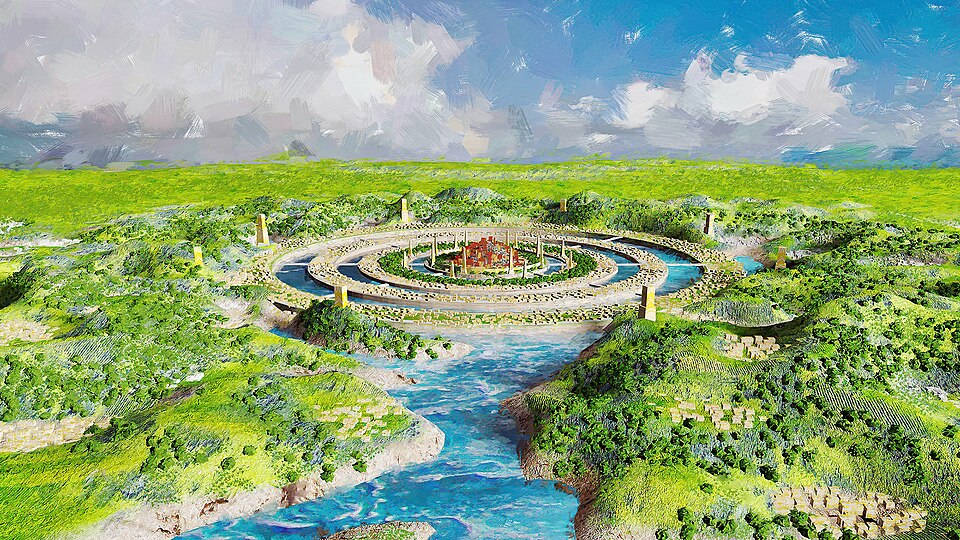
Image of ancient Atlantis as it might have looked, surrounded by green land. (Wikipedia/CC BY-SA 4.0).
The possible existence of an authentic Atlantis was actively discussed during classical antiquity. Almost ignored in the Middle Ages, it was then rediscovered by humanists in the modern era, and inspired the utopian works of several Renaissance writers, such as Francis Bacon’s ‘New Atlantis’, while most present-day philologists and classicists agree on the story’s fictional nature.















