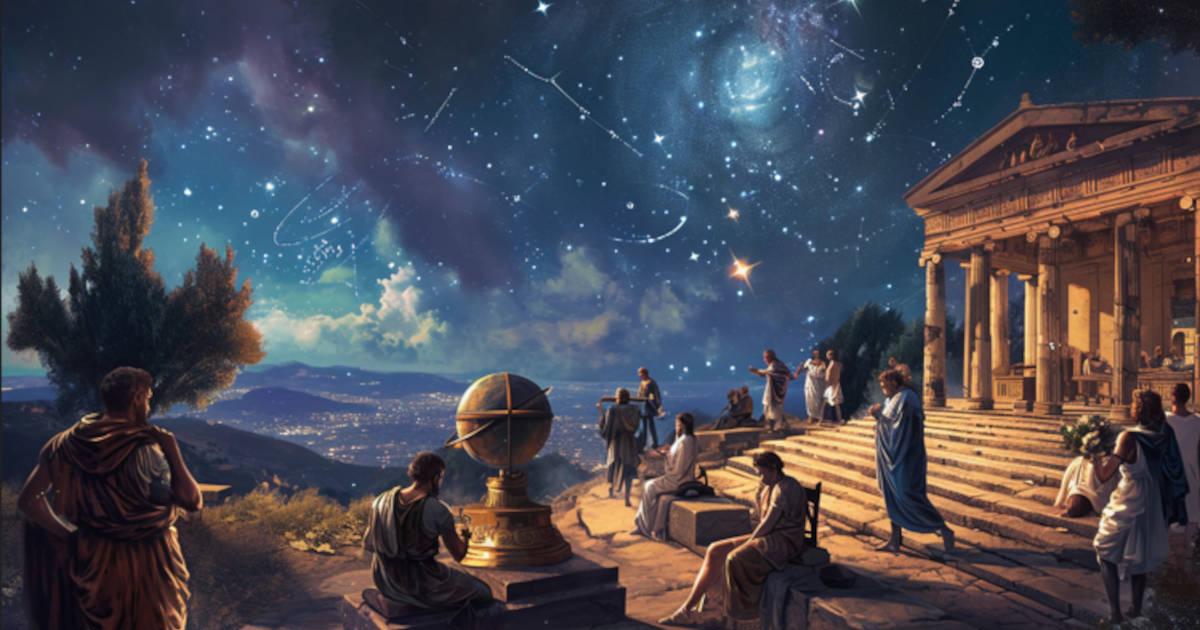

Although there was interest in the motion of the celestial bodies long before the ancient Greeks, ancient Greek astronomy is distinctive in that it is the first astronomical tradition in the West to be proto-scientific one. Ancient Greek astronomy emerged out of the worldview of Thales which sought natural explanations for cosmic phenomena in contrast to earlier traditions which relied on explanations from mythology. Ancient Greek astronomers used their observations to eventually construct a complex mathematical and physical model of the cosmos. Although it turned out to be wrong, it is significant in being the first Western attempt to create a scientific theory for the structure and workings of the cosmos.
Origins of Scientific Greek Astronomy
The Pre-Socratic Philosophers (600-400 BC)
Prior to about 600 BC, the ancient Greek view of cosmology does not appear to have differed significantly from that of surrounding cultures. This began to change in the first half of the sixth century BC with the emergence of the Milesian school. The Milesian school was the first school of Greek philosophy, part of the broader pre-Socratic phase of Greek philosophy.
Thales (620-575/550 BC)
Ancient Greek science, and philosophy in general, begins with Thales. Thales lived in Miletus in modern Turkey. Thales is credited as the first Greek philosopher and the first to seek natural explanations for the origins of things in the world, rather than attributing them to the activities of the gods.
Thales is believed to have predicted an eclipse in 585 BC, though it is not clear how he would have attained the necessary knowledge to predict it. Thales is said to have believed that Earth was disk-shaped and floated on an infinite expanse of water. He also believed that water was the primordial substance from which everything sprang. Very little is known about Thales, let alone his astronomical ideas. Nonetheless, his focus on what and how questions regarding the world, for example how the world was formed, as opposed to who and why questions common in mythology, helped lay the foundation of scientific Greek astronomy and the modern science of astronomy.