With no, or slim, evidence, Egyptologists claim that all of Egypt’s pyramids were built to be tombs. With an abundance of robust evidence, I will theorize that all of Egypt’s pyramids were built to serve a more practical purpose, that is to harvest electrons contained in igneous rock in the Earth’s lithosphere.
The fundamental science that supports the Giza power plant theory is the same understanding of nature that is embodied in every other pyramid in Egypt. It is, as Ahmed Adly specifically noted, “the power generated from an exceptional understanding of the physical properties of the rocks.” While Adly was referring to the ancient Egyptians’ presumed knowledge and understanding of rocks, today, fortunately, we have scientists who, in my opinion, have recovered that lost knowledge—and what they have discovered has the potential to transform the planet in ways we cannot even imagine.
When Rocks Go Crunch
In The Giza Power Plant, I described the King’s Chamber as a resonant chamber that, because of its material makeup, converted mechanical energy (vibration) to electrical energy. I quoted the work of other authors who claimed that the Aswan granite out of which the chamber was constructed was composed of feldspar and up to 55% silicon quartz crystal. With the quartz crystal subject to vibration, I theorized that the piezoelectric effect of the crystal was responsible for generating electron flow.
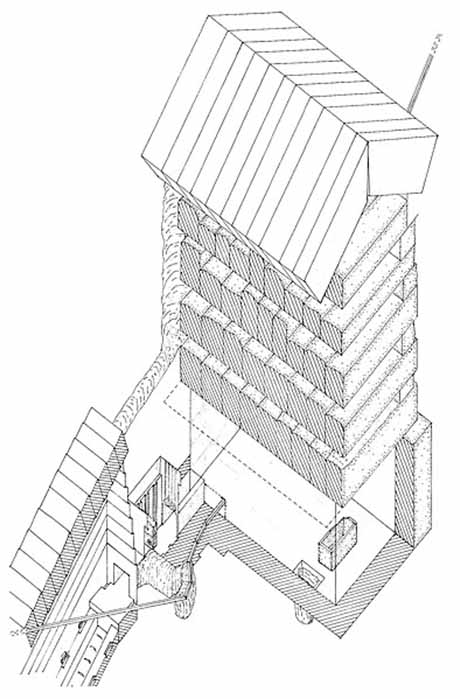
Because of the features and dimensions of the North Shaft that make it suitable for use as a waveguide for microwave energy, I posited that the King’s Chamber complex and its shafts connecting to the outside would serve as a maser (microwave amplification through stimulated emission radiation.) The key evidence to support this theory are the North Shaft, with dimensions suitable for hydrogen radiation, and a bulbous opening in the south wall, shaped like a microwave horn antenna, that collected the amplified energy stimulated in the resonant King’s Chamber.