

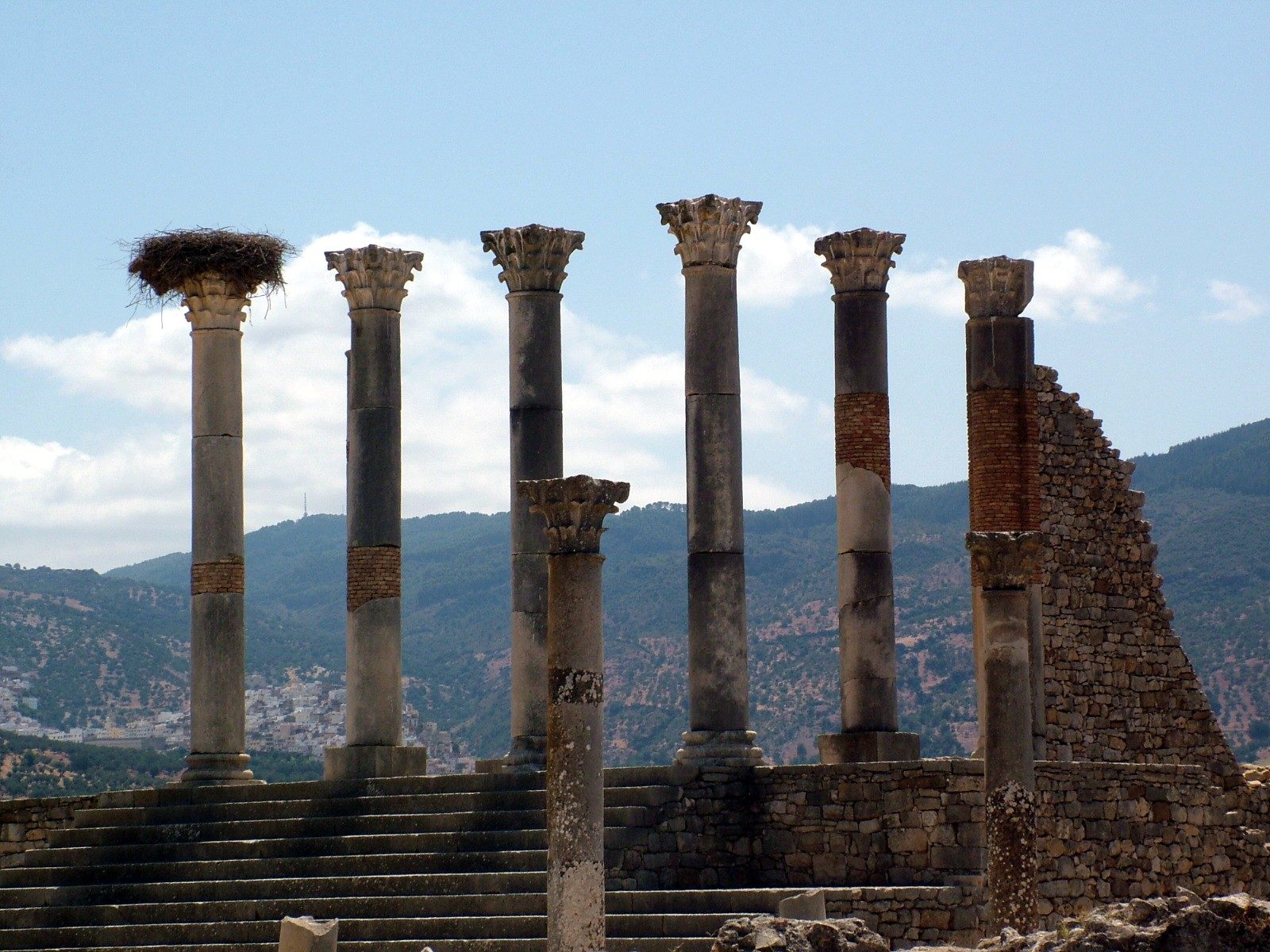
Photo: Marcin Sochacki (Wanted), CC BY-SA 4.0 via Wikimedia Commons Source
A Roman city in Morocco with fine mosaics. It dates from 400 BC and is associated with Ancient Rome and Berbers. It is a UNESCO World Heritage Site.
- Country
- Morocco
- Region
- Africa
- Period
- 3rd century BC to AD 11th century
- Kind of site
- Carthaginian archaeological site, ancient city, Roman archaeological site
- Dates from
- 400 BC
- Period or culture
- Ancient Rome, Berbers, Punic people
- Heritage status
- World Heritage Site; Moroccan cultural heritage
- Located in
- Oualili, Morocco
- Also known as
- Mint of Volubilis
- Coordinates
- 34.0711° N, 5.5536° WWikipedia and Wikidata agree within 3.56 km
- UNESCO
- World Heritage site 836
- Reference
- Wikidata Q391215
- Encyclopedia
- Wikipedia article
About this place
Volubilis is a partly excavated Berber-Roman city in Morocco, situated near the city of Meknes, that may have been the capital of the Kingdom of Mauretania, at least from the time of King Juba II. Before Volubilis, the capital of the kingdom may have been at Gilda. Built in a fertile agricultural area, it developed from the 3rd century BC onward as a Berber, then proto-Carthaginian, settlement before being the capital of the kingdom of Mauretania. It grew rapidly under Roman rule from the 1st century AD onward and expanded to cover about 42 hectares (100 acres) with a 2.6 km (1.6 mi) circuit of walls. The city gained a number of major public buildings in the 2nd century, including a basilica, temple and triumphal arch.
Adapted from the Wikipedia article Volubilis (this version), lightly edited for style, under the CC BY-SA 4.0 license.
Nearby places
Open in the Atlas →- Arch of Caracalla 0.4 km (0.2 mi)
- Sidi Said, Morocco 1.5 km (0.9 mi)
- Aïn Schkor 3.7 km (2.3 mi)
- Tocolsida 4.5 km (2.8 mi)
- Rirha 12 km (8 mi)
- Oued Beht 41 km (25 mi)














Recent comments