

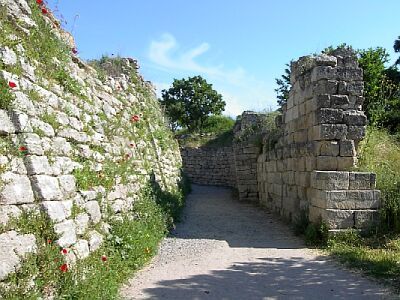
Photo: Unknown author, CC BY-SA 3.0 via Wikimedia Commons Source
Troy is the layered mound of Hisarlik near the Dardanelles in northwest Turkey. People lived there from about 3000 BC into the Roman and Byzantine periods, leaving more than nine cities built one on top of another. Most scholars accept the site as Homer's Troy, though whether a Trojan War happened as the Iliad tells it is Disputed.
The layered mound of Hisarlik in northwest Turkey, widely identified with Homer's Troy. It dates from 3000 BC. It is a UNESCO World Heritage Site.
- Country
- Turkey
- Region
- Asia
- Period
- about 3000 BC to AD 500
- Kind of site
- Archaeological site, ancient city, settlement mound
- Dates from
- 3000 BC
- Heritage status
- World Heritage Site
- Located in
- Çanakkale Province, Turkey
- Also known as
- Ancient Troy; City of Troy; Ilion; Ilium; Teukroi
- Coordinates
- 39.9575° N, 26.2389° EWikipedia and Wikidata agree within 0.0 km
- UNESCO
- World Heritage site 849
- Reference
- Wikidata Q22647
- Encyclopedia
- Wikipedia article
About this place
Troy or Ilion was an ancient city located in present-day Çanakkale, Turkey. It is best known as the setting for the Greek myth of the Trojan War. The modern-day archaeological site, also known as Hisarlık, is open to the public as a tourist destination, and was added to the UNESCO World Heritage list in 1998. Troy was repeatedly destroyed and rebuilt during its 4000 years of settlement. As a result, nine archaeological layers have been identified at the site, each corresponding to a city built on the ruins of the previous. Archaeologists refer to these layers using Roman numerals, Troy I being the earliest and Troy IX being the latest. Troy was first settled around 3600 BC and grew into a small fortified city around 3000 BC (Troy I).
Adapted from the Wikipedia article Troy (this version), lightly edited for style, under the CC BY-SA 4.0 license.














Recent comments