

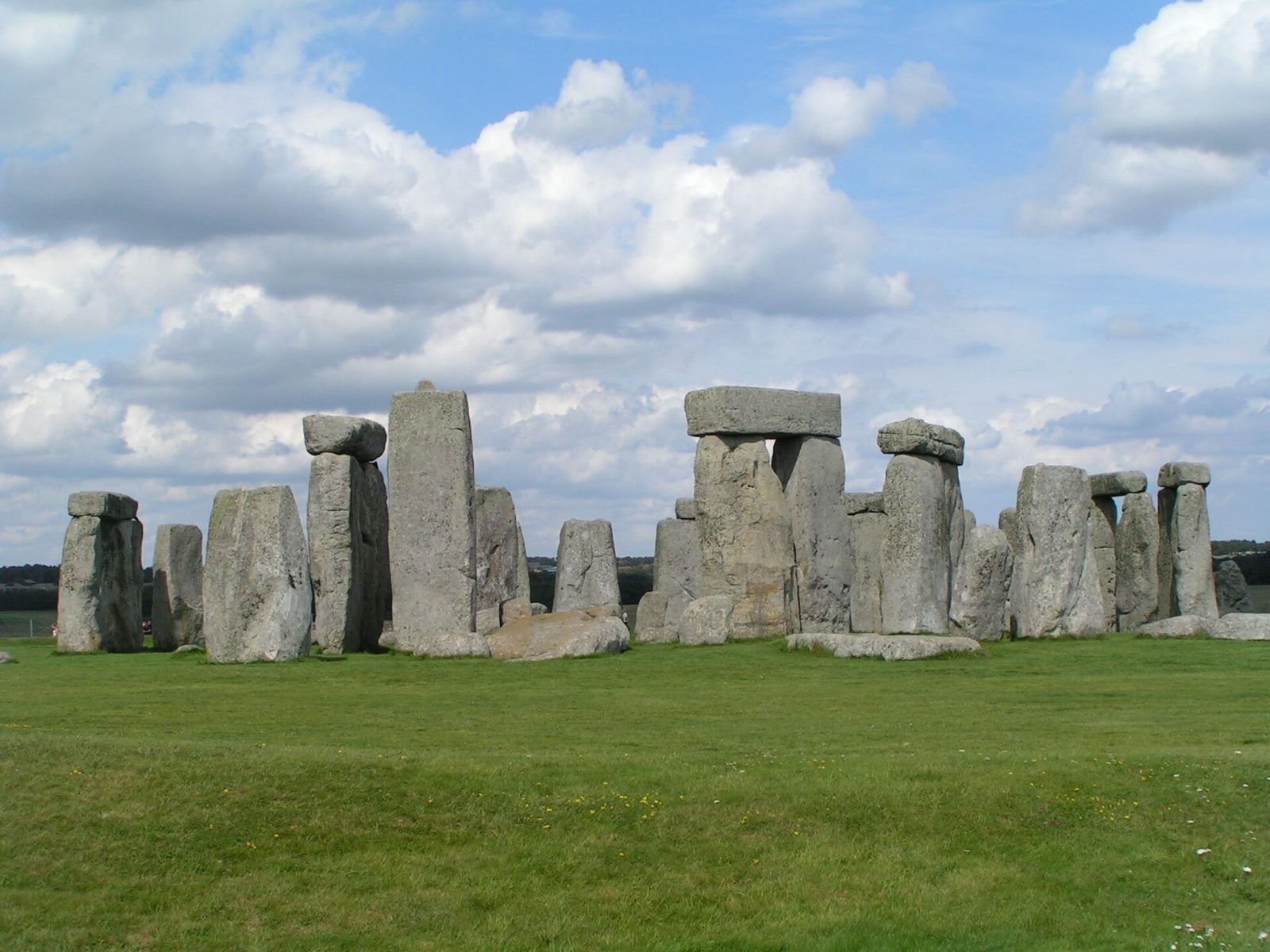
Photo: Stefan Kühn, CC BY-SA 3.0 via Wikimedia Commons Source
Stonehenge is a ring of standing stones on Salisbury Plain in Wiltshire, England. It was begun around 3000 BC and rebuilt in stages over some 1,500 years, with its main axis aligned on the midsummer sunrise and midwinter sunset. Where its stones came from is a live question, and the claim that they were brought from Wales and Scotland is Disputed in our Fact Check.
A ring of standing sarsens and smaller bluestones on Salisbury Plain, built and rebuilt over some 1,500 years and aligned on the midsummer sunrise and midwinter sunset. It dates from the 30th century BC and is associated with the Neolithic and the Bronze Age. It is a UNESCO World Heritage Site.
- Country
- United Kingdom
- Region
- Europe
- Period
- about 3000 to 1500 BC
- Kind of site
- Cromlech, henge, monument
- Dates from
- 30th century BC
- Period or culture
- Neolithic, Bronze Age
- Heritage status
- Scheduled monument; World Heritage Site
- Part of
- Stonehenge, Avebury and Associated Sites
- Located in
- Amesbury, United Kingdom
- Coordinates
- 51.1789° N, 1.8261° WWikipedia and Wikidata agree within 0.0 km
- UNESCO
- World Heritage site 373
- Reference
- Wikidata Q39671
- Encyclopedia
- Wikipedia article
About this place
Stonehenge is a prehistoric megalithic structure on Salisbury Plain in Wiltshire, England, two miles west of Amesbury. It consists of an outer ring of vertical sarsen standing stones, each around 13 feet (4.0 m) high, seven feet (2.1 m) wide, and weighing around 25 tons, topped by connecting horizontal lintel stones which are held in place with mortise and tenon joints, a feature unique among contemporary monuments. Inside is a ring of smaller bluestones. Inside these are free-standing trilithons: two bulkier vertical sarsens joined by a single lintel. The whole monument, now in ruins, is aligned towards the sunrise on the summer solstice and sunset on the winter solstice. The stones are set within earthworks in the middle of the densest complex of Neolithic and Bronze Age monuments in England, including several hundred tumuli (burial mounds).
Adapted from the Wikipedia article Stonehenge (this version), lightly edited for style, under the CC BY-SA 4.0 license.
Nearby places
Open in the Atlas →- Heelstone Ditch 0.5 km (0.3 mi)
- Bush Barrow 0.8 km (0.5 mi)
- Cursus Barrows 0.9 km (0.5 mi)
- Bowl barrow located south of The Cursus and east of Fargo Plantation forming part of The Cursus round barrow cemetery 0.9 km (0.6 mi)
- Two bowl barrows and four bell barrows forming the greater part of a round barrow cemetery known as the New King Barrows 1.2 km (0.7 mi)
- Coneybury Anomaly 1.3 km (0.8 mi)














Recent comments