

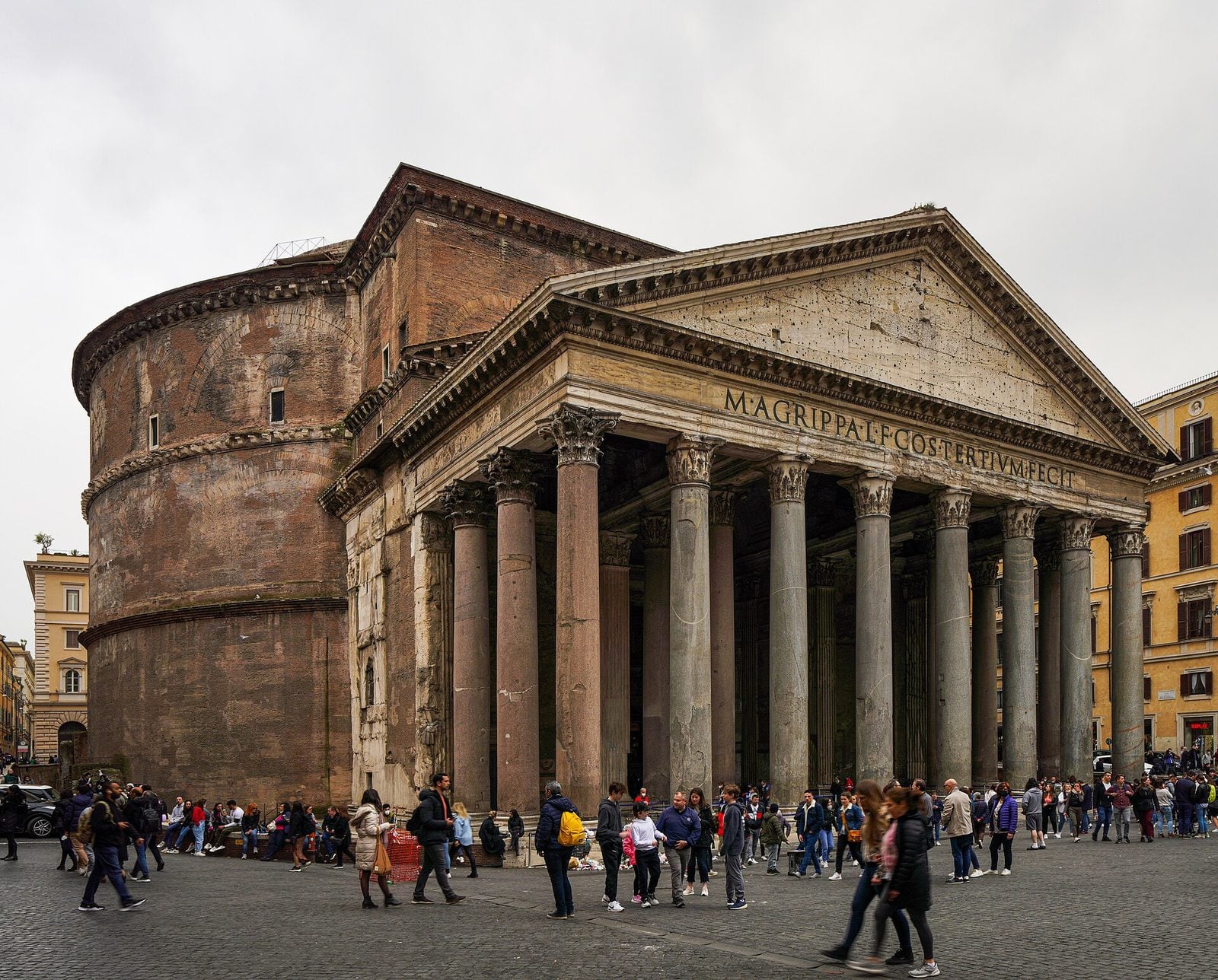
Photo: NikonZ7II, CC BY-SA 4.0 via Wikimedia Commons Source
A Roman temple with the largest unreinforced concrete dome in the world, still in use as a church. It dates from the 2nd century AD and is associated with the culture of ancient Rome. It is part of Italy's national heritage.
- Country
- Italy
- Region
- Europe
- Period
- about AD 113 to 125
- Kind of site
- Roman temple, Roman archaeological site, minor basilica
- Dates from
- 2nd century AD
- Period or culture
- culture of ancient Rome
- Heritage status
- Italian national heritage
- Architect or builder
- Apollodorus of Damascus
- Located in
- Rome, Italy
- Also known as
- Pantheon (Rome, Italy); Santa Maria ad Martyres; Basilica of Our Lady of the Martyrs; Basilica of Santa Maria ad Martyres; Basilica of Santa Maria
- Coordinates
- 41.8986° N, 12.4768° EWikipedia and Wikidata agree within 0.01 km
- Reference
- Wikidata Q99309
- Encyclopedia
- Wikipedia article
About this place
The Pantheon (UK:, US: ; Latin: Pantheum, from Ancient Greek Πάνθειον '[temple] of all the gods') is an ancient Polytheist temple in Rome, Italy, originally built under Roman emperor Augustus and reconstructed under Hadrian. Since AD 609, it has served as the Roman Catholic Basilica of Saint Mary and the Holy Martyrs (Italian: Basilica di Santa Maria ad Martyres) with the special Pontifical privilege of immemorial status. The Pantheon was built on the site of an earlier temple, which had been commissioned by Marcus Vipsanius Agrippa during the reign of Augustus. After the original burnt down, the present building was completed by the emperor Hadrian and probably dedicated c. AD 126. Its date of construction is uncertain, because Hadrian chose to re-inscribe the new temple with Agrippa's original date inscription from the older temple.
Adapted from the Wikipedia article Pantheon, Rome (this version), lightly edited for style, under the CC BY-SA 4.0 license.
Nearby places
Open in the Atlas →- Stadium of Domitian 0.3 km (0.2 mi)
- Odeon of Domitian 0.3 km (0.2 mi)
- Temple of Marcus Aurelius 0.4 km (0.2 mi)
- Fortuna Huiusce Diei, Aedes 0.4 km (0.2 mi)
- Arch of Claudius 0.4 km (0.2 mi)
- Curia of Pompey 0.4 km (0.2 mi)














Recent comments