

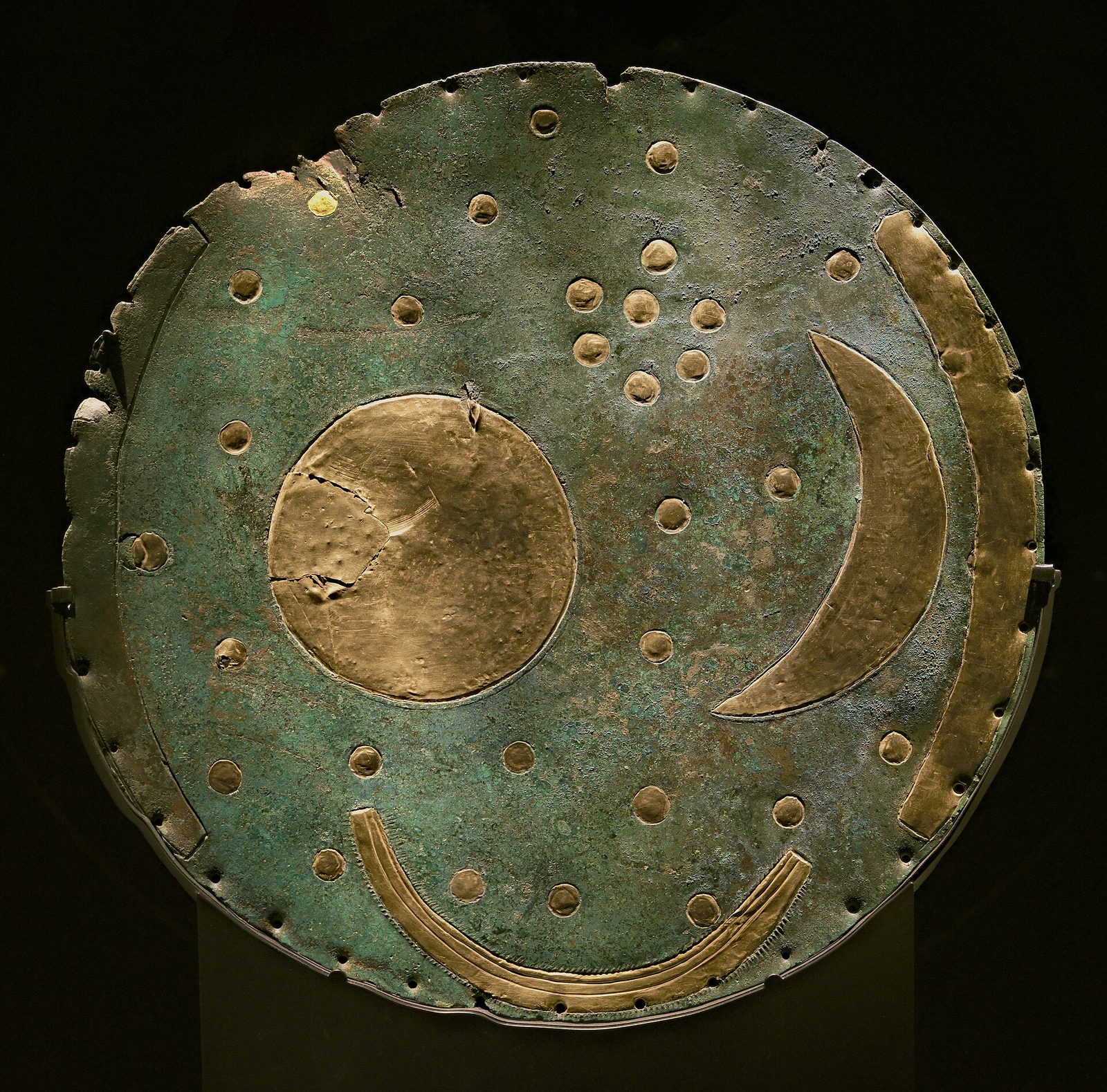
Photo: Shonagon, CC0 via Wikimedia Commons Source
The Nebra sky disc was found on the Mittelberg hill in Saxony-Anhalt; it is the oldest known concrete depiction of the cosmos. It dates from the 16th century BC and is associated with the Unetice culture. It is protected as a Memory of the World International Register.
- Country
- Germany
- Region
- Europe
- Period
- about 1600 BC
- Kind of site
- Archaeological artefact, metal artwork
- Dates from
- 16th century BC
- Period or culture
- Unetice culture
- Heritage status
- Memory of the World International Register
- Coordinates
- 51.2839° N, 11.5200° EWikipedia and Wikidata agree within 0.0 km
- Reference
- Wikidata Q157094
- Encyclopedia
- Wikipedia article
About this place
The Nebra sky disc is a bronze disc of around 30 cm diameter and a weight of 2.2 kg, having a blue-green patina and inlaid with gold symbols. These symbols are interpreted generally as the Sun or full moon, a lunar crescent, and stars, including a cluster of seven stars, axiomatically interpreted as the Pleiades. Two golden arcs along the sides (one now missing) are thought to have marked the angle between the solstices. Another arc at the bottom with internal parallel lines is usually interpreted as a solar boat with numerous oars, although some authors have also suggested that it may represent a rainbow, the Aurora Borealis, a comet, or a sickle. In 1999, the disc was found buried on the Mittelberg hill near Nebra in Germany.
Adapted from the Wikipedia article Nebra sky disc (this version), lightly edited for style, under the CC BY-SA 4.0 license.
Nearby places
Open in the Atlas →- Monumental church Memleben Monastery 2.6 km (1.6 mi)
- Menhir von Saubach 6.6 km (4.1 mi)
- Derfflinger Hügel 13 km (8 mi)
- Huthügel 13 km (8 mi)
- Großsteingrab Langeneichstädt 17 km (11 mi)
- Hallonge 20 km (12 mi)














Recent comments