

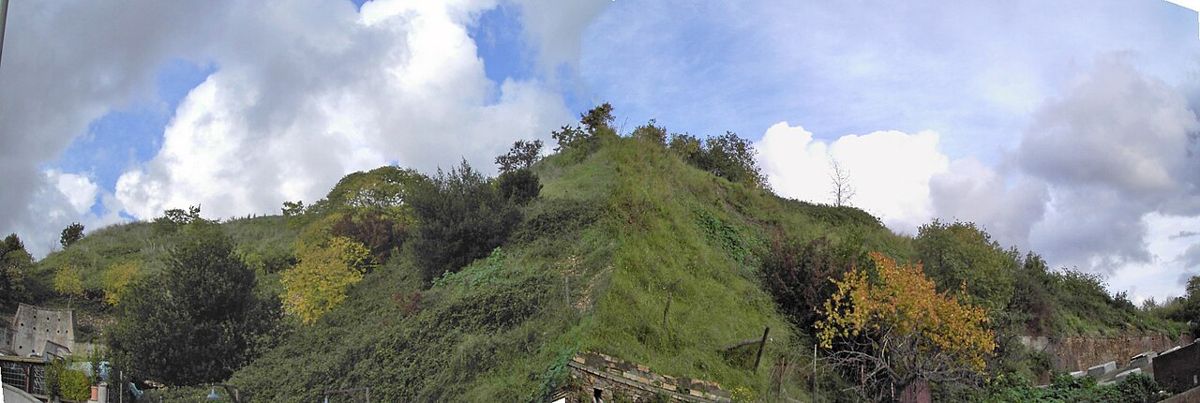
Photo: No machine-readable author provided. Lalupa assumed (based on copyright claims)., Public domain via Wikimedia Commons Source
Monte Testaccio is an Artificial mountain made from broken Roman pottery. It is associated with Ancient Rome.
- Country
- Italy
- Region
- Europe
- Period
- Ancient Rome
- Kind of site
- Artificial hill, archaeological site
- Period or culture
- Ancient Rome
- Located in
- Rome, Italy
- Coordinates
- 41.8759° N, 12.4757° ECoordinates from Wikidata
- Reference
- Wikidata Q781595
- Encyclopedia
- Wikipedia article
About this place
Monte Testaccio or Monte Testaceo, also known as Monte dei Cocci, is an artificial mound in Rome composed almost entirely of testae, fragments of broken ancient Roman pottery, nearly all discarded amphorae, some of which were labelled with tituli picti. It is one of the largest spoil heaps found anywhere in the ancient world, covering an area of 2 hectares (4.9 acres) at its base and with a volume of approximately 580,000 cubic meters (760,000 cu yd), containing the remains of an estimated 53 million amphorae. It has a circumference of nearly a kilometer (0.6 mi) and stands 35 meters (115 ft) high, though it was probably considerably higher in ancient times. It stands a short distance away from the east bank of the River Tiber, near the Horrea Galbae where the state-controlled reserve of olive oil was stored in the late 2nd century AD.
Adapted from the Wikipedia article Monte Testaccio (this version), lightly edited for style, under the CC BY-SA 4.0 license.
Nearby places
Open in the Atlas →- Forum Vinarium 0.3 km (0.2 mi)
- Pyramid of Cestius 0.4 km (0.3 mi)
- Porticus Aemilia 0.5 km (0.3 mi)
- Emporium 0.5 km (0.3 mi)
- Pons Probi 0.6 km (0.4 mi)
- Arch of San Lazzaro 0.7 km (0.4 mi)
Place data from Wikidata (CC0). Ancient Origins has not yet reviewed this entry in depth.














Recent comments