

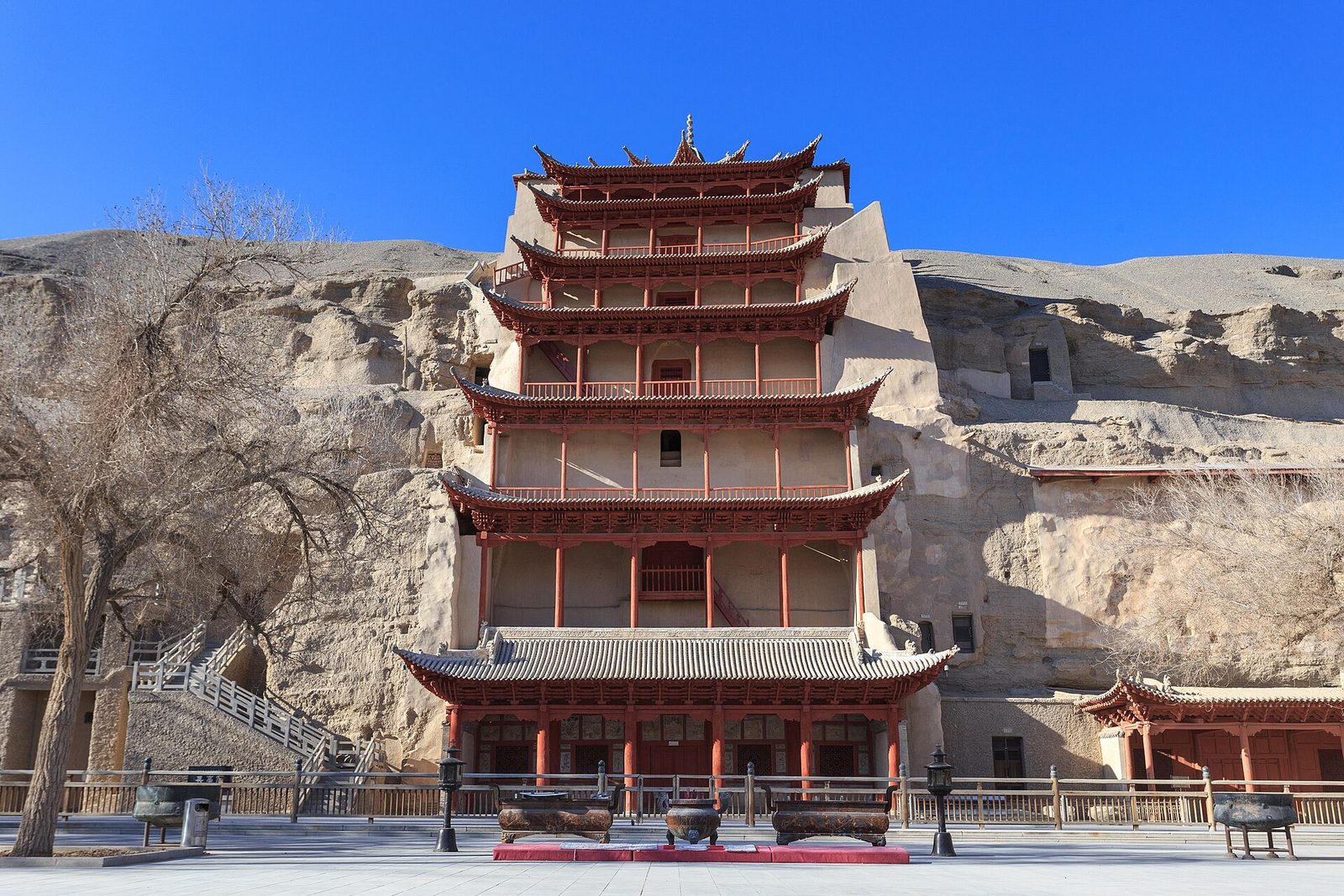
Photo: Zhangzhugang, CC BY-SA 4.0 via Wikimedia Commons Source
Hundreds of Buddhist cave temples near Dunhuang on the Silk Road. It is a UNESCO World Heritage Site.
- Country
- China
- Region
- Asia
- Period
- AD 4th to 14th century
- Kind of site
- Cave, building complex, architectural ensemble
- Heritage status
- Major Historical and Cultural Site Protected at the National Level; World Heritage Site
- Located in
- Guazhou, China
- Also known as
- Mogao ku
- Coordinates
- 40.0372° N, 94.8042° EWikipedia and Wikidata agree within 0.0 km
- UNESCO
- World Heritage site 440
- Reference
- Wikidata Q43286
- Encyclopedia
- Wikipedia article
About this place
The Mogao Caves, also known as the Thousand Buddha Grottoes or Caves of the Thousand Buddhas, form a system of 500 temples 25 km southeast of the center of Dunhuang, an oasis located at a religious and cultural crossroads on the Silk Road, in Gansu province, China. The caves may also be known as the Dunhuang Caves; however, this term is also used as a collective term to include other Buddhist cave sites in and around the Dunhuang area, such as the Western Thousand Buddha Caves, Eastern Thousand Buddha Caves, Yulin Caves, and Five Temple Caves. The caves contain some of the finest examples of Buddhist art spanning a period of 1,000 years. The first caves were dug out in 366 CE as places of Buddhist meditation and worship; later the caves became a place of pilgrimage, and caves continued to be built at the site until the 14th century.
Adapted from the Wikipedia article Mogao Caves (this version), lightly edited for style, under the CC BY-SA 4.0 license.
Nearby places
Open in the Atlas →- Five Temple Caves 43 km (27 mi)
- Xuanquanzhi 51 km (32 mi)
- Yulin Caves 96 km (60 mi)
- Anxi 112 km (69 mi)
- Wenshushan Grottoes 305 km (190 mi)
- Lop Desert 359 km (223 mi)














Recent comments