

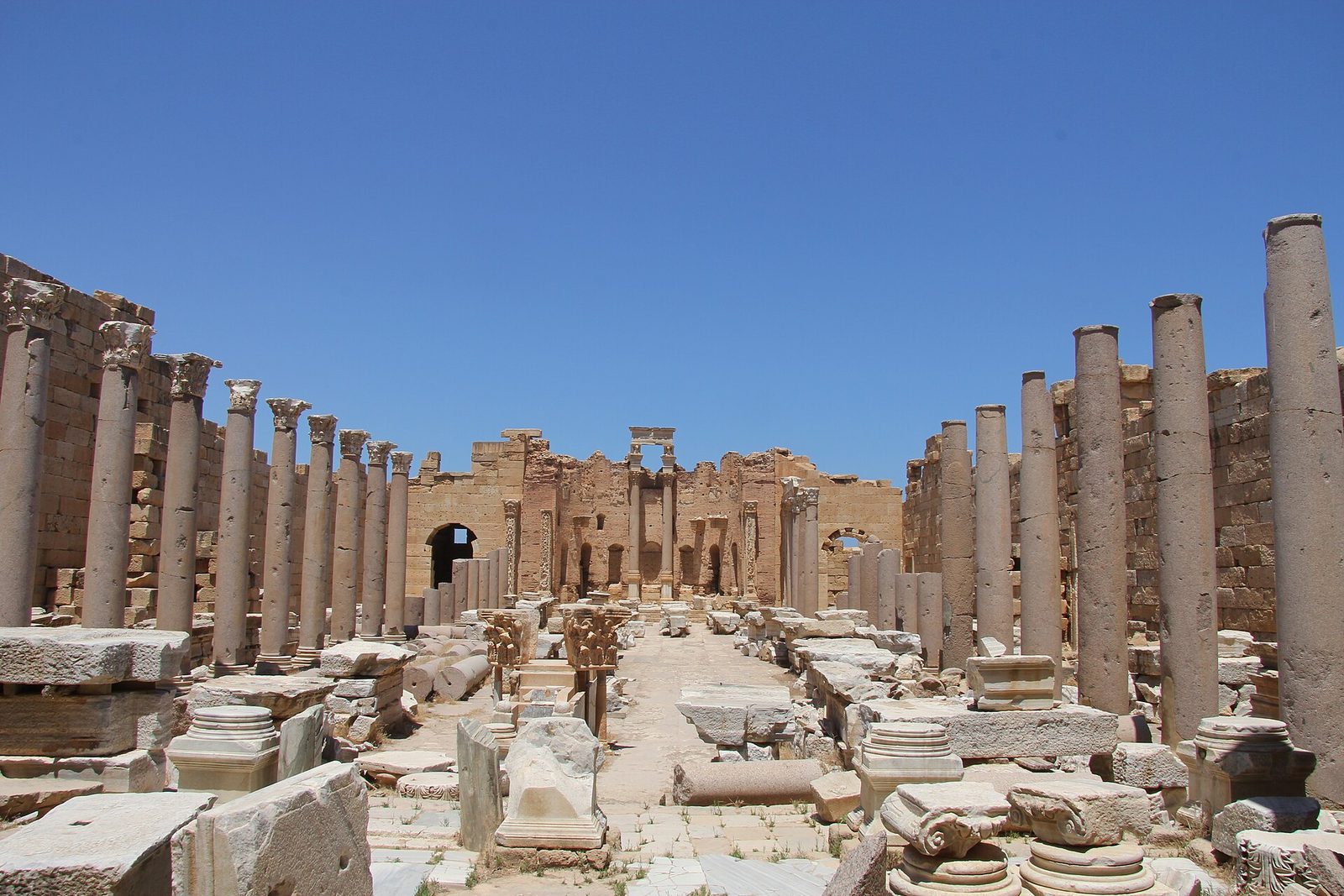
Photo: joepyrek from Richmond, Va, USA, CC BY-SA 2.0 via Wikimedia Commons Source
One of the most spectacular Roman cities of the Mediterranean, birthplace of Septimius Severus. It dates from the 7th century BC and is associated with the Roman Empire. It is a UNESCO World Heritage Site.
- Country
- Libya
- Region
- Africa
- Period
- from the 7th century BC
- Kind of site
- Ancient city, emporium, Roman city
- Dates from
- 7th century BC
- Period or culture
- Roman Empire
- Heritage status
- World Heritage Site
- Located in
- Al Khums, Libya
- Also known as
- Ulpia Traiana; Labdah; Mint of Leptis Magna
- Coordinates
- 32.6392° N, 14.2906° EWikipedia and Wikidata agree within 0.09 km
- UNESCO
- World Heritage site 183
- Reference
- Wikidata Q191504
- Encyclopedia
- Wikipedia article
About this place
Leptis or Lepcis Magna, also known by other names in antiquity, was a prominent city of the Carthaginian Empire and Roman Libya at the mouth of the Wadi Lebda in the Mediterranean. Established as a Punic settlement prior to 500 BC, the city experienced significant expansion under Roman Emperor Septimius Severus (r. 193 to 211), who was born in the city. The 3rd Augustan Legion was stationed here to defend the city against Berber incursions. After the legion's dissolution under Gordian III in 238, the city was increasingly open to raids in the later part of the 3rd century. Diocletian reinstated the city as provincial capital, and it grew again in prosperity until it fell to the Vandals in 439. It was reincorporated into the Eastern Empire in 533 but continued to be plagued by Berber raids and never recovered its former importance.
Adapted from the Wikipedia article Leptis Magna (this version), lightly edited for style, under the CC BY-SA 4.0 license.
Nearby places
Open in the Atlas →- Severan Basilica 0.4 km (0.2 mi)
- Hunting Baths, Lepcis Magna 0.5 km (0.3 mi)
- Cinyps 19 km (12 mi)
- Oea 108 km (67 mi)
- Gasr Banat 137 km (85 mi)
- Hadd-Hajar-Clausura 167 km (104 mi)














Recent comments