

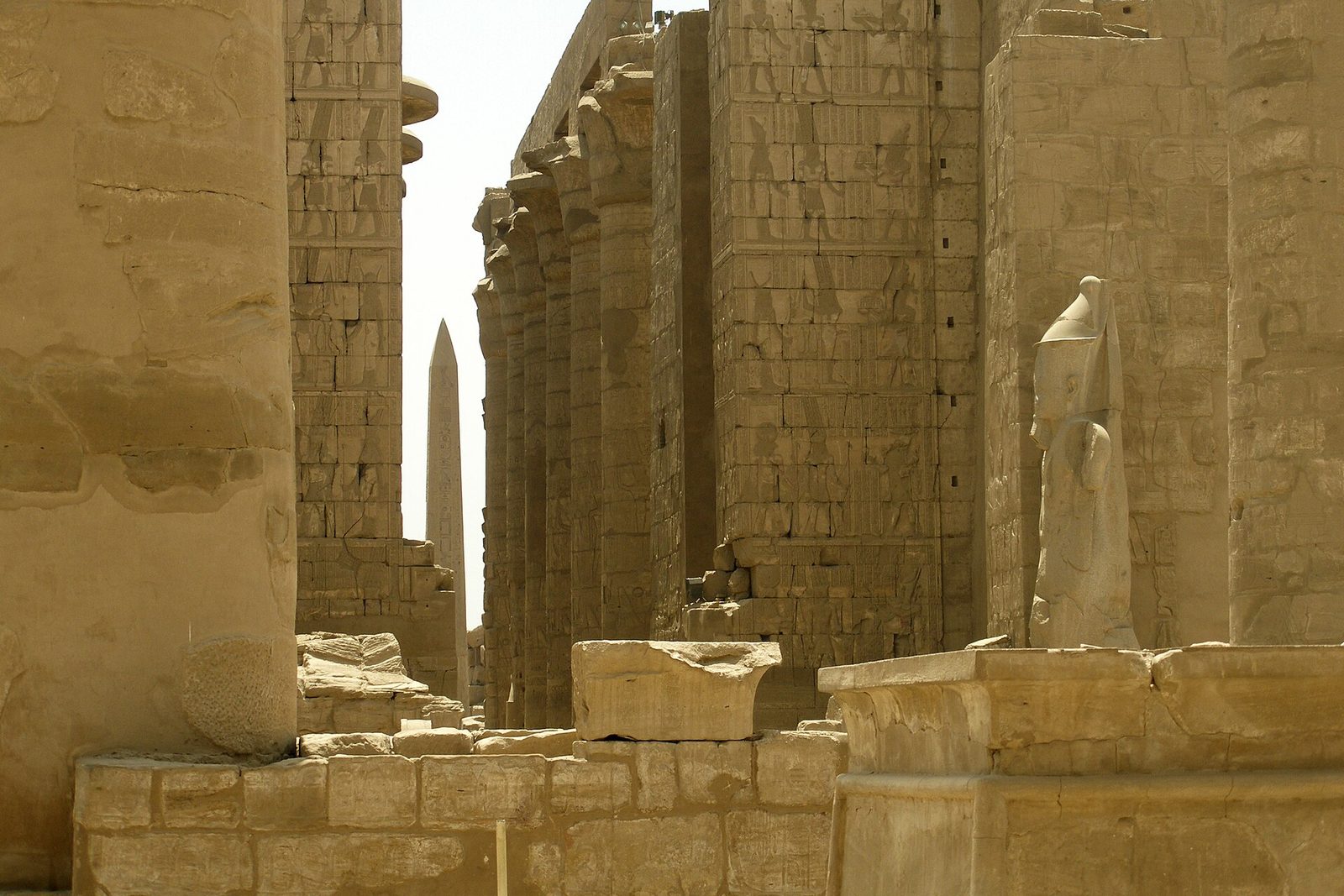
Photo: Vyacheslav Argenberg, CC BY 4.0 via Wikimedia Commons Source
The vast temple complex of Amun at Luxor with the Great Hypostyle Hall. It dates from 1900 BC and is associated with Ancient Egypt. It is part of a UNESCO World Heritage Site.
- Country
- Egypt
- Region
- Africa
- Period
- about 2000 BC onward
- Kind of site
- Temple, archaeological site
- Dates from
- 1900 BC
- Period or culture
- Ancient Egypt
- Heritage status
- Part of UNESCO World Heritage Site
- Part of
- Thebes
- Located in
- Luxor Governorate, Egypt
- Also known as
- Temple of Karnak
- Coordinates
- 25.7183° N, 32.6583° EWikipedia and Wikidata agree within 0.0 km
- Reference
- Wikidata Q522862
- Encyclopedia
- Wikipedia article
About this place
The Karnak Temple Complex, commonly known as Karnak, comprises a vast mix of temples, pylons, chapels, and other buildings near Luxor, Egypt. Construction at the complex began during the reign of Senusret I (reigned 1971 to 1926 BCE) in the Middle Kingdom (c. 2000 to 1700 BC) and continued into the Ptolemaic Kingdom (305 to 30 BCE), although most of the extant buildings date from the New Kingdom. The area around Karnak was the ancient Egyptian Ipet-isut ("The Most Selected of Places") and the main place of worship of the 18th Dynastic Theban Triad, with the god Amun as its head. It is part of the monumental city of Thebes, and in 1979 it was added to the UNESCO World Heritage List along with the rest of the city.
Adapted from the Wikipedia article Karnak (this version), lightly edited for style, under the CC BY-SA 4.0 license.
Nearby places
Open in the Atlas →- Temple of Khonsu 0.3 km (0.2 mi)
- Precinct of Mut 0.8 km (0.5 mi)
- The King’s Festivities Road 1.5 km (1.0 mi)
- Luxor Temple 2.8 km (1.7 mi)
- El-Tarif 3.1 km (1.9 mi)
- Saff el-Dawaba 3.5 km (2.2 mi)














Recent comments