

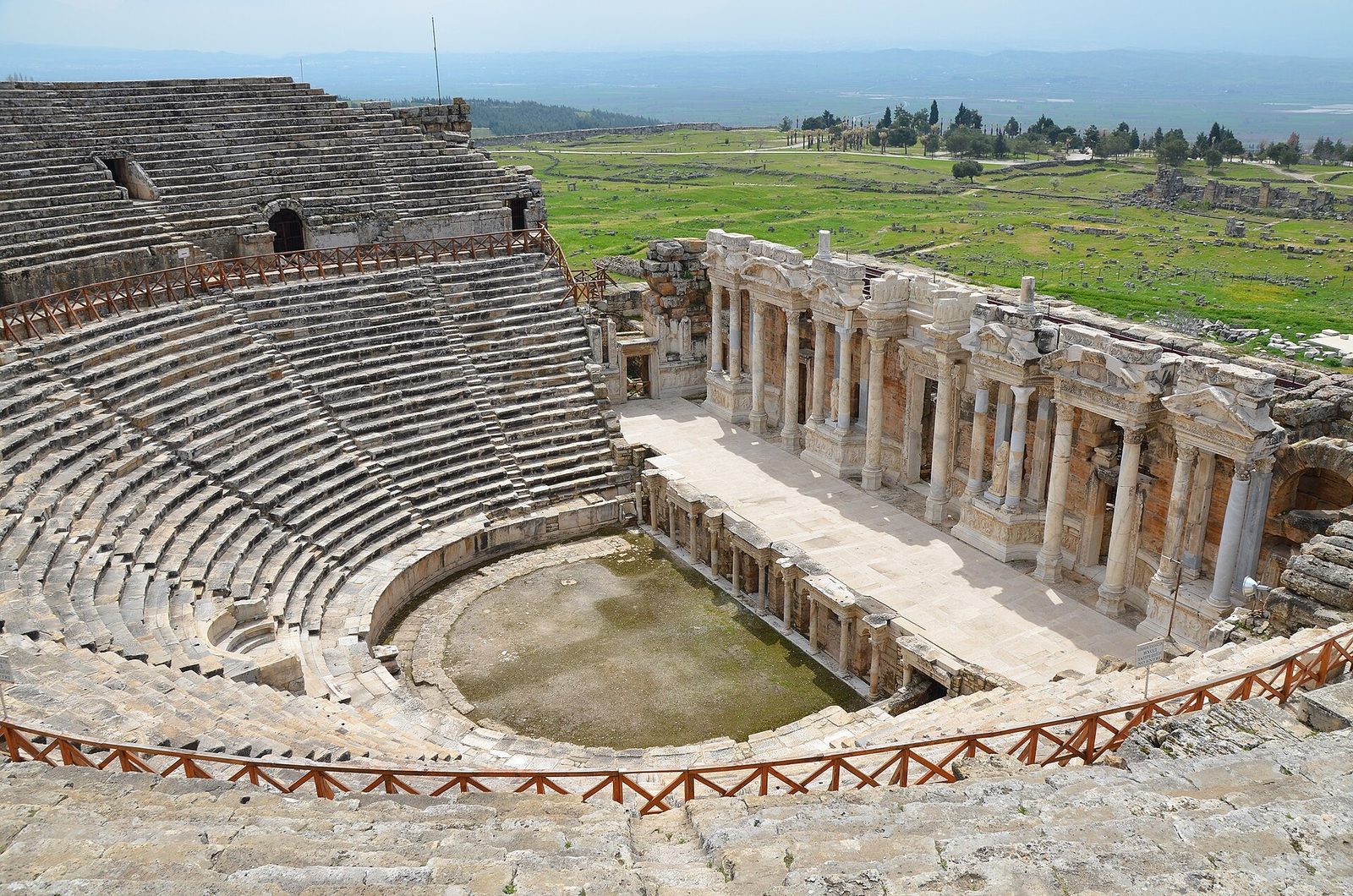
Photo: Carole Raddato, CC BY-SA 2.0 via Wikimedia Commons Source
A Greco-Roman spa city above the white terraces of Pamukkale, with the Plutonium gate to hell. It is part of a UNESCO World Heritage Site. It is part of Hierapolis-Pamukkale.
- Country
- Turkey
- Region
- Asia
- Period
- from the 2nd century BC
- Kind of site
- Archaeological site
- Heritage status
- Part of UNESCO World Heritage Site
- Part of
- Hierapolis-Pamukkale
- Located in
- Pamukkale district, Turkey
- Also known as
- Mint of Hierapolis
- Coordinates
- 37.9250° N, 29.1258° EWikipedia and Wikidata agree within 0.0 km
- Reference
- Wikidata Q7428276
- Encyclopedia
- Wikipedia article
About this place
Hierapolis (; Ancient Greek: Ἱεράπολις, lit. "Holy City") was a Hellenistic Greek city in Phrygia, in southwestern Anatolia, Turkey. It was founded in the 3rd century BC, on the site of a Phrygian cult center of the Anatolian mother goddess Cybele, It was famous for its hot springs, its high quality wool fabrics and dyes, and as the birthplace of the Stoic philosopher Epictetus. Its extensive remains are adjacent to modern Pamukkale in Turkey. The hot springs have been used as a spa since at least the 2nd century BCE, with many patrons retiring or dying there as evidenced by the large necropolis filled with tombs, most famously that of Marcus Aurelius Ammianos, which bears a relief depicting the earliest known example of a crank and rod mechanism, and the Tomb of Philip the Apostle.
Adapted from the Wikipedia article Hierapolis (this version), lightly edited for style, under the CC BY-SA 4.0 license.
Nearby places
Open in the Atlas →- Laodicea North Theater 9.8 km (6.1 mi)
- Septimius Severus Nymphaeum 10.0 km (6.2 mi)
- Temple A 10.0 km (6.2 mi)
- Central Agora 10 km (6 mi)
- Laodicea on the Lycus 10 km (6 mi)
- Kilaraza 12 km (8 mi)














Recent comments