

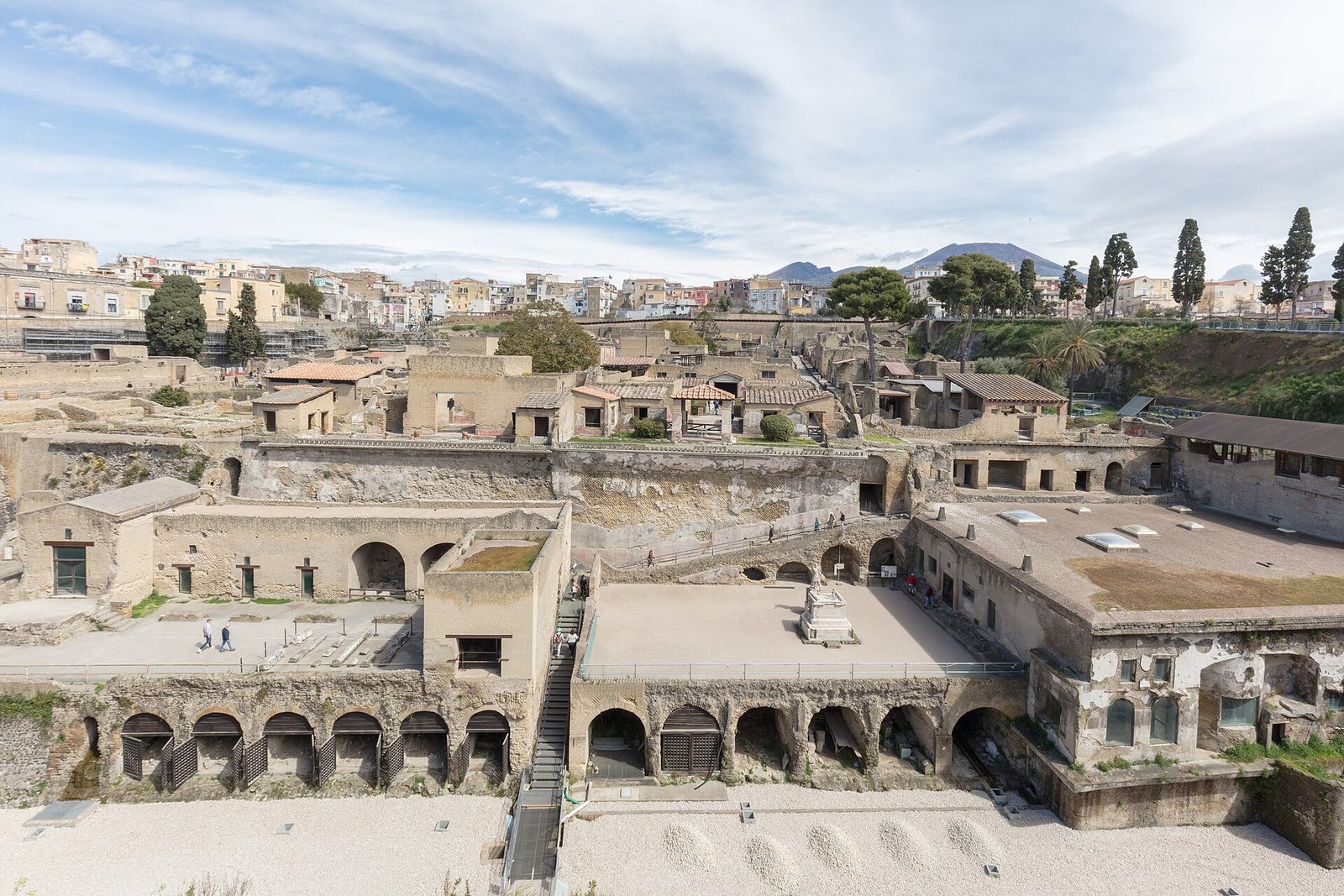
Photo: Diego Delso, CC BY-SA 4.0 via Wikimedia Commons Source
A Roman town buried by Vesuvius under deep volcanic deposits that preserved wood, food and papyrus scrolls. It is associated with Osci and the Samnites. It is part of a UNESCO World Heritage Site.
- Country
- Italy
- Region
- Europe
- Period
- buried AD 79
- Kind of site
- Ancient city, destroyed city, roman ruins
- Period or culture
- Osci, Samnites, Roman civilization
- Heritage status
- Part of UNESCO World Heritage Site
- Part of
- Archaeological Areas of Pompei, Herculaneum and Torre Annunziata
- Located in
- Ercolano, Italy
- Coordinates
- 40.8060° N, 14.3482° EWikipedia and Wikidata agree within 0.06 km
- Reference
- Wikidata Q178813
- Encyclopedia
- Wikipedia article
About this place
Herculaneum is an ancient Roman town located in the modern-day comune of Ercolano, Campania, Italy. Herculaneum was buried under a massive pyroclastic flow in the eruption of Mount Vesuvius in 79 AD. Like the nearby city of Pompeii, Herculaneum is notable as one of the few well-preserved ancient Roman cities, as the volcanic material that buried the town helped protect it from looting and weathering. Although less known than Pompeii today, it was the first and, for a long time, the only discovered Vesuvian city (in 1709). Pompeii was revealed in 1748 and identified in 1763. Unlike Pompeii, the mainly pyroclastic material that covered Herculaneum carbonized and preserved more wooden objects such as roofs, beds, and doors, as well as other organic-based materials such as food and papyrus.
Adapted from the Wikipedia article Herculaneum (this version), lightly edited for style, under the CC BY-SA 4.0 license.
Nearby places
Open in the Atlas →- Casa del Colonnato Tuscanico 0.5 km (0.3 mi)
- Villa Sora (Torre del Greco) 3.8 km (2.4 mi)
- Villa di Caius Olius Ampliatus 4.6 km (2.9 mi)
- Neapolis 8.5 km (5.3 mi)
- Parthenope 8.8 km (5.5 mi)
- Lucullus' villa in Naples 8.8 km (5.5 mi)














Recent comments