

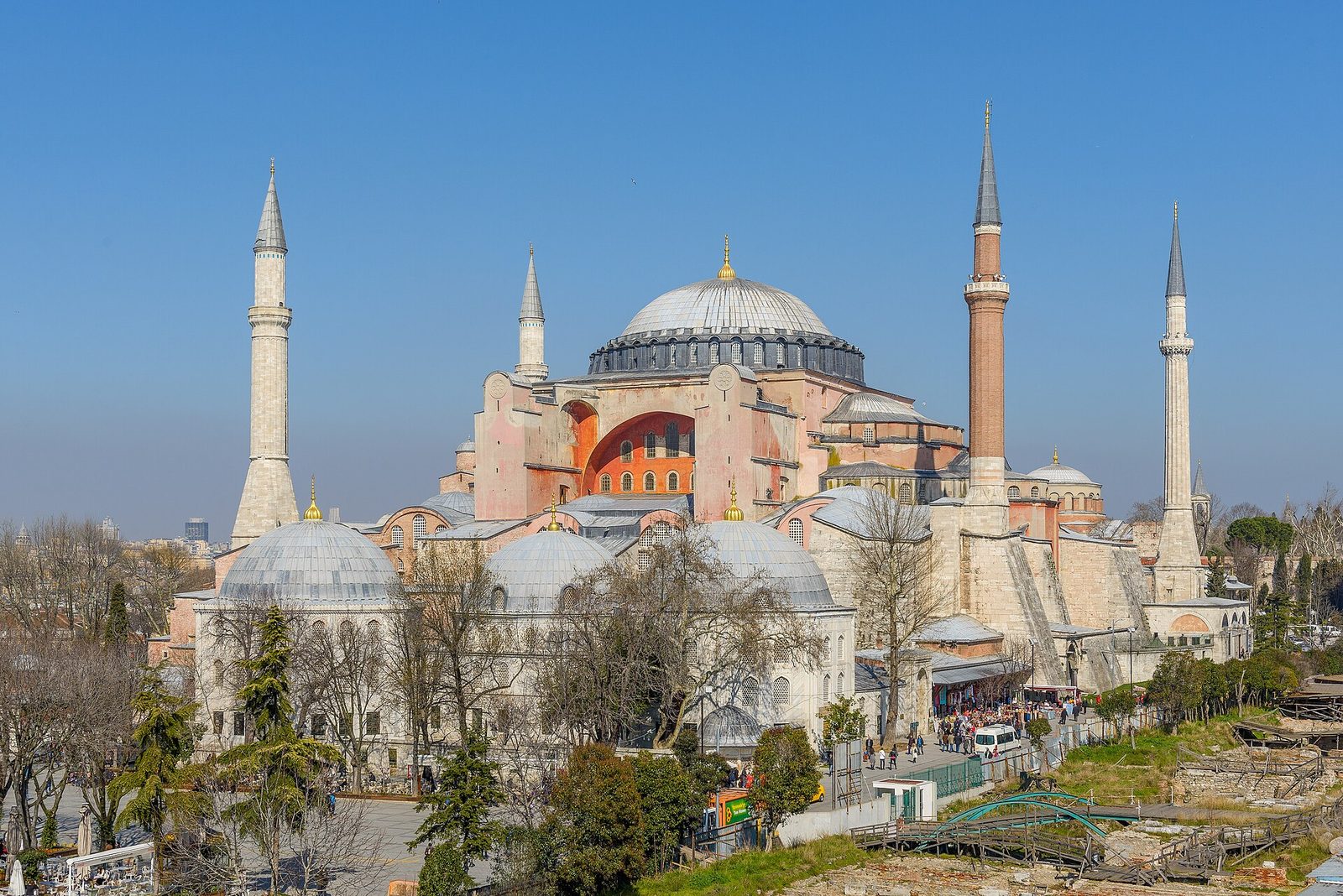
Photo: Arild Vågen, CC BY-SA 3.0 via Wikimedia Commons Source
The great Byzantine church of Constantinople, later a mosque, with a vast floating dome. It dates from AD 532 and is associated with Byzantine architecture and Ottoman architecture. It is part of a UNESCO World Heritage Site.
- Country
- Turkey
- Region
- Asia
- Period
- completed AD 537
- Kind of site
- Mosque, secularized church, secularized mosque
- Dates from
- AD 532
- Period or culture
- Byzantine architecture, Ottoman architecture
- Heritage status
- Part of UNESCO World Heritage Site; Cultural property requiring protection
- Part of
- Historic Areas of Istanbul
- Architect or builder
- Isidore of Miletus, Anthemius of Tralles, Trdat the Architect
- Located in
- Fatih, Turkey
- Also known as
- Santa Sophia; St. Sophia Basilica; Church of Saint Sophia; Church of the Holy Wisdom; Hagia Sophia Mosque
- Coordinates
- 41.0083° N, 28.9800° EWikipedia and Wikidata agree within 0.0 km
- UNESCO
- World Heritage site 356
- Reference
- Wikidata Q12506
- Encyclopedia
- Wikipedia article
About this place
Hagia Sophia, officially the Hagia Sophia Grand Mosque, is a mosque and a major cultural and historical site in Istanbul, Turkey. It was formerly a church (360 to 1453) and a museum (1935 to 2020). The last of three church buildings to be successively erected on the site by the Eastern Roman Empire, it was completed in AD 537, becoming the world's largest interior space and among the first to employ a fully pendentive dome. It is considered the epitome of Byzantine architecture and is said to have "changed the history of architecture". From its dedication in 360 until 1453, Hagia Sophia served as the cathedral of Constantinople in the Byzantine liturgical tradition, except for the period 1204 to 1261 when the Latin Crusaders installed their own hierarchy.
Adapted from the Wikipedia article Hagia Sophia (this version), lightly edited for style, under the CC BY-SA 4.0 license.
Nearby places
Open in the Atlas →- Basilica Cistern 0.2 km (0.1 mi)
- Constantinople 0.5 km (0.3 mi)
- Theodosius Cistern 0.6 km (0.4 mi)
- Byzantium 0.6 km (0.4 mi)
- Forum of Constantine 0.8 km (0.5 mi)
- Forum of Theodosius 1.4 km (0.9 mi)














Recent comments